What Is a Content Gap? How to Find Questions Your Content Doesn't Answer
A practical guide to finding the unanswered questions, missing details, and incomplete information hiding in content you already have.

|
Posted: September 15, 2026 |
A content gap is information your audience needs that your existing content doesn't answer well enough.
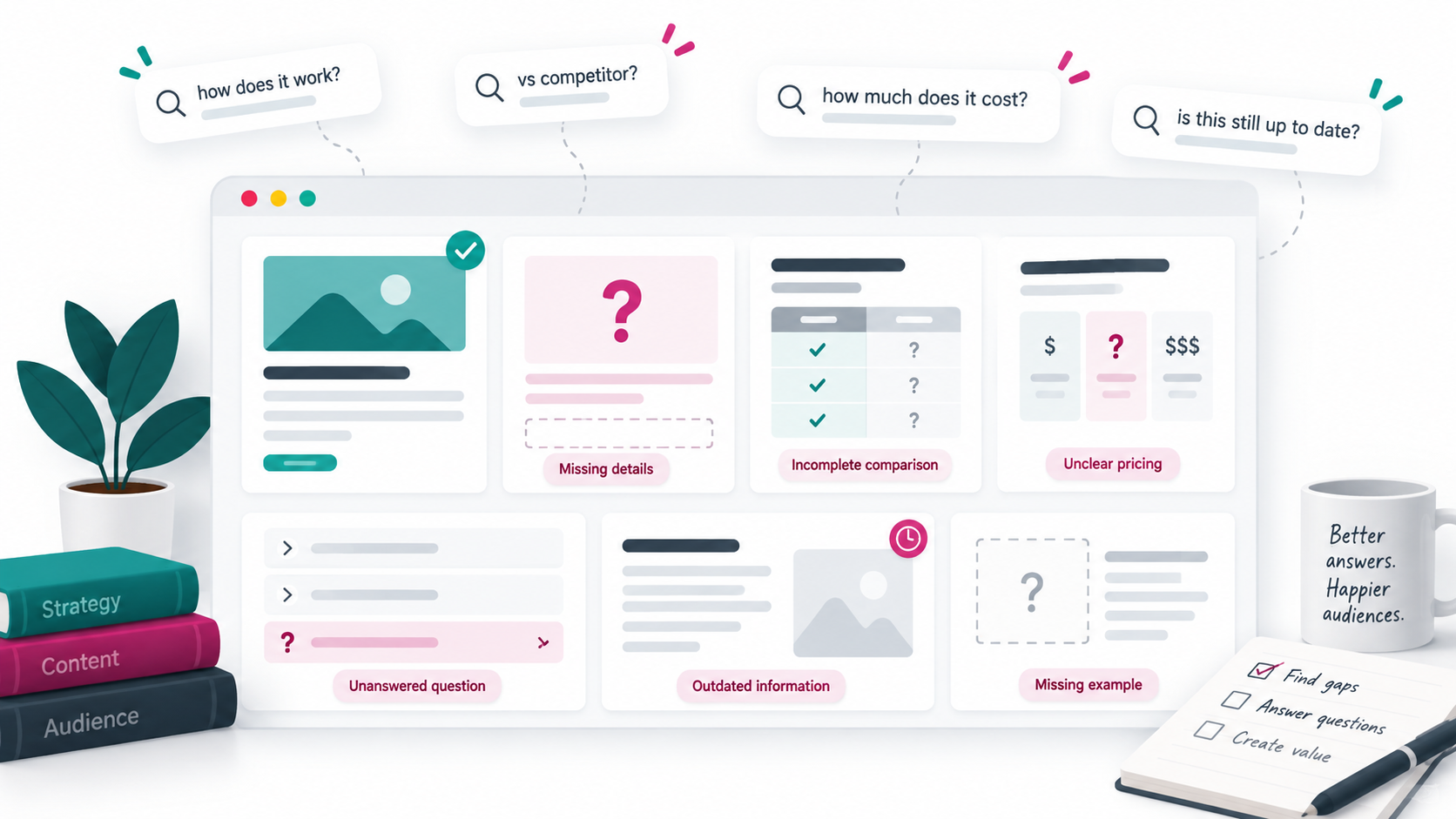
Sometimes the gap is obvious because you have nothing on the subject. More often, it's buried inside content that already exists. A product page explains the features but leaves pricing unclear. A comparison covers specifications without discussing limitations. A guide explains the broad process but skips the point where people usually get stuck.
This is why content gaps are broader than missing keywords. Keyword research can show that people search for a subject. Competitor analysis can show where another site ranks and yours doesn't. Content gap analysis asks a different question: does your existing content give people enough information to understand the subject, make a decision, verify a claim, or complete the task they came for?
What counts as a content gap?
A useful working definition is:
A content gap exists when your audience needs information to understand, evaluate, verify, or act on a relevant subject, and your content doesn't provide enough of it.
How much information is "enough" depends on the question.
Someone checking a store's opening hours probably needs a short factual answer. Someone choosing business software may need pricing, compatibility, limitations, implementation details, comparisons, and evidence behind important claims.
Google's people-first content guidance takes a similar view of content quality. It asks publishers to consider whether their pages give a substantial and complete treatment of the subject and whether readers leave with enough information to accomplish what they came to do.
That standard is more useful than simply asking whether you already have a page on the topic.
Content gaps and keyword gaps aren't the same thing
The narrower SEO use of "content gap" usually starts with competitors.
For example, Ahrefs' Content Gap tool identifies keywords that competing sites rank for and your site doesn't. That's a useful way to find subjects you may have overlooked.
The limitation is that keyword comparisons are much better at finding absent coverage than diagnosing incomplete coverage.
You could already rank for the relevant search and still leave someone wondering:
- What does it actually cost?
- Will it work for my situation?
- How does it compare with the other option I'm considering?
- What are the drawbacks?
- How does this work in practice?
- Is the information still current?
- What supports the claim being made?
In those cases, the topic isn't missing. Part of the answer is.
Semrush now describes content gaps more broadly as subjects an audience cares about that a site either hasn't covered or could cover better. Its framework includes content that is thin, outdated, unclear, or mismatched with what the audience actually wants. Semrush's content gap analysis guide is useful here because it separates keyword coverage from the wider question of whether existing content is doing its job.
Useful content can still have a gap
A page doesn't need to be bad to be incomplete.
ContentEngine's September 2026 research asked 200 respondents about the most recent time they looked online for information about a product or service. Only 39.5% said their main source answered their question completely. Another 41.5% said it mostly answered the question. Read the full ContentEngine survey results.
"Mostly" is the interesting group for content teams. Their main source was useful enough to get them part of the way, but something was still unresolved.
The same study found that 72.5% used two or more sources. That doesn't mean every multi-source journey represents a content failure. People compare and verify information for perfectly sensible reasons. It does show that assembling a complete answer from several places is common in product and service research.
When reviewing an existing page, it helps to ask what a reasonable reader would still need to look up somewhere else.
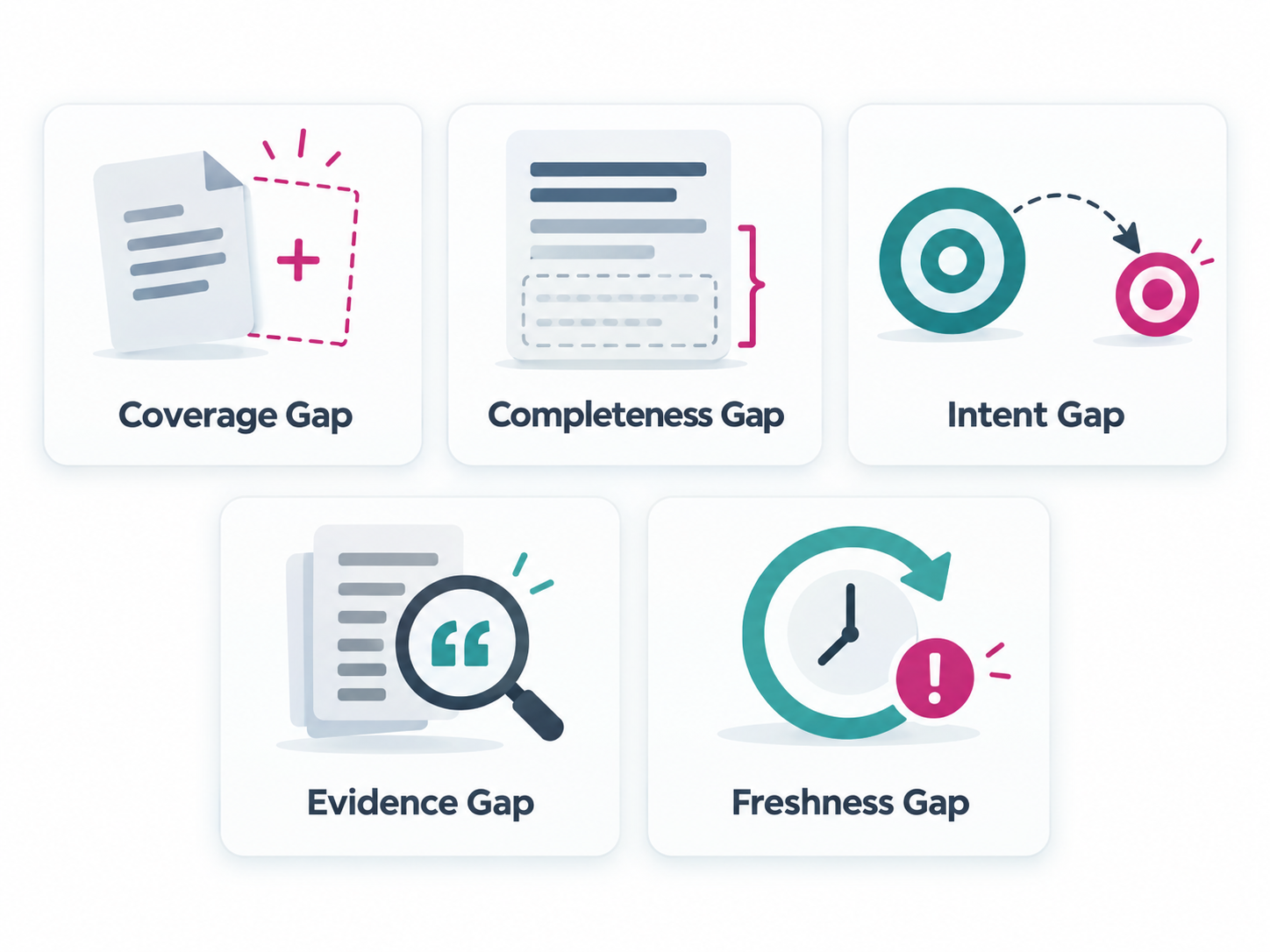
Five types of content gaps
Classifying the problem before deciding what to publish prevents every gap from turning into another article.
These categories aren't meant as a rigid industry taxonomy. They're a practical way to work out what's actually missing.
Coverage gaps
A coverage gap is the straightforward case. Your audience has a relevant question and you don't answer it anywhere.
A software company might explain its main features in detail while having no content about a use case that comes up repeatedly in sales conversations. A local service company may describe every service it offers without explaining which one fits which situation.
If the question matters to the audience and belongs within the company's area of expertise, new content may be justified.
Completeness gaps
A completeness gap appears when the page exists but stops short of answering something important.
A service page explains what's included but leaves the total cost vague. A comparison lists features without discussing tradeoffs. A tutorial walks through setup but skips the point where users are most likely to run into trouble.
The ContentEngine survey gives some concrete examples. Price or total cost was the most commonly reported missing or unclear information, selected by 33.5% of respondents. Comparisons with alternatives were cited by 22%. Respondents also reported missing evidence, limitations, current information, suitability to their circumstances, and explanations of how something worked.
These gaps are easy to overlook because the content inventory says the topic is already covered.
Intent gaps
Two people researching the same subject may be trying to do completely different things.
Someone looking into email marketing software might want a basic explanation of the category. Another person is comparing vendors. Someone else only cares about pricing or whether the software integrates with a particular system.
A general overview may be a perfectly good page and still be the wrong answer for the second or third reader.
An intent gap exists when the page covers the right subject but doesn't serve the reason someone came to it. Fixing that gap may mean expanding the current page. It may mean creating separate content when the information needs are genuinely different.
Evidence gaps
Sometimes the missing information is proof.
A statistic has no original source. A comparison declares one product better without explaining why. An article makes a strong claim based on research the reader can't inspect.
In the ContentEngine study, 16% of respondents said evidence supporting claims was missing or unclear. Reliability checking was also common. Thirty-two percent compared information with another independent source, while 26% opened supporting material.
Google's people-first guidance also asks publishers to consider whether content presents information in a way that makes it trustworthy, including clear sourcing and evidence of expertise.
For claims that materially affect a decision, evidence isn't decoration around the answer. It's part of the answer.
Freshness gaps
Some content becomes incomplete simply because the underlying information changes.
Prices move. Software interfaces are redesigned. Product features appear and disappear. Regulations change. New research replaces older findings.
A page can continue attracting traffic long after parts of it have become unreliable.
In the ContentEngine survey, 15.5% of respondents said it was unclear whether information they found was still current. Twenty-six percent said they checked publication or update dates while assessing reliability.
A freshness problem usually calls for maintaining the page that already owns the subject rather than publishing another version of it.
How to find questions your content doesn't answer
Keyword tools are useful here, but they aren't the only place to look.
Real questions show up wherever audiences have to explain what they're trying to understand. That includes search queries, sales conversations, customer support, internal site search, reviews, Reddit threads, forums, social media comments, surveys, and follow-up questions people ask after reading existing content.
Semrush's current guidance makes the same point. Keyword and AI prompt data can reveal demand, but questions raised in sales calls, support tickets, reviews, customer interviews, social listening, and community discussions can expose needs that never appear clearly in a keyword report.
Once you've collected the questions, compare them with what you already publish.
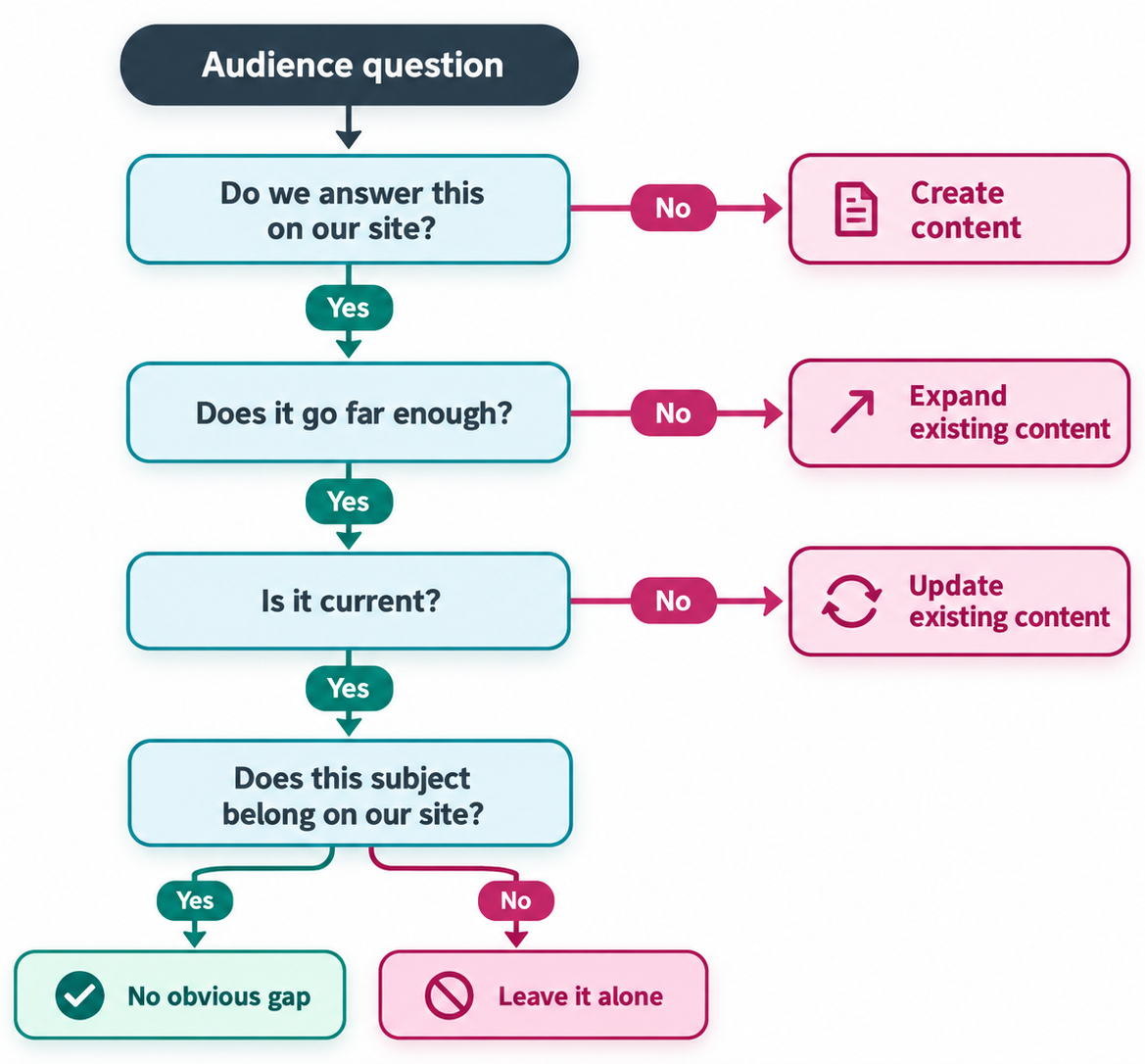
Do we answer this anywhere? If not, you have a coverage gap.
Does the existing answer go far enough? If not, you have a completeness gap.
Does it match what the reader is trying to do? If not, you have an intent gap.
Can important claims be checked? If not, you have an evidence gap.
Is the information still accurate? If not, you have a freshness gap.
Does this subject actually belong on our site? If not, there may be no gap worth filling.
The last outcome is important. Finding a question doesn't automatically create a publishing obligation.
A simple example: a pizza business
Consider a hypothetical pizza restaurant. This is an illustration, not an audit of a real company.
Its website already has a menu, ordering information, location pages, and football-night promotions. Looking at broad topics alone, the site seems well covered.
Then customers start asking about dietary suitability.
Suppose the restaurant doesn't explain which items are vegetarian or what can reasonably be modified. That's a coverage gap if the information doesn't exist anywhere.
If dietary labels are present but customers still can't tell which substitutions are possible, the issue is completeness.
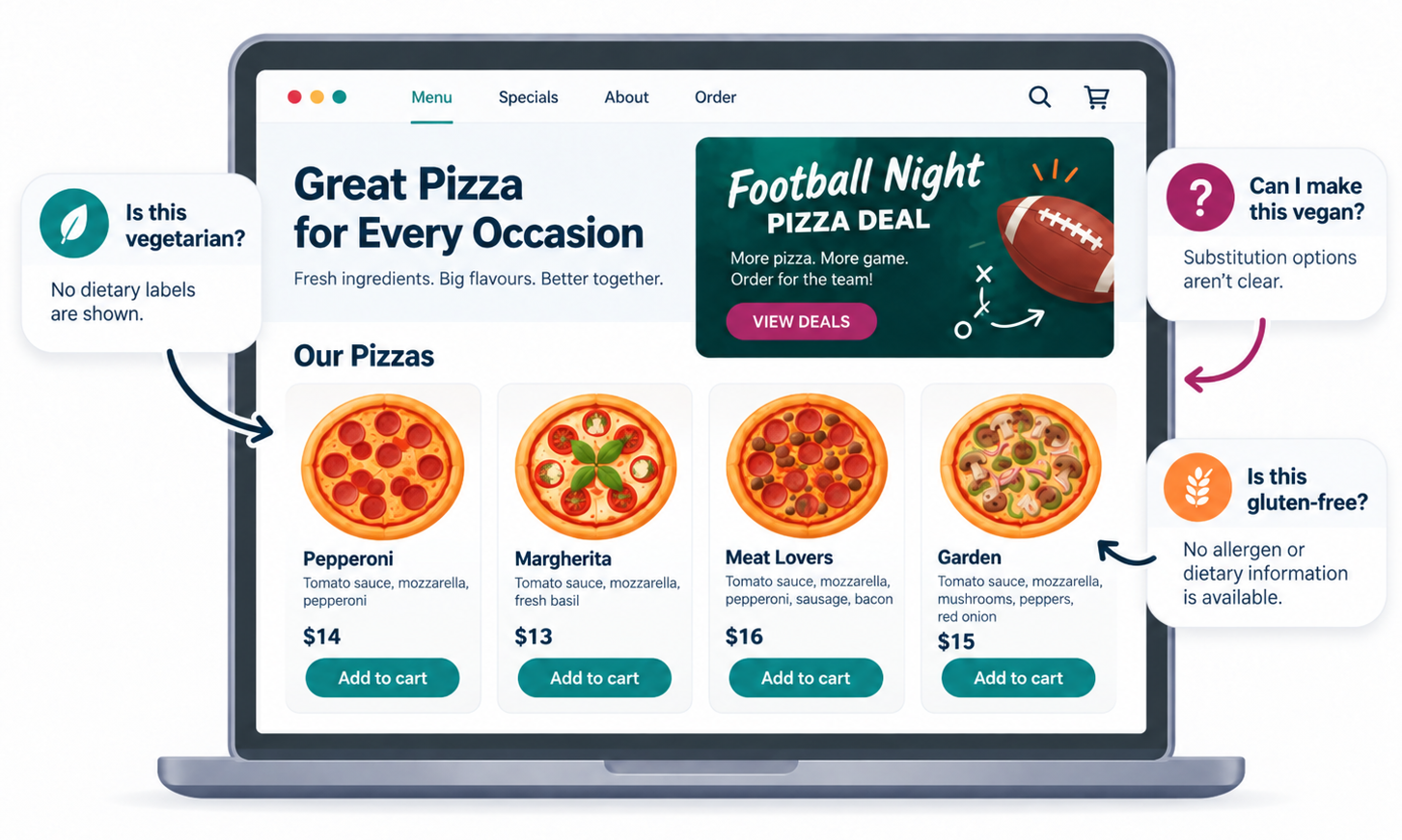
If the only useful information is buried inside a football-night promotion while someone is trying to plan an order for a group with different dietary needs, the available content doesn't match the intent particularly well.
And if the answer sits on an old menu page that no longer reflects the current offering, the problem is freshness.
"Pizza" was never the missing topic. The gap was the information someone needed to place an order with confidence.
Follow-up questions often show where the first answer stopped
The original query doesn't always reveal the full information need.
Someone starts by asking what a product does. Once they know that, they realize they need to know whether it works with their existing setup. Then price matters. Then limitations. Then how it compares with another product.
The ContentEngine survey picked up some of this behavior. Among respondents dealing with incomplete information, 23.5% said they changed their search wording or asked a follow-up question.
Those follow-ups can be more revealing than the original broad query because they're closer to the part of the decision that remains unresolved.
If the same question keeps appearing in Search Console, support tickets, sales conversations, community discussions, or AI interactions, that is stronger evidence of a genuine gap than finding the phrase once in a keyword export.
Don't turn every question into a page
Content gap analysis becomes counterproductive when every discovered question turns into a publishing assignment.
Google's guidance for generative AI features in Search specifically warns against creating separate content for every possible variation of how someone might search. It also says there is no ideal page length and that content should be built around the audience and subject rather than an arbitrary format requirement.
Before filling a gap, check whether the question belongs within your useful area of coverage.
Does your audience care about it? Do you have credible knowledge or evidence to answer it? Does it connect naturally with what your organization does? Would the answer help someone understand the subject, solve a problem, or make a decision? Can you keep it accurate if the information changes?
If the case is weak, leave it alone.
A competitor having a page doesn't change that. Neither does search volume.
Google's people-first guidance asks whether a site has an intended audience and whether it has a primary purpose or focus. Those are useful constraints for content gap work because they stop "missing coverage" from gradually becoming "anything we might rank for."
The gap should determine the format
Finding a question doesn't tell you whether the answer needs an FAQ, an extra paragraph, a comparison table, a new article, or a full guide.
Some questions genuinely need two sentences. Others need context, worked examples, instructions, or several competing options laid out properly.
The ContentEngine survey gives some indication of that range. When respondents were asked what additional information format would have helped most, a detailed explanation was the largest individual response at 22.5%. A short direct answer was selected by 15.5%, while step-by-step instructions, relevant examples, and comparisons also attracted meaningful shares.
There's no good reason to force a complicated information need into an FAQ because it happens to be phrased as a question. The reverse is true too. A straightforward factual answer doesn't need its own long-form article.
Decide whether to create, expand, update, or leave alone
Once you've identified a real gap, there are several reasonable responses.
There will be edge cases. Sometimes several weak pages should be consolidated. A large guide may need to be split because different audiences are looking for different things. An apparently simple question may require original research before you can answer it responsibly.
The important part is diagnosing the problem before adding another URL to the site.
Semrush makes a related point in its content gap guidance: an analysis can identify places where content is missing, weak, unclear, or outdated, and the appropriate response might be a new page, an update, clearer structure, or additional supporting detail.
Which content gaps should you prioritize?
A genuine gap can still be a low priority.
A question raised by most prospects deserves different treatment from something found once in a competitor keyword report. Missing pricing on an important commercial page is likely to matter more than a peripheral definition several steps removed from what your business does.
For a first pass, consider:
- How often the question appears
- How closely it relates to your audience and subject area
- Whether the missing information affects an important decision or task
- Whether you can answer it credibly
- Whether an existing page can carry the answer
- How much work the answer will take to maintain
Search volume can help with that judgment, but it shouldn't make the judgment on its own.
A page can perform well and still contain a gap
Rankings and traffic tell you that people are finding a page. They don't tell you whether the page finishes the job.
The ContentEngine survey found that only 19% of respondents used a single source during their most recent product or service information search, while 72.5% used two or more.
Some of that is normal verification. A company page shouldn't be expected to replace independent reviews, community discussion, or every comparison someone may want before making a decision.
The useful signal is repetition.
If readers repeatedly leave a page to answer the same predictable question elsewhere, the page deserves another look. Maybe pricing is missing. Maybe the claim needs evidence. Maybe a limitation is being avoided. Maybe readers need an example before the explanation makes sense.
Asking what someone would reasonably need to look up next is often a better content gap test than checking whether the keyword already appears somewhere on the site.
A page can perform well and still contain a gap
Questions worth answering can surface in more places than a keyword report. They appear in audience conversations, search behavior, community discussions, current events, and the follow-up questions people keep asking around a subject.
That fits a broader view of reactive marketing. The stimulus doesn't always have to be a breaking story. It can also be evidence that people keep encountering the same unanswered or incompletely answered question.
ContentEngine helps teams work from those signals by monitoring relevant sources, researching a subject, and developing content around what they find. The harder decisions still belong to the marketer: whether the question matters, whether the existing answer is actually inadequate, and whether the right response is a new page, a better section on an existing one, or nothing at all.
A useful content gap isn't simply something missing from your site. It's missing information that your audience has a reason to need.
Frequently Asked Questions About Content Gaps
What is a content gap?
A content gap is information your audience needs that your existing content does not answer well enough. It can be a completely missing topic, but it can also be an incomplete answer, outdated information, missing evidence, or content that does not match what the reader is trying to accomplish.
What is the difference between a content gap and a keyword gap?
A keyword gap usually refers to search terms that competitors rank for and your site does not. A content gap is broader. You may already cover the keyword and still leave important questions unanswered, such as pricing, limitations, comparisons, suitability, or supporting evidence.
What are the main types of content gaps?
Useful content gaps can be grouped into five types: coverage gaps, completeness gaps, intent gaps, evidence gaps, and freshness gaps. The type of gap helps determine whether you should create new content, expand an existing page, update old information, or leave the subject alone.
How do you find content gaps?
Look at the questions people ask in search queries, sales conversations, support tickets, internal site searches, reviews, social media, forums, Reddit discussions, surveys, and follow-up questions. Then compare those questions with your existing content to see whether the answer exists, goes far enough, matches the reader's intent, is properly supported, and is still current.
Does every content gap need a new article?
No. Some gaps are better handled by expanding an existing page, updating outdated information, adding evidence, improving a comparison, or answering a short question directly. Creating a new page only makes sense when the information need is substantial enough to justify one.
Should you fill every content gap you find?
No. A question may have search demand and still fall outside your audience, expertise, or useful area of coverage. If the subject is not relevant to the people you serve or you cannot answer it credibly, leaving it alone can be the better content decision.
Can a page rank well and still have a content gap?
Yes. Rankings and traffic show that people can find a page, but they do not prove that the page answers everything a reader reasonably needs. A well-performing page can still leave gaps around pricing, evidence, limitations, comparisons, examples, or current information.