
How People Find Complete Answers Across Search, AI and Social Media
The modern digital landscape has reached a point where the discovery of information is perceived as nearly effortless, yet the attainment of a complete answer remains an elusive, multi-stage process. New research indicates that users are increasingly acting as their own primary investigators, stitching together fragmented data from search engines, AI assistants, and social platforms to reach a final resolution.

|
Posted: September 15, 2026 |

In September, 2026, a study of 200 respondents examined the behaviors and expectations of individuals seeking information online regarding products and services. The findings suggest a fundamental shift in the nature of the "content gap." While the technical infrastructure of the internet is highly efficient at surfacing relevant snippets, it often fails to provide a cohesive, end-to-one-place solution. This survey analysis explores the disconnect between the ease of discovery and the difficulty of completion, revealing that the primary challenge for modern information seekers is not finding a source, but rather assembling an answer from a disparate array of sources.
The Ease Paradox: Discovery vs. Completion
The most striking contradiction within the data lies in how respondents perceive the difficulty of their search. A substantial majority-75.5%-described the overall process of finding information as "very" or "somewhat" easy. Only 8% characterized the task as difficult. This high level of satisfaction suggests that search engines, social media algorithms, and AI interfaces are successfully lowering the barrier to entry for information gathering.
However, a deeper look at the results reveals that this subjective feeling of ease does not correlate with source efficiency. Only 39.5% of respondents reported that their main source answered their question completely. A plurality-41.5%-found that their primary source only "mostly" answered the question, while 16% said it was only "partly" successful.
This creates what can be termed the "Ease Paradox." Users feel the process is easy not because they find the answer immediately, but because the cost of continuing the search is low. The friction of moving from one tab to another, or from a search engine to an AI chatbot, has been minimized to the point where users do not view multi-sourcing as a burden. Instead, they have normalized a workflow of "answer assembly," where the first click is merely the start of a journey rather than the destination.
The Multi-Source Mandate
The data reinforces the reality that information seeking is a multi-source endeavor. Only 19% of respondents relied on a single source during their most recent search for product or service information. In contrast, 72.5% used two or more sources, with 50.5%-more than half of the total sample-using exactly two sources.
This behavior suggests that the "one-and-done" search session is becoming a relic of the past. Even when a source is helpful, users feel a habitual or tactical need to verify, expand, or contextualize the information they have received. The fact that nearly 80% of those who could recall their journey used multiple platforms highlights a significant shift in user expectations. No single channel "owns" the information journey from start to finish.
The distribution of these sources is remarkably broad:
- Search Engines: Used by 56.5% of respondents.
- Social Media: Used by 48.5%.
- Company Websites/Apps: Used by 44.5%.
- AI Assistants/Chatbots: Used by 33.5%.
- Review Sites: Used by 29.5%.
- Forums/Online Communities: Used by 24%.
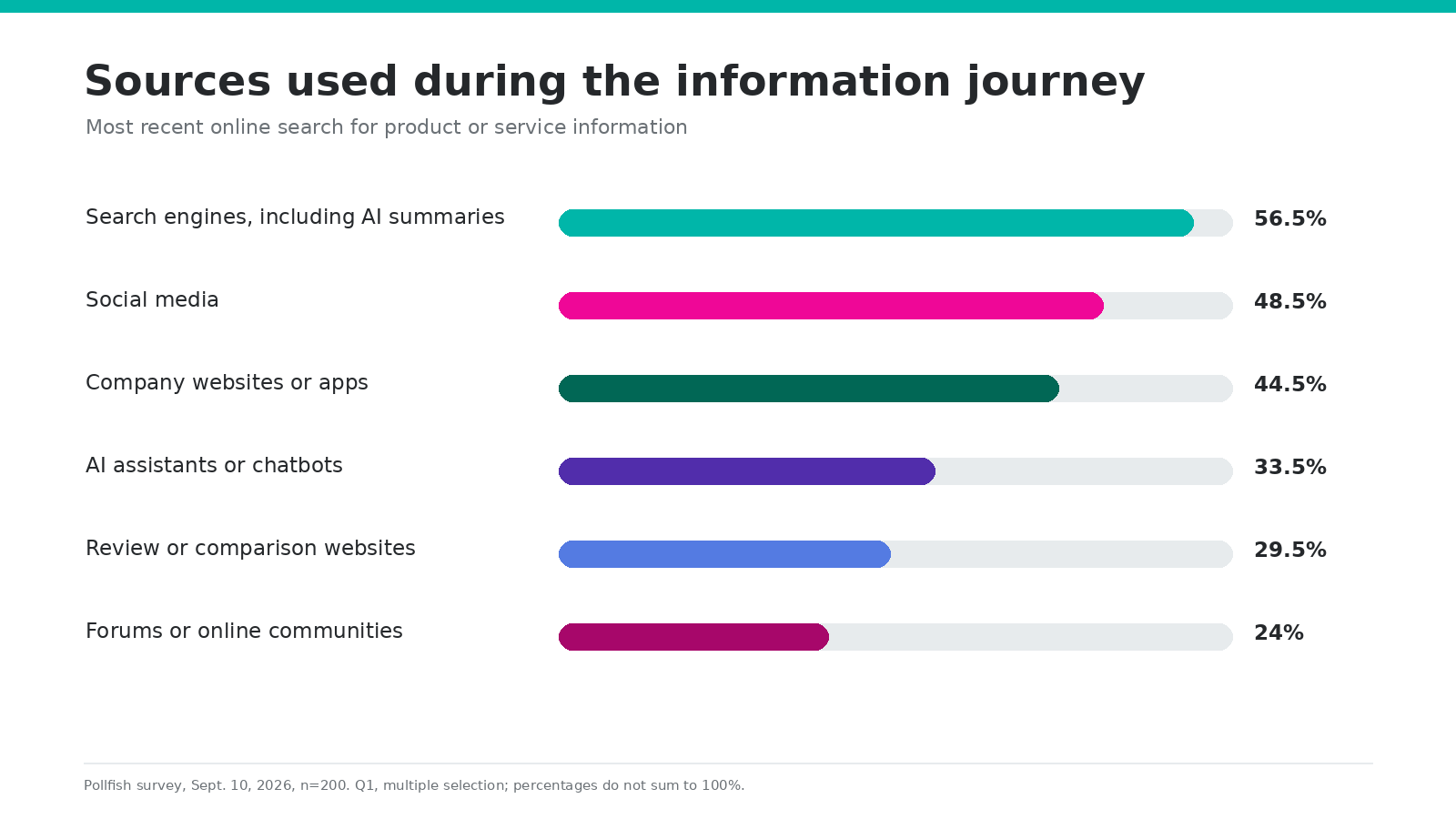
While search engines remain the most common tool, they no longer represent a dominant majority of the activity. Social media and company-owned assets are nearly as vital to the process. The presence of AI assistants in over a third of all journeys indicates that AI has rapidly moved from a niche experimental tool to a mainstream utility in commercial research.
The Fragmentation of Primary Authority
When respondents were asked to identify their "main" source of information-the one they relied on most-no single category achieved a majority. Social media (24%) narrowly edged out traditional search results (19.5%) and company websites (17.5%).
The role of AI in this hierarchy is substantial. When combining AI assistants/chatbots (14%) and AI-generated search summaries (11%), it is clear that 25% of respondents now rely primarily on an AI-mediated interface for their answers. This 25% share places AI on par with social media as a primary driver of information.
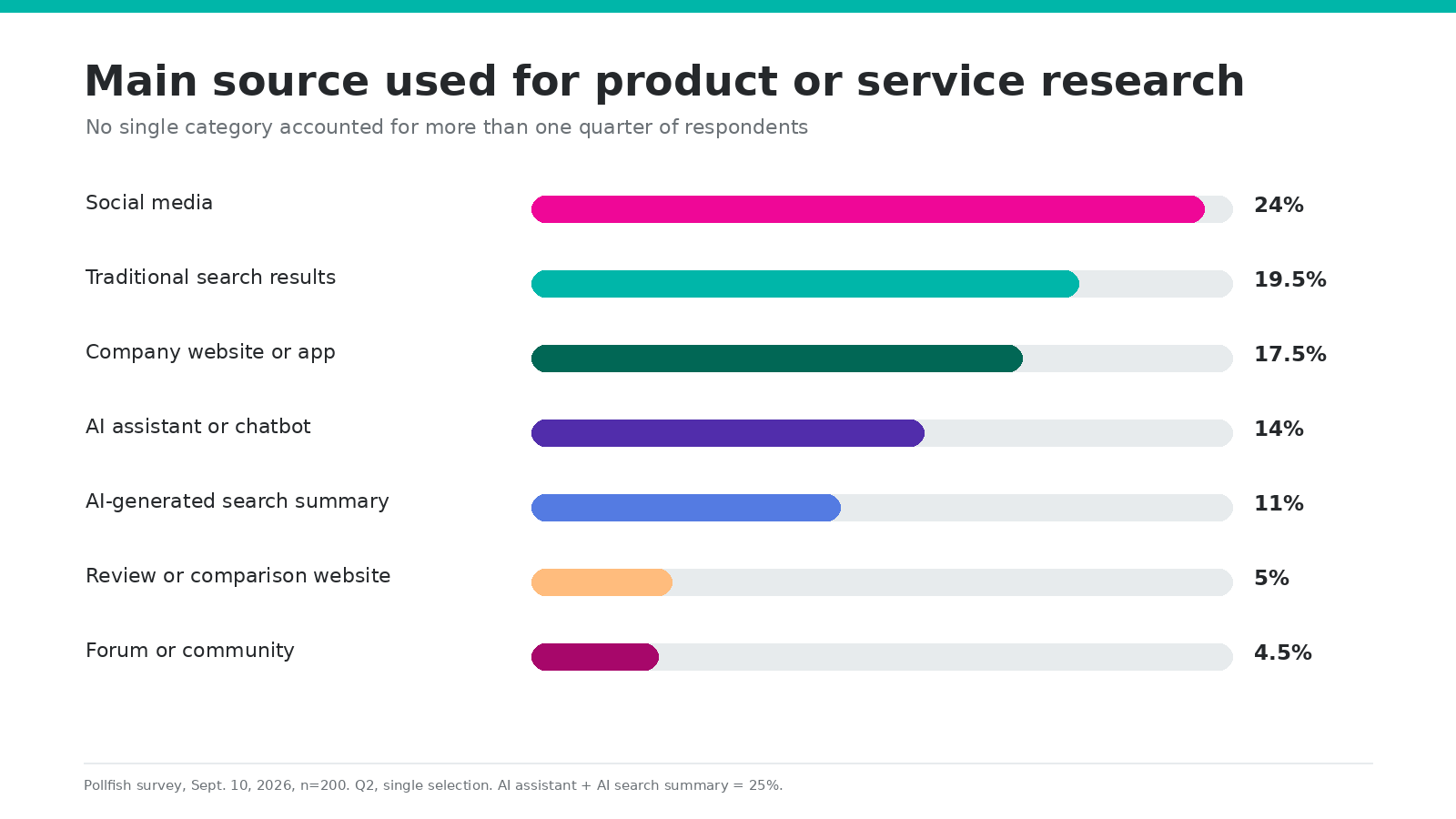
This fragmentation suggests that users are matching their needs to the specific strengths of different platforms. They may go to search for breadth, social media for firsthand experience, and AI for synthesis. For brands and content publishers, this means that visibility on a single platform is no longer sufficient to capture the audience's trust or attention. The "main" source is increasingly a matter of user preference rather than platform dominance.
Quantifying the Content Gap: What is Missing?
The survey provides a concrete map of where current digital content is failing users. Only 25% of respondents reported that "nothing was missing or unclear" from their search results. The remaining 75% identified specific gaps that prevented them from reaching a state of completion.
The most prevalent missing piece of information was "price or total cost," cited by 33.5% of respondents. This suggests a significant transparency gap in commercial content. Even when users find a product or service that meets their needs, the inability to find clear financial details often stalls the journey.
Beyond pricing, the gaps fall into several distinct categories:
- Decision Completeness: 22% lacked a comparison with alternatives. Users are not just looking for a product; they are looking for a reason to choose one over another.
- Evidentiary Completeness: 16% reported a lack of evidence supporting the claims made in the content.
- Temporal Completeness: 15.5% were unsure if the information was still current or up-to-date.
- Balanced Completeness: 15.5% noted a lack of information regarding limitations or drawbacks.
- Contextual Completeness: 14% were unsure if the product or service was suitable for their specific circumstances.
- Explanatory Completeness: 14% felt the "how it works" or "how to use it" instructions were insufficient.
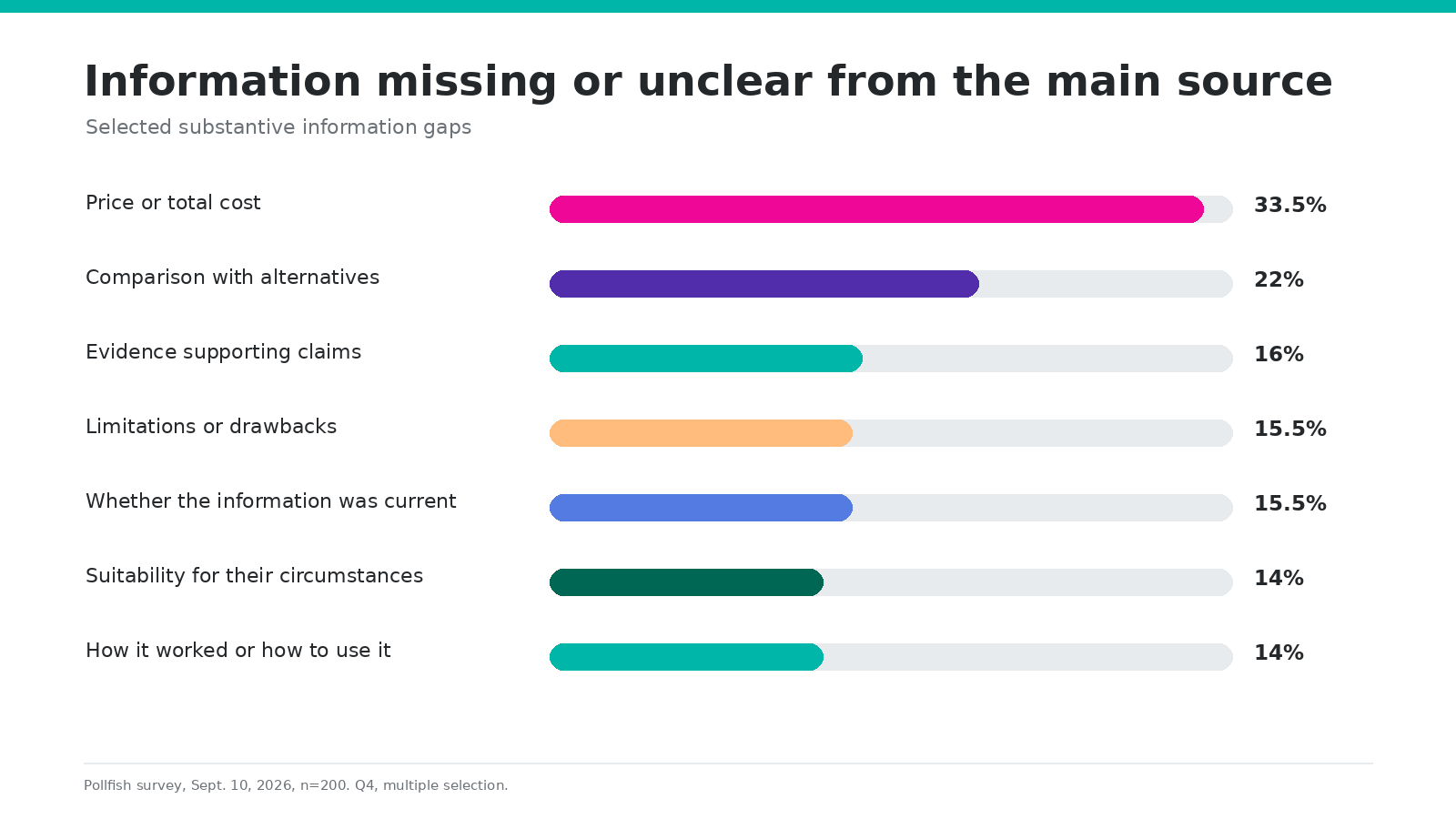
These findings redefine the "content gap" as something more nuanced than a simple lack of topical coverage. A brand may have a page about a product (topical relevance), but if that page lacks pricing, comparisons, and evidence of claims, it contains a functional gap that forces the user to look elsewhere.
1. Problem
2. Cause
3. Solution
Problem
Many users fail to obtain fully complete answers from their main information source.
Cause
This happens because information is fragmented across multiple platforms, and individual sources often lack practical decision-critical details.
Solution
Content creators should deliver comprehensive, transparent, and verifiable information optimized for discovery across various search, AI, and social media platforms to close these gaps.
User Reactions to Incomplete Information
When a primary source fails to provide a complete answer, users do not typically abandon their search. Instead, they engage in a series of "recovery" behaviors. Among those who found their initial answer lacking, 32.5% checked another source immediately.
Other common responses include:
- Query Refinement: 23.5% changed their search wording or asked a follow-up question.
- Human Consultation: 16% asked another person, and 14.5% contacted the company directly.
- Procrastination or Abandonment: 13% postponed the task, and 11% stopped the search without a resolution.
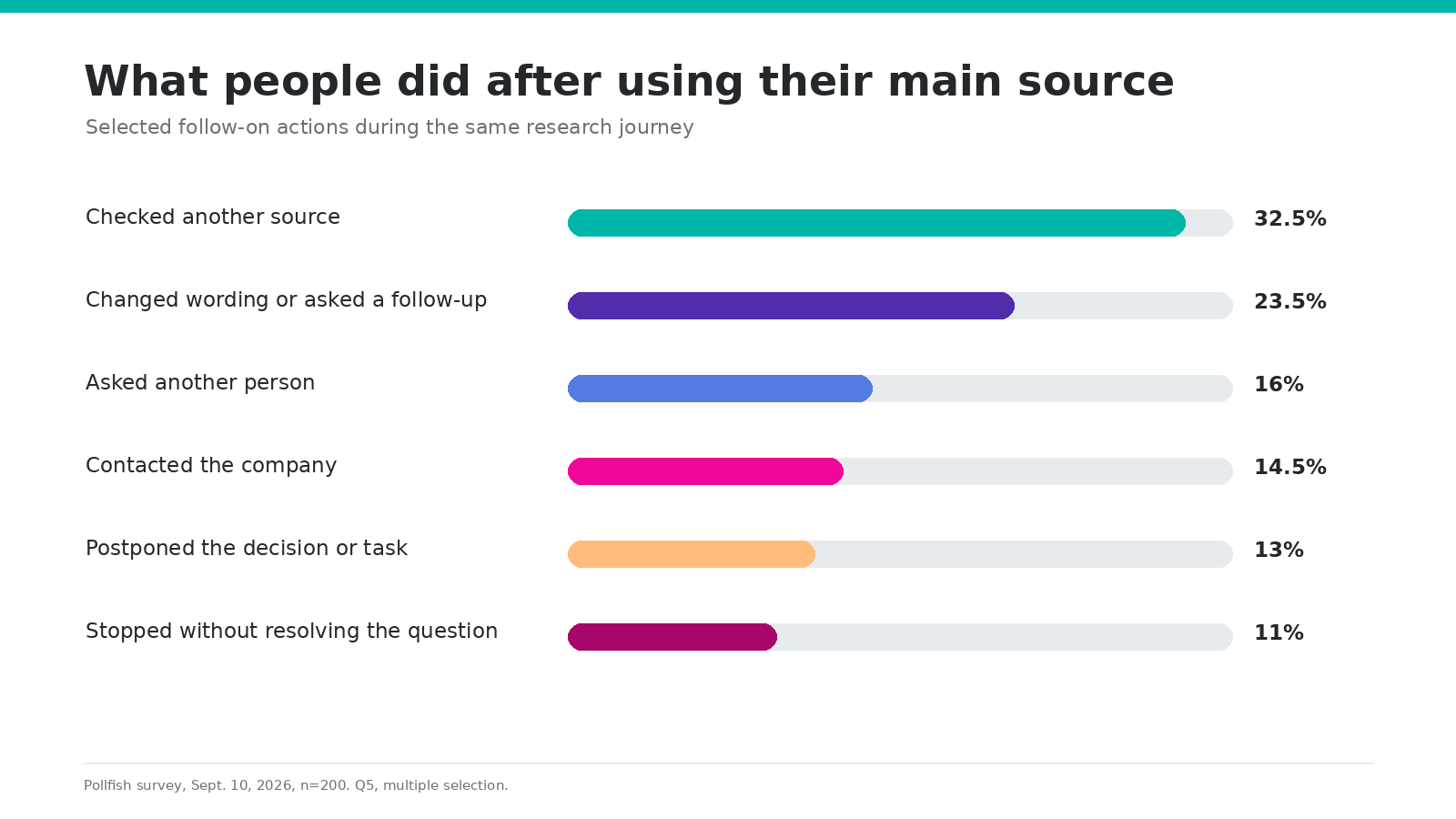
The fact that nearly a quarter of users respond to an incomplete answer by refining their query is particularly instructive. It suggests that the information gap itself generates new, more specific questions. A user who starts with a broad search like "best accounting software" may move to "accounting software with inventory tracking for small business" or "does [Brand X] integrate with Shopify?" once they realize the first set of results was too generic. This highlights the importance of anticipating follow-up needs within the initial piece of content.
The Validation Phase: Trust and Reliability
The survey reveals that finding an answer is often only half the battle; the other half is verifying that the answer is trustworthy. Only 15% of respondents said they did not perform a reliability check on the information they found. The vast majority engaged in proactive verification.
The most common method of verification was "comparing with another independent source" (32%). This reinforces the multi-source nature of the journey; users are cross-referencing platforms to see if the story remains consistent. Other reliability checks included:
- Checking publication/update dates (26%): Freshness is a primary indicator of reliability.
- Opening supporting material (26%): Users are looking for the original data or documents behind a claim.
- Asking a knowledgeable person (23.5%): Human authority remains a powerful fallback.
- Investigating the author/publisher (19%): Source reputation matters.
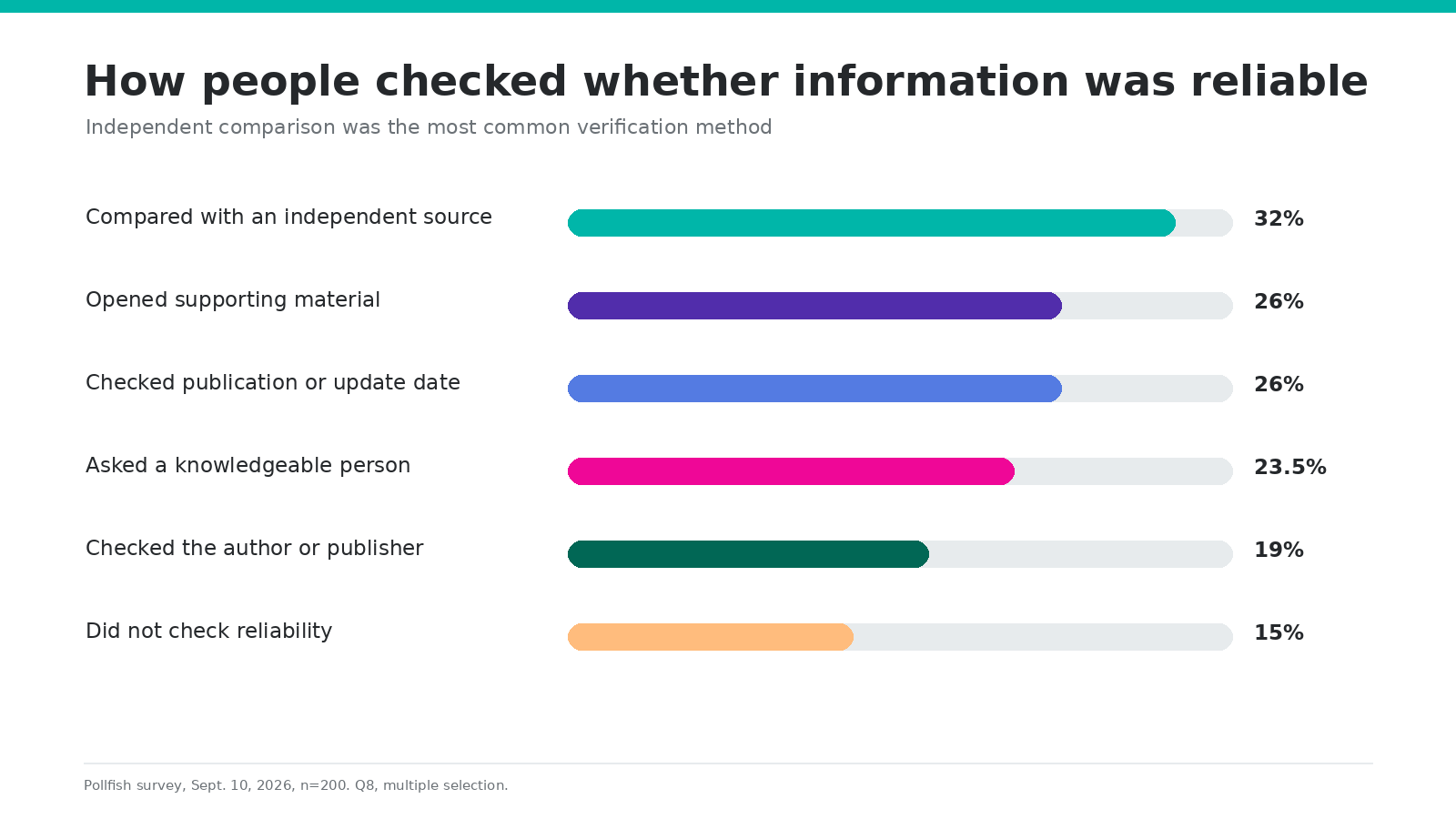
This data suggests that content cannot simply "be" correct; it must also "prove" it is correct. Providing citations, clear dates, and transparent authorship is not just a matter of aesthetic preference; it is a functional requirement for users who are predisposed to doubt what they find.
The Demand for Depth: Moving Beyond the FAQ
One of the more actionable insights from the study concerns the format of information. When asked what format would have helped most in their search, only 15.5% of respondents prioritized a "short, direct answer."
The majority of users-58%-preferred richer, more detailed content formats:
- Detailed Explanations: 22.5%
- Step-by-step Instructions: 13%
- Relevant Examples: 11.5%
- Comparison of Alternatives: 11%
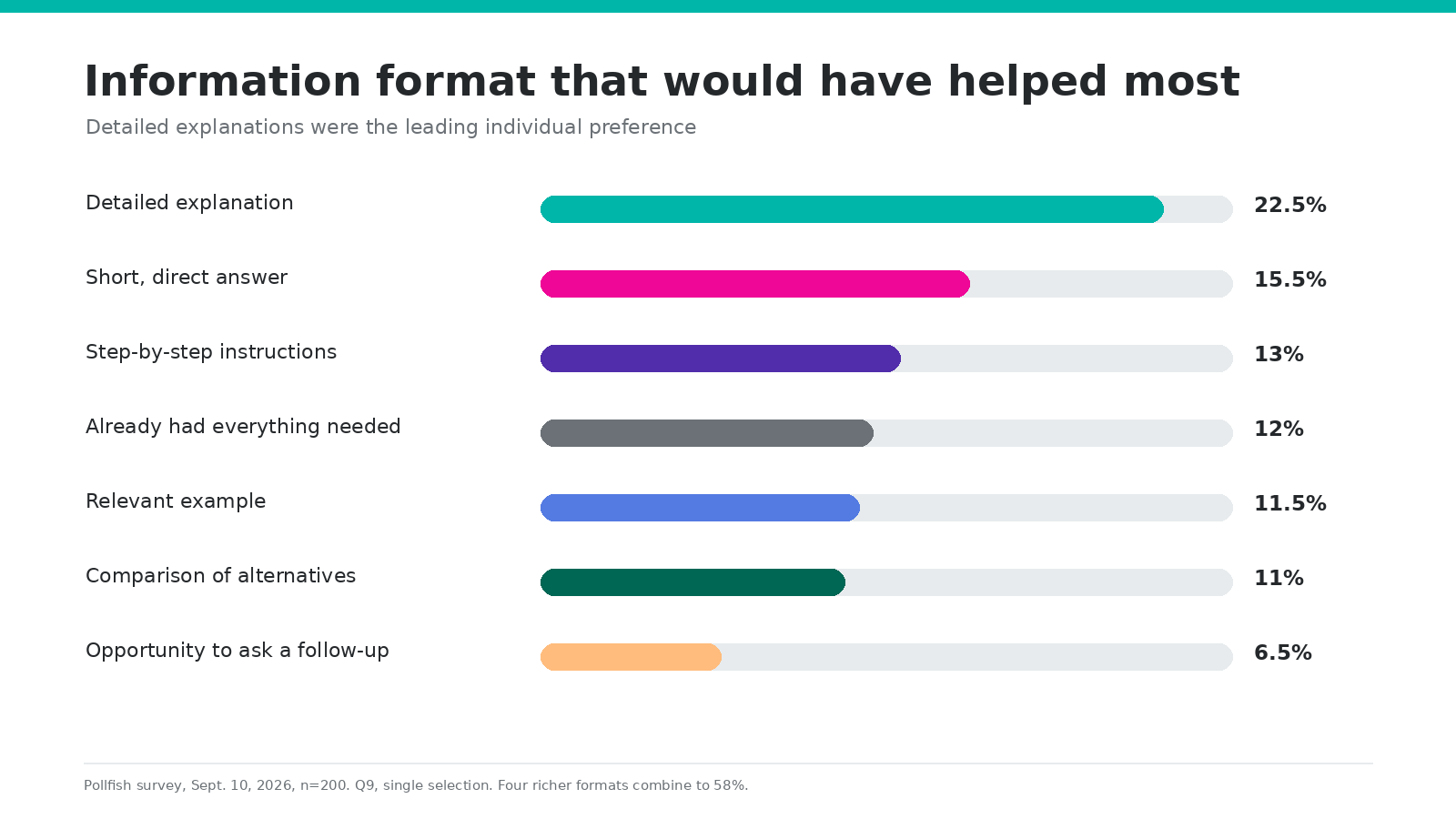
This finding challenges the prevailing trend toward "snackable" content and AI-generated snippets. While short answers are useful for simple facts (e.g., "What time does the store close?"), they are often insufficient for the commercial and product-service searches examined in this study. For these more complex journeys, users are looking for depth, context, and instruction. They don't just want to know what the answer is; they want to understand the how and the why.
Multi-Channel Information Ecosystems
The research confirms that the digital information environment is not a series of silos, but a fluid ecosystem. Users move freely between search engines, AI assistants, and social media. Search engines act as a primary discovery tool (56.5%) but also as a secondary recovery tool (31% of people used a search engine when their first source failed).
Social media's role as a legitimate information source is also cemented by this data. With 48.5% of users utilizing social platforms and 24% identifying it as their "main" source, social media has moved beyond its origins as a promotional channel. It is now a place where people perform actual research. The conversations, reviews, and creator content found on social media are being used to fill the "evidence" and "personal suitability" gaps left by traditional websites.
Similarly, AI is not replacing search so much as it is fragmenting it. The 25% of users who primarily rely on AI-mediated answers represent a significant portion of the market, but they are not a separate cohort. They are users who likely use search and social media alongside AI to build a complete picture.
Common Mistakes
Several common pitfalls hinder effective content that meets users' multi-source information needs.
- Focusing solely on SEO rankings — Neglects answer completeness and user verification needs.
- Ignoring social media as an information source — Misses user engagement and real information gaps.
- Over-relying on AI as a replacement — Underestimates the complementary roles of other platforms.
- Publishing incomplete content — Lacks pricing, comparisons, or evidence that users strongly seek.
Strategic Implications for Content Strategy
The results of this survey provide a clear directive for content publishers, marketers, and SEO professionals. The goal of content should be "completion," not just "visibility."
Address the Full Information Chain: Keywords should be viewed as the start of a chain of needs. If a user searches for a product, they will almost certainly need to know the cost, how it compares to competitors, and whether it is suitable for their specific context. Content that addresses all these stages is more likely to keep the user on the page and prevent them from returning to the search engine.
Prioritize Verification Signals: Because users are actively looking for reasons to trust information, publishers should make verification easy. This includes prominent "last updated" dates, links to original sources, and clear evidence for any claims made.
Invest in Depth and Format Diversity: The preference for detailed explanations and step-by-step instructions over short answers suggests that "comprehensive" still wins over "quick." Brands should look to expand their content beyond simple FAQs into tutorials, case studies, and deep-dive comparisons.
Monitor Social and AI Contexts: Since social media and AI assistants are such prominent sources of primary information and follow-up research, brands must ensure their information is accurate and available in those environments. This may involve social listening to identify common questions and ensuring that website content is structured in a way that is easily extracted and summarized by AI.
Closing the Gap Between Discovery and Completion
The internet has solved the discovery problem. Users can find "an" answer in seconds. However, the completion problem remains unsolved. The fact that 72.5% of people use multiple sources and only 39.5% find their first source completely satisfactory indicates a massive opportunity for publishers who can bridge these gaps.
A content gap is no longer just a missing keyword; it is a missing dimension of an answer. Whether it is a lack of pricing, a missing comparison, or an absence of supporting evidence, these gaps are what drive users away from a brand and back into the arms of a search engine or a competitor. By focusing on "answer assembly" and providing the depth, evidence, and context that users are currently stitching together manually, publishers can transform their content from a mere stop on a journey into a final destination.
Methodological Notes
This survey was conducted on September 10, 2026, with a sample of 200 respondents who had recently searched for information online regarding a product or service. The analysis utilized unweighted respondent percentages, as these provided the clearest top-line figures.
It should be noted that the sample size of 200 is sufficient for identifying broad behavioral trends but may not capture the nuances of specific sub-demographics. Additionally, the study's focus on commercial and product/service information means the findings may not generalize to other information-seeking behaviors, such as academic research, political inquiries, or health-related searches.
The routing of certain questions, specifically Q7, resulted in a smaller sub-sample (116 respondents) of those who found their initial source lacking. While this sub-sample is statistically consistent with the overall findings, it should be interpreted with appropriate caution regarding its smaller scale. Finally, while Pollfish provided stratified figures, they did not materially alter the conclusions drawn from the raw percentages reported here. Lower-level cross-tabulations between primary source selection and specific information gaps were not available for this analysis.
Full Survey Results & Findings can be downloaded here.