Reactive marketing has become a crucial capability for brands that want to stay relevant in a fast-moving digital environment. Research emphasizes that this type of marketing, branded content that responds to events happening in real time, can boost engagement, strengthen authenticity, and allow brands to enter cultural conversations in ways that feel more natural than a carefully planned marketing campaign.


But social platforms are crowded, attention spans are short, and the moment moves on quickly. In this environment, brands that respond with agility often outperform those following long production timelines. Oreo’s simple post during the Super Bowl blackout illustrates this power.
The message took only minutes to produce. It became the most memorable ad moment of the night because it arrived at exactly the right time. Reactive marketing is not improvisation. It works best when supported by a clear structure that helps teams react with purpose and consistency. This brings us to the core framework behind modern reactive marketing.
"
Proactive marketing operates on a longer timeline. It is structured, strategic, and rooted in planning. It includes campaign calendars, seasonal initiatives, brand storytelling, product launches, and multi channel programs that develop over weeks or months. Proactive marketing is foundational. It builds reputation, clarity, and continuity, ensuring that a brand’s presence remains strong even when the cultural environment becomes quiet or unpredictable.
Where reactive marketing offers immediacy, proactive marketing offers stability. It helps shape the perception of the brand over time, and it provides the consistent message that audiences rely on.
Both forms of marketing support one another. A strong proactive strategy provides the context that allows reactive moments to feel intentional and on brand.
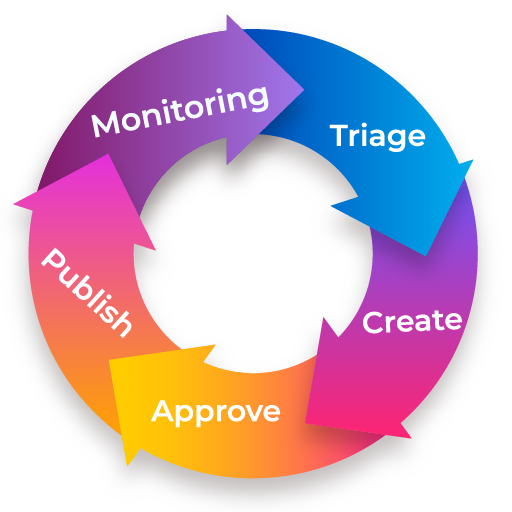
Below is the high-level structure that guides every reactive marketing effort. It captures the full journey from identifying a moment to publishing content that resonates.

This sequence serves as the backbone of your strategy. The rest of this guide explains how each stage works in practice.
A successful reactive marketing strategy begins with awareness. Brands must track the cultural landscape continuously, using reliable systems to identify relevant moments before competitors do. Research highlights the importance of real-time monitoring tools, trend dashboards, and social listening platforms to keep teams informed as conversations emerge.
Certain categories consistently create fertile ground for reactive opportunities: sports, entertainment, television and film, technology outages, environmental events, and viral social moments. These topics generate rapid engagement and emotional reactions, making them ideal triggers for timely responses.
During the recent global IT outage, KitKat and Decathlon noticed the moment immediately and responded with playful interpretations of the digital failure. Audiences welcomed the humor, which aligned with both brands’ tones. This illustrates how strong monitoring enables fast, fitting reactions.
Monitoring also helps brands avoid sensitive or inappropriate topics. Missteps such as American Apparel’s “Sandy Sale” or the misuse of the Aurora hashtag happened because teams reacted without understanding context. A mature monitoring system does not just detect opportunities. It identifies risks before they become brand problems.
Not every trending topic deserves a brand message. Most trending topics will fall outside of your brand’s scope. The triage phase ensures that teams select only the moments that matter and avoid those that pose unnecessary risk.
Effective triage involves asking the right questions
IKEA’s reaction to Cristiano Ronaldo removing Coca-Cola bottles during a press conference is a model of strong triage. The brand created a reusable bottle mock-up named “Cristiano,” which was humorous, simple, aligned with brand values, and perfectly timed.
Successful triage requires discipline. It protects the brand from reacting where it should not and focuses energy where it can make a meaningful impact.
Once a moment passes triage, the creative phase begins. Speed is important, but speed alone is not enough. Research shows that the most effective reactive content tends to be concise, visual, and rooted in a single clear idea. It should reflect brand identity even when created under tight timelines.
Lego demonstrated this beautifully when it referenced Tesla’s Cybertruck reveal. The brand posted a single Lego brick labeled as a “shatterproof vehicle.” It was playful, instantly recognizable as Lego, and positioned perfectly within the wave of conversation surrounding the Cybertruck.
Coca-Cola’s socially distanced Times Square billboard is another example of thoughtful reactive creation. By spacing out its iconic letterforms, the brand delivered a message that was relevant to global news while staying true to its visual identity.
To support rapid creative production, many teams maintain:
These assets reduce decision fatigue and make it easier to produce quality content at speed.
The approval step is often the biggest bottleneck in reactive marketing. A strategy that relies on slow approval loops will miss nearly every opportunity.
Research from Brandwatch emphasizes the importance of a rapid approval chain that still maintains brand safety. Many teams adopt a tiered system in which low-risk content can be approved by a social lead and brand manager, while medium-risk content may require quick PR or legal review. In cases of high-risk or sensitive topics, most brands default to silence. A reactive strategy thrives when approvals are clear, fast, and proportionate to the risk.
Oreo succeeded during the blackout because their approval authority was present in the room. Without fast sign-off, their now-famous line would never have been posted.
Once approved, the content should be published immediately. Different channels support different types of reactive expression.
To improve future performance, measurement must be built into the workflow. Research identifies core metrics such as engagement rate, brand mentions, sentiment, conversions, and ad performance. These metrics reveal how well the content resonated and whether the strategy is improving over time.
One of the strongest examples of reactive publishing came from Stanley when a customer posted a video of her burned car with an intact Stanley tumbler inside. The brand responded by offering her a new tumbler and a new car. The quick, human reaction sparked massive engagement and reinforced Stanley’s brand position.
Publishing is not the end of the process. It is part of a learning loop that helps refine future reactions.
A reactive marketing strategy becomes far more powerful when supported by a well-structured playbook. Just like in sports, a playbook ensures that teams know exactly how to monitor, assess, create, and approve content in real time, while protecting against inconsistency and allowing mobility within teams.
A strong internal playbook includes:
This structure ensures that reactive marketing becomes a dependable capability rather than an improvised effort.
This guide pairs with a free toolkit that includes:
These resources help teams put the five-part system into action with minimal friction.
Reactive marketing helps brands move at the speed of the internet. Although reactive moments may appear spontaneous, the brands that succeed are the ones that are prepared ahead of time. With a structured approach built around Monitoring, Triage, Creation, Approval, and Publishing, teams can participate in the right moments with confidence and clarity.
Reactive marketing is not about reacting to everything. It is about choosing the moments that matter and responding in ways that feel true to the brand. Brands that adopt this approach remain visible, relevant, and memorable in a world that is constantly shifting.