Adults Told About AI-Generated Ads Later Expressed Lower Trust
In a survey of 446 U.S. adults, respondents presented with a scenario in which they learned about an advertisement's use of artificial intelligence after a satisfactory purchase were less likely to trust the advertiser or buy from it again than respondents who were told upfront.

|
Posted: August 26, 2026 |
Synopsis
ContentEngine surveyed two separate samples of 223 U.S. adults to examine whether the timing of an artificial intelligence disclosure was associated with different reactions to an online advertisement. Every respondent was told the advertisement persuaded them to make an unplanned purchase and that they were satisfied with the product. One sample was told before the purchase that the ad was created entirely using AI. The other learned this afterward and was told the ad had not disclosed it.
Respondents who learned about the AI involvement later were 12 percentage points less likely to say they would trust the advertiser, 13 points less likely to say they would buy from it again and 13 points more likely to say they felt misled. Across both samples, 90% considered AI disclosure important and 88% considered human review important.
Key Findings
- Trust was lower when AI use was learned later. About 65% of respondents in the later-discovery group said they would trust the advertiser at least a fair amount, compared with 77% of those informed upfront.
- Repeat purchase intent followed the same pattern. About 67% of the later-discovery group said they would be at least somewhat likely to buy from the advertiser again, compared with 80% of the upfront-disclosure group.
- Feeling misled increased after later discovery. Seventy percent of respondents who learned about the AI use afterward felt at least somewhat misled, compared with 57% of respondents who knew upfront.
- Disclosure did not remove every concern. Even in the upfront-disclosure group, 57% felt misled and 62% felt manipulated at least somewhat.
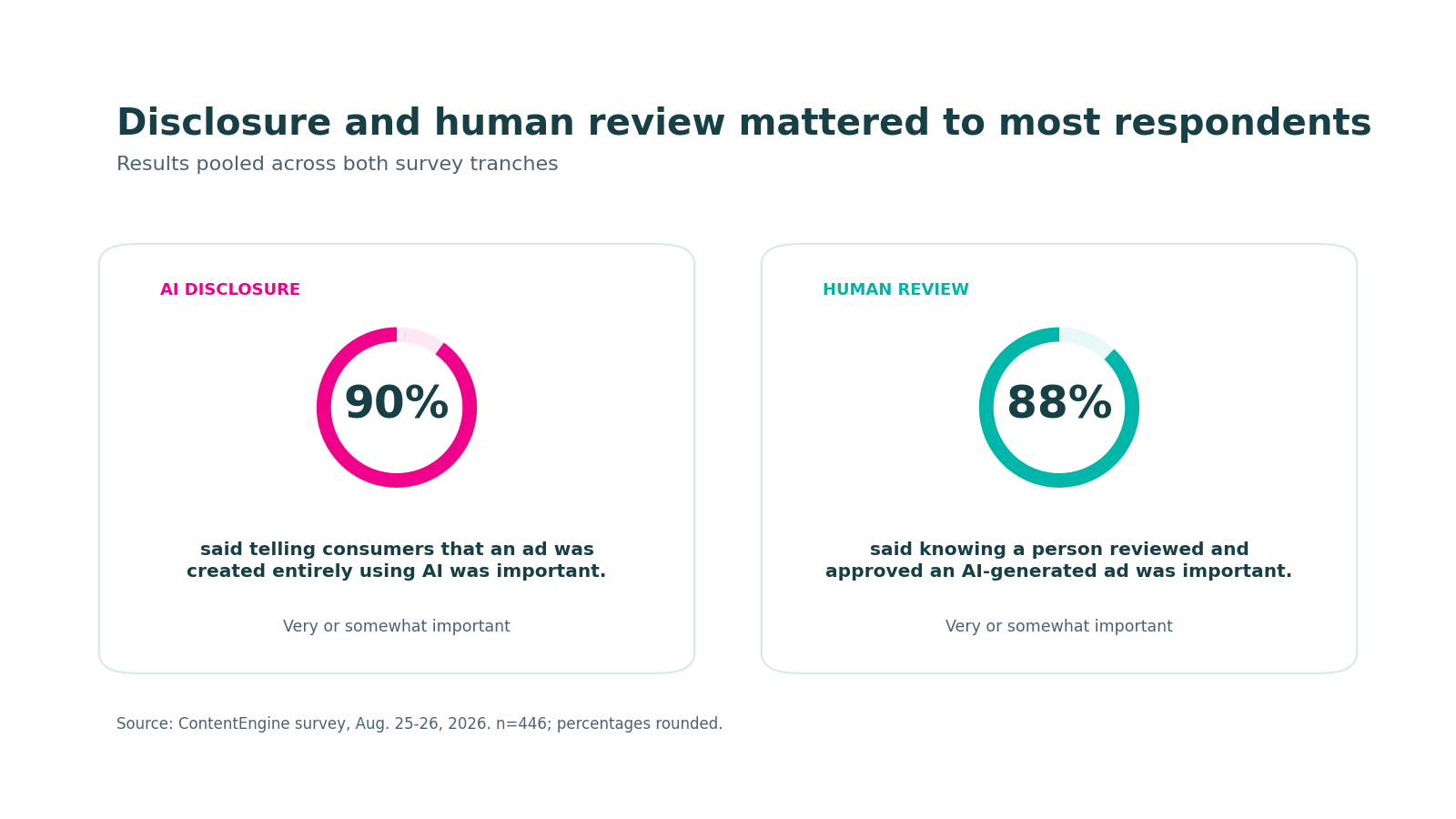
- Disclosure and oversight drew broad support. Across both samples, 90% said disclosing AI use in advertising was at least somewhat important, while 88% said the same about human review and approval.
What the Survey Tested
The survey used two versions of the same hypothetical purchase. Both described an online advertisement for a product the respondent had not planned to buy. In both versions, the ad persuaded the respondent to make the purchase, and the respondent was satisfied after using the product.
The key difference was when the use of AI entered the scenario. Tranche A disclosed before the purchase that the advertisement's words and images were created entirely using AI. Tranche B revealed this after the purchase and explicitly said the advertisement had not disclosed it when the respondent saw it.
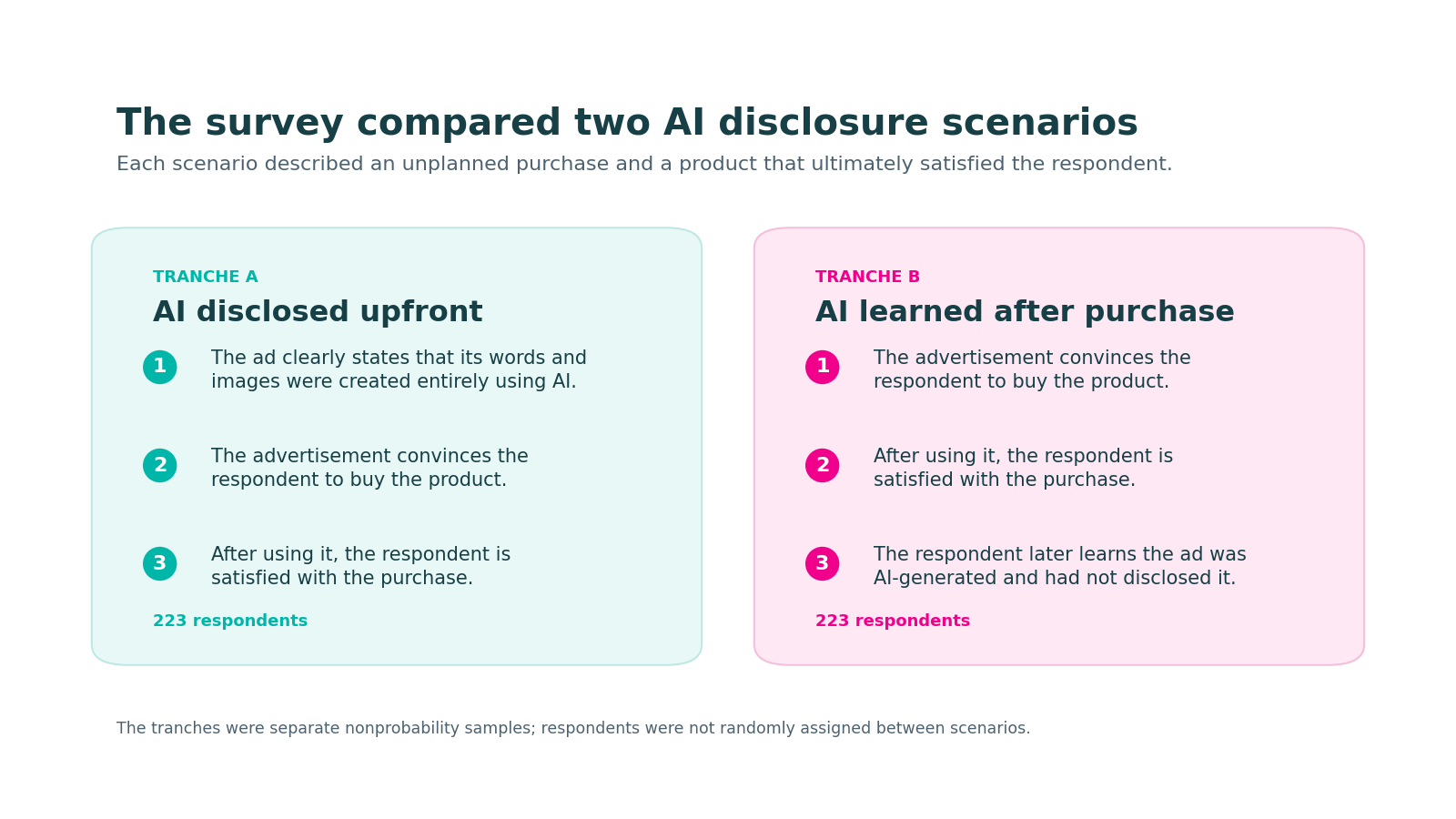
This design held the successful purchase outcome constant. It therefore examined whether respondents reacted differently to the advertiser even when the product delivered a satisfactory experience.
It did not isolate disclosure timing as a single causal factor. The later-discovery scenario also told respondents that the advertisement had failed to disclose its use of AI, which may have directly shaped answers about feeling misled. The tranches were also fielded as separate samples rather than as a randomized experiment.
Later Discovery Was Associated With Lower Trust and Loyalty
The clearest differences appeared in trust and future purchase intent.
Among respondents informed upfront, 76.7% said they would trust the advertiser either a great deal or a fair amount. That figure was 65% among respondents who learned about the AI involvement afterward, a difference of 11.7 percentage points.
The difference in repeat purchase intent was similar. About 79.8% of the upfront-disclosure group said they would be very or somewhat likely to buy from the advertiser again, compared with 67.3% of the later-discovery group. That was a difference of 12.6 points.
Feeling misled moved in the opposite direction. About 70% of respondents who learned later said they felt misled a lot or some, compared with 57% of those informed upfront. The 13-point difference was the largest measured gap between the groups.
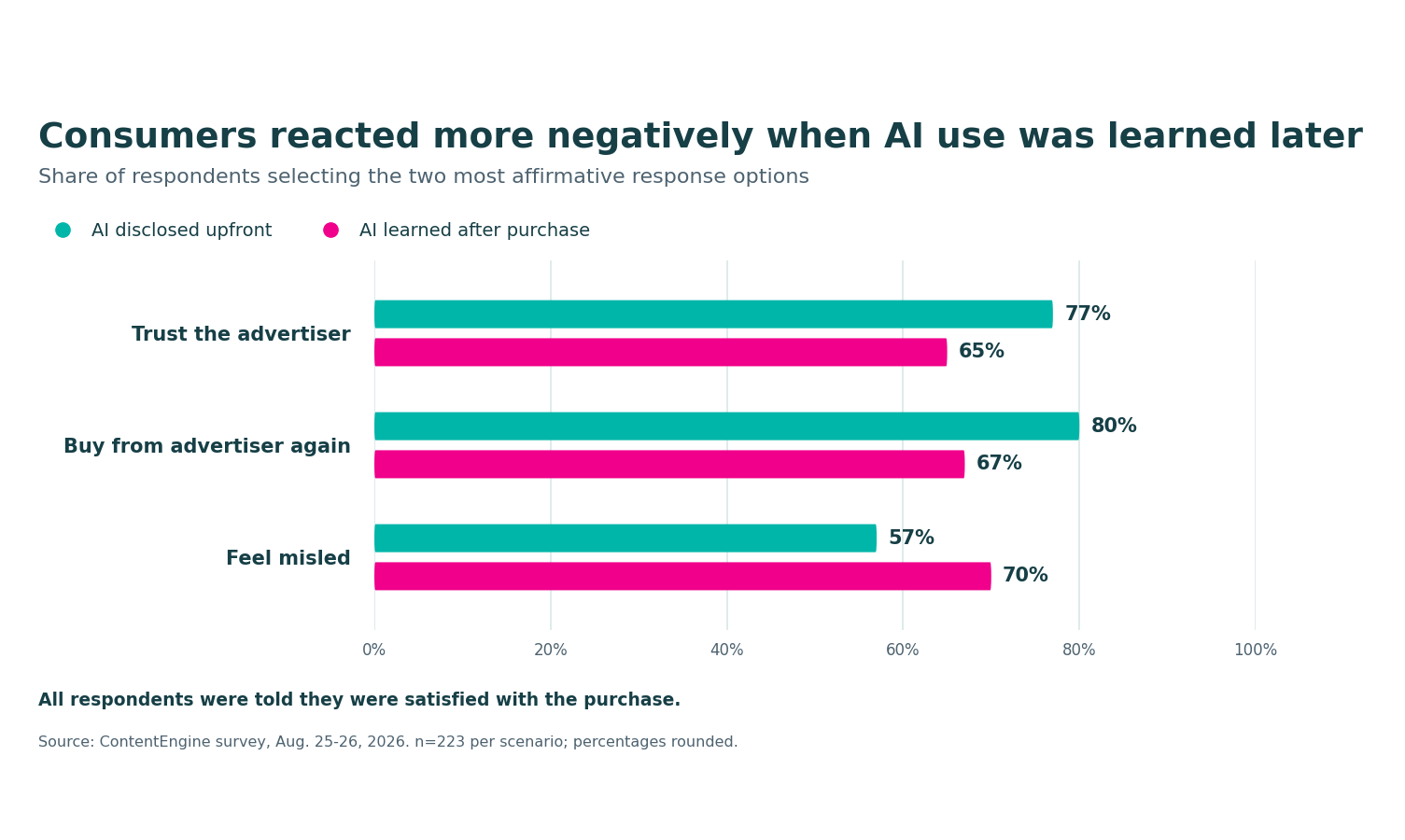
After the analysis was adjusted for the eight survey comparisons, trust, repeat purchase intent and feeling misled remained statistically significant. The estimated differences were also bounded away from zero in their 95% confidence intervals.
These results do not show that a satisfactory product is irrelevant. Every respondent was told the purchase ended well, so the survey cannot compare satisfaction with dissatisfaction. The results instead suggest that product satisfaction may not fully protect the advertiser when a consumer discovers undisclosed AI involvement later.
Upfront Disclosure Did Not Remove All Consumer Discomfort
Upfront disclosure produced more favorable results than later discovery on the survey's clearest measures, but it did not eliminate negative reactions.
Among respondents told about the AI-generated advertisement before the purchase, 57% said they felt misled a lot or some. About 62% said they felt manipulated a lot or some. Those figures complicate any simple claim that a disclosure by itself resolves consumer unease.
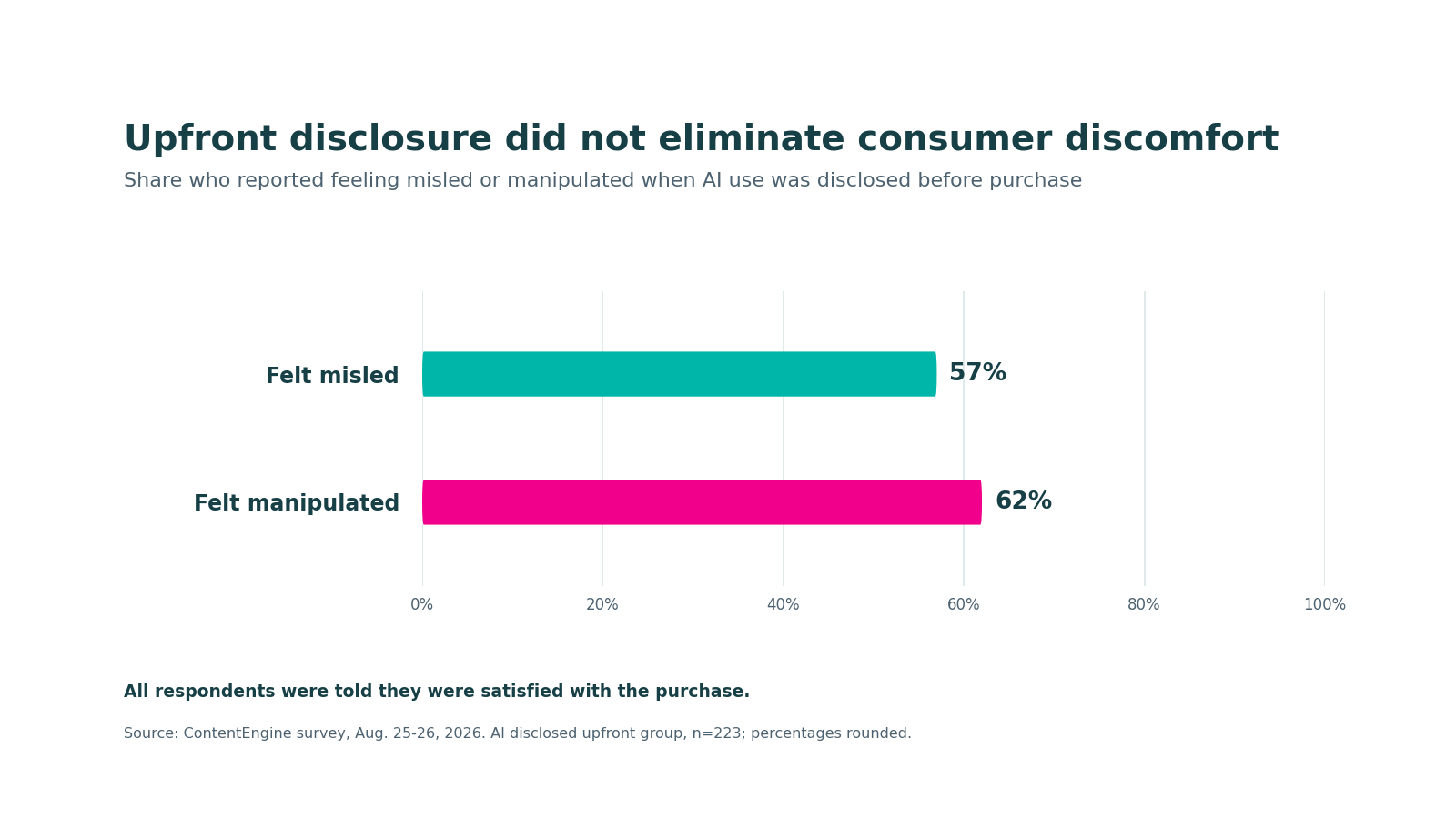
The wording offers several plausible explanations. Respondents were asked to imagine an advertisement persuading them to make an unplanned purchase, which may have made the persuasive act itself feel manipulative. They were also told the entire advertisement was created using AI, a stronger condition than using AI for only part of the production process.
The survey did not ask respondents why they chose those answers. The results therefore identify persistent discomfort but cannot determine whether it came from AI, advertising persuasion, the unplanned purchase or some combination of those elements.
Most Respondents Wanted AI Disclosure and Human Review
Support for transparency extended across both scenarios. Of the 446 respondents, 402, or 90.1%, said it was very or somewhat important for brands to tell consumers when an advertisement had been created entirely using AI.
Human oversight received nearly the same level of support. A total of 394 respondents, or 88.3%, said it was very or somewhat important to know that a person had reviewed and approved an AI-generated advertisement before publication.
The human-review result was almost identical in the two samples: 87.9% in the upfront-disclosure group and 88.8% in the later-discovery group. That consistency is notable because the scenarios framed disclosure very differently.
The findings support treating disclosure and review as separate responsibilities. A disclosure tells the audience how an advertisement was made. Human review establishes that someone remains accountable for what the advertisement says, shows and implies.
Several Other Differences Were Less Conclusive
The later-discovery group also reported more regret and manipulation, while fewer respondents said they would recommend the advertiser or considered disclosure important. Those differences were smaller or less precise and did not remain statistically significant after correcting for the eight comparisons.
Human-review importance differed by less than 1 percentage point between the samples. This was the smallest difference measured.
The table below reports the top-two response share for every survey item. For trust, purchase intent and recommendation, the figures represent the two favorable categories. For regret, feeling misled and feeling manipulated, they represent the two strongest negative categories. The importance measures combine “very important” and “somewhat important.”
| Measure | AI Disclosed Upfront | AI Learned Afterward | Difference | 95% Confidence Interval | Adjusted p |
|---|---|---|---|---|---|
| Trust advertiser | 76.7% | 65.0% | -11.7 points | -20.0 to -3.3 | .040 |
| Buy from advertiser again | 79.8% | 67.3% | -12.6 points | -20.7 to -4.5 | .021 |
| Regret purchase | 53.4% | 60.5% | +7.2 points | -2.0 to +16.3 | .378 |
| Feel misled | 57.0% | 70.0% | +13.0 points | +4.1 to +21.9 | .030 |
| Recommend advertiser | 73.1% | 67.7% | -5.4 points | -13.8 to +3.1 | .426 |
| Feel manipulated | 62.3% | 70.4% | +8.1 points | -0.7 to +16.8 | .285 |
| Consider disclosure important | 92.8% | 87.4% | -5.4 points | -10.9 to +0.1 | .284 |
| Consider human review important | 87.9% | 88.8% | +0.9 points | -5.1 to +6.9 | .768 |
What Advertisers Can Take From the Findings
The results provide a practical warning about evaluating AI-generated advertising only by immediate performance. An advertisement can persuade someone to buy a product they ultimately like while still leaving the advertiser with less trust and weaker repeat purchase intent when the AI involvement is discovered later.
Disclosure should happen early enough to inform the purchase decision. A notice that appears only after a consumer has acted may explain how an advertisement was made, but it cannot serve the same function as information provided before the decision.
Human review also deserves a defined role rather than a ceremonial approval step. Respondents placed nearly equal importance on disclosure and human review, suggesting they care both about knowing when AI was used and knowing that a person remained responsible for the final advertisement.
The discomfort reported by the upfront group is a reminder that transparency is not a substitute for judgment. Brands still need to consider whether the advertisement's claims, targeting and persuasive techniques will feel appropriate once consumers understand how the creative was produced.
Methodology
ContentEngine conducted two online surveys of U.S. adults through SurveyMonkey Audience. Each survey received 223 completed responses, for a combined total of 446. Tranche A was fielded Aug. 25-26, 2026. Tranche B was fielded Aug. 25, 2026.
The tranches used separate nonprobability samples. Respondents opted into online survey panels and were not randomly selected from all U.S. adults. Respondents were not randomly assigned between the two scenarios. The results were not weighted, and no weight variable was included in the exports.
Because these were nonprobability samples, a conventional margin of sampling error is not reported and the results should not be projected to all U.S. adults. Percentages describe the people who completed these surveys.
All 223 respondents in each tranche answered the eight research questions. Demographic information included age, gender, household income, device type and major U.S. region. Six respondents did not have a region classification. The two samples did not differ significantly on the measured demographic variables, although similarity on those characteristics does not rule out differences on unmeasured traits.
The primary comparisons in this report combine the first two response categories for each question. Differences are reported in percentage points with unpooled 95% confidence intervals. Two-sided tests of proportions were used, and p-values were adjusted across the eight comparisons using the Holm method. The intervals describe uncertainty under the statistical model; they are not margins of sampling error for all U.S. adults.
The top-two analysis was exploratory and was not preregistered. Separate comparisons of the full four-category response distributions produced nominal differences for some questions, but none remained statistically significant after adjustment for multiple comparisons.
The analysis was conducted from the response-level SurveyMonkey exports and checked against the supplied top-line workbooks. Counts matched across the raw and top-line files.
Limitations
The survey compared separate samples rather than randomly assigning respondents within one experiment. Differences between the samples could therefore contribute to the results even though their measured demographic profiles were similar.
The scenarios also differed in more than timing. Tranche B explicitly said the advertisement did not disclose its use of AI. That wording directly invokes nondisclosure and may have increased the likelihood that respondents said they felt misled.
The scenario was hypothetical, and respondents did not view a real advertisement, spend money or use a real product. Stated trust and purchase intentions may not match behavior in an actual marketplace.
All respondents were told the advertisement was created entirely using AI. The findings may not apply to advertisements in which AI plays a smaller role, such as resizing images, generating variations or assisting a human copywriter.
The survey did not measure race, ethnicity or education, and it did not ask respondents to explain their answers. It therefore cannot determine which part of the scenario produced the discomfort reported by the upfront-disclosure group.
Question Wording
Tranche A: AI disclosed upfront
Imagine you see an online advertisement for a product you hadn't planned to buy. The advertisement clearly states that its words and images were created entirely using artificial intelligence, or AI.
The advertisement convinces you to buy the product. After using it, you're satisfied with your purchase.
Tranche B: AI learned afterward
Imagine you see an online advertisement for a product you hadn't planned to buy. The advertisement convinces you to buy the product. After using it, you're satisfied with your purchase.
Later, you learn that the advertisement's words and images were created entirely using artificial intelligence, or AI. The advertisement didn't disclose this when you saw it.
Both tranches then received the same eight questions:
- Based on this situation, how much would you trust the brand that advertised the product?
(A great deal, a fair amount, not too much or not at all.) - How likely would you be to buy another product from this brand?
(Very likely, somewhat likely, not too likely or not at all likely.) - How much, if at all, would you regret buying the product?
(A lot, some, not too much or not at all.) - How much, if at all, would you feel misled by the brand?
(A lot, some, not too much or not at all.) - How likely would you be to recommend this brand to someone else?
(Very likely, somewhat likely, not too likely or not at all likely.) - How much, if at all, would you feel manipulated by the advertisement?
(A lot, some, not too much or not at all.) - How important is it for brands to tell consumers when an advertisement has been created entirely using AI?
(Very important, somewhat important, not too important or not at all important.) - How important would it be to you to know that a person reviewed and approved an AI-generated advertisement before it was published?
(Very important, somewhat important, not too important or not at all important.)
Download the Results
Download the combined top-line and response-level survey results.
The downloadable PDF contains the complete top-line tables and all 446 individual response records. Completely blank identifying fields were omitted from its appendix and documented in the file.