
Axios's AI Shift May Redefine Journalism Standards
While many critics view the automation of news as the industry's final collapse, the Axios partnership with OpenAI suggests a different path where technology sustains what markets no longer can. This shift might be the only way to preserve local reporting in an era of disappearing newsrooms and dwindling resources.

|
Posted: August 20, 2026 |

Local journalism in the United States has spent the better part of two decades on life support. First came the widespread digitization that gutted subscriptions and left legacy newspapers in shambles. Then private equity firms arrived, snapping up publications to turn them into digital ad farms managed by skeleton crews. Now, a new technological shift is causing another wave of anxiety across newsrooms. Axios, a company that built its reputation on a clinical, bulleted style of reporting known as Smart Brevity, has entered a three-year agreement with OpenAI. The deal allows OpenAI to underwrite 13 local newsletters that will get free access to content-generating tools, while OpenAI gets access to Axios content to train its models. Critics view this as the final nail in the coffin for traditional reporting, but for those watching the rapid expansion of American news deserts, the move looks less like a betrayal and more like a necessary evolution.
Jim VandeHei, the co-founder of Axios, has not minced words about his position. Speaking to the Columbia Journalism Review, VandeHei described himself as an "AI lab rat." He has been explicit with his staff, telling them they don't have a choice but to embrace the technology. For VandeHei, the debate isn't about whether AI should be in the newsroom, but how quickly it can be integrated to save a failing business model. He dismissed those who resist the change as "AI deniers," essentially suggesting they'll be left behind by a market that no longer rewards traditional, slow-moving narrative journalism. While his rhetoric is harsh, it reflects a grim reality: the old ways of funding local news are gone, and what's left is a choice between automation or silence.
Synopsis
Axios, a US media company, has partnered with OpenAI to integrate AI tools into local journalism by automating content generation for 13 local newsletters. Through this three-year agreement, OpenAI gains access to Axios content to train its ChatGPT model, while Axios pushes its staff to embrace AI or risk job loss. This move has raised concerns due to conflicts of interest, as Axios covers technology and OpenAI extensively, and reflects challenges facing local journalism amid industry decline and automation trends.
The Gravity of the Local News Crisis
To understand why a company like Axios is willing to risk its reputation on an AI experiment, one has to look at the catastrophic state of local reporting. According to the 2025 State of Local News report from Northwestern University, nearly 40% of all local U.S. newspapers have vanished since 2005. This isn't just a loss of business; it's a loss of community infrastructure. Roughly 50 million Americans now live in areas with limited or no access to a reliable source of local news. In the last year alone, more than 130 newspapers shut down. The number of counties lacking any local news source has risen to 212, while 1,525 counties have only one remaining source.
The decline in manpower is even more staggering. In 2002, the U.S. averaged about 40 journalists per 100,000 residents. By 2026, that number has fallen to 7.8, representing an 81% decline. In many places, the local reporter who once covered the school board, city hall, and small business openings has simply disappeared. Muck Rack's 2026 Local Journalist Index shows that 70% of U.S. counties fall below even this anemic national average. When these reporters vanish, the vacuum is filled by misinformation, or worse, nothing at all.
This scarcity has measurable financial and social costs. Research suggests that states with fewer local journalists face municipal borrowing costs roughly 17% higher than average. Without a watchdog to monitor local government spending, the risk to lenders increases, and taxpayers foot the bill. Furthermore, there is a clear link between local news and civic participation. Counties with low journalist density score significantly lower on indices of voter turnout and charitable giving. Even loneliness rates are higher in states with weaker local news environments, as residents lose the shared stories that bind a community together.
Problem
Local journalism is collapsing, leaving millions without dedicated reporters and creating information deserts.
Cause
A drastic decline in journalists per capita due to financial struggles, closures, and limited digital funding.
Solution
Integrate AI tools to automate laborious tasks, improve newsroom efficiency, and potentially revive local news coverage while safeguarding journalistic ethics.
Testing the Lean Newsroom Model
Axios is positioning its OpenAI partnership as a test case for whether leaner local newsrooms can be economically viable. The goal is to see if AI can automate the administrative and repetitive tasks of a newsroom, leaving the human journalists to focus on actual reporting. VandeHei has asked whether AI can "basically automate everything you need in a local market other than the journalist and the journalism itself."
In this view, AI is not a replacement for the reporter but a force multiplier. If a tool can transcribe an hour-long city council meeting in seconds, summarize a 100-page municipal budget, or draft a routine weather alert, the human reporter is freed up to do the deep-dive investigative work that machines can't replicate. The current financial model for local news often forces a single reporter to produce three or four stories a day just to keep a website active. That volume makes quality nearly impossible. If AI handles the volume, the human can handle the quality.
The Axios model is uniquely suited for this transition. Since its founding in 2016, the company has avoided the flowery prose and long-form narratives of traditional journalism. Its "Smart Brevity" style uses bullet points, bold headings, and short paragraphs to deliver information as efficiently as possible. This structured format is remarkably similar to how generative AI models organize data. By leaning into this style, Axios has already done the heavy lifting of preparing its readers for a world where information is delivered with machine-like precision.
What Readers Actually Accept From AI Newsrooms
To test where audiences draw the line, ContentEngine surveyed 100 U.S. respondents through Pollfish about trust in AI-assisted journalism. The results support neither blanket rejection nor full automation. Instead, they point to human review as a meaningful dividing line.
When an article was described as drafted by AI and reviewed by a professional journalist, 42.6% of respondents said they would trust it and 23.5% said they would distrust it. For an article created entirely by AI without human review, trust fell to 25.9% while distrust climbed to 51.7%.
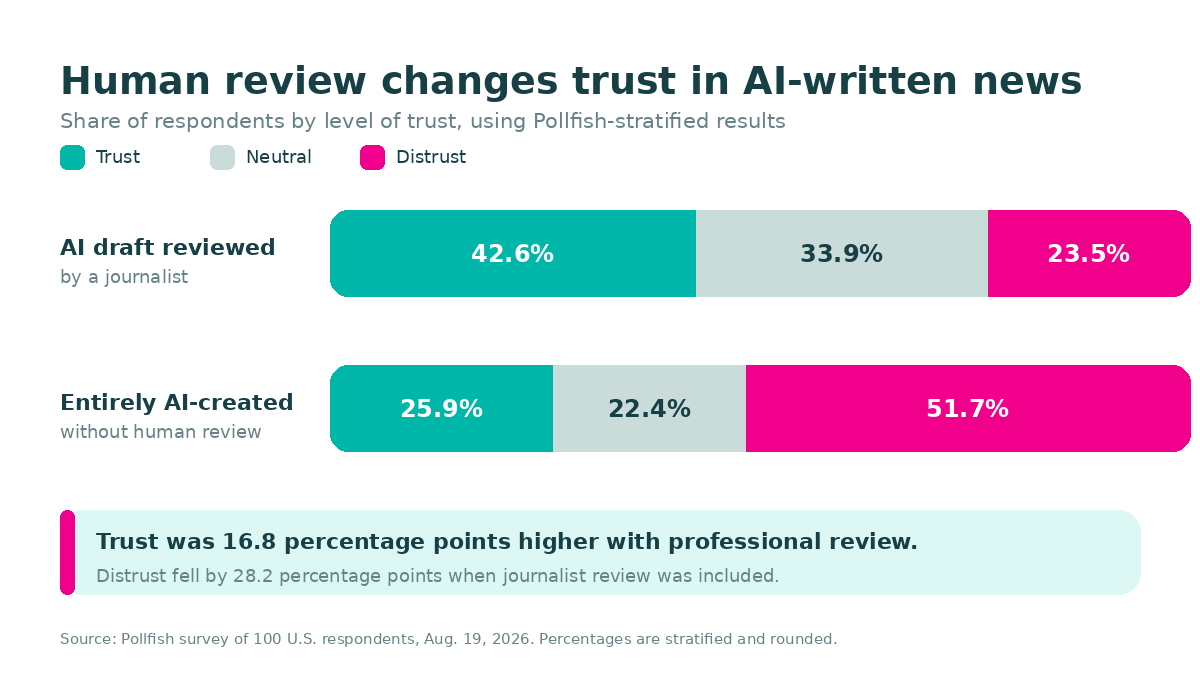
The respondent-level shift was just as notable. Almost half, 48.2%, gave the journalist-reviewed scenario a more trusting rating than the unreviewed scenario. Another 47.3% gave both scenarios the same rating, while only 4.5% became less trusting when professional review was included.
The same boundary appeared when respondents were asked for the highest level of AI involvement they would accept in a newsroom:
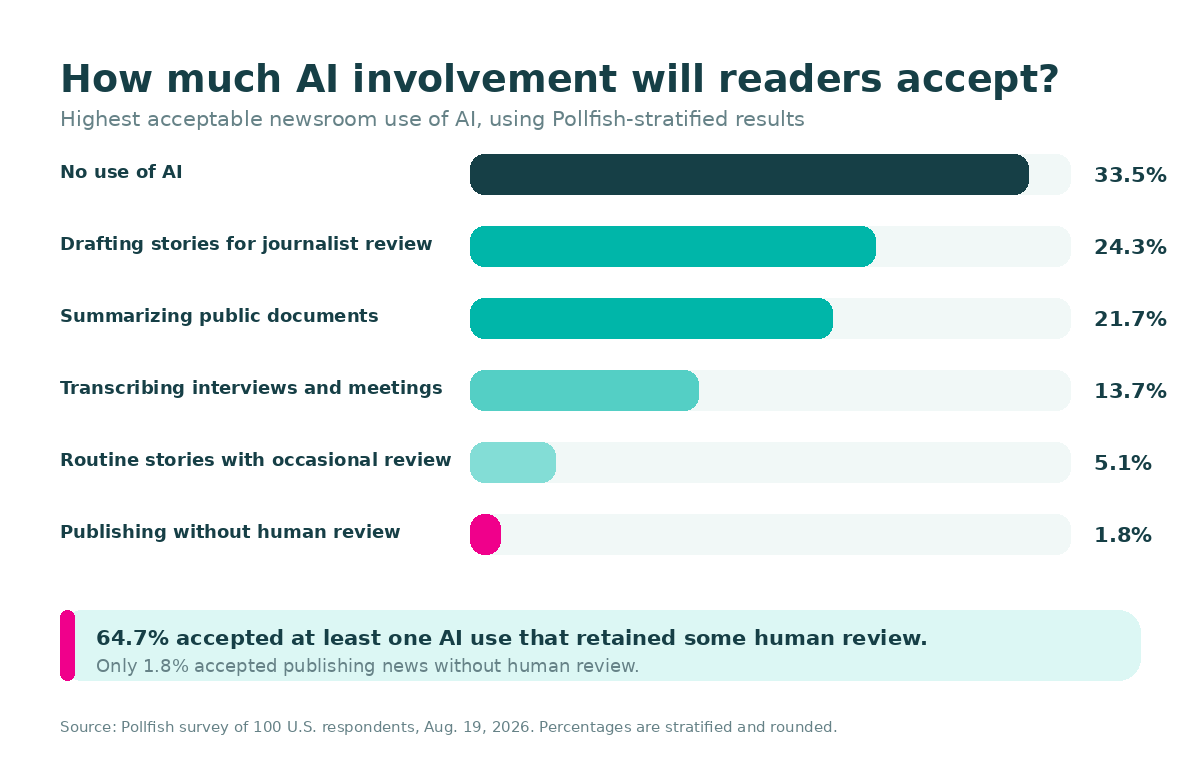
Taken together, 64.7% accepted at least one use of AI that retained some level of human review. Just 1.8% selected publishing news without human review. For lean newsroom models, that distinction matters: audiences appear considerably more open to AI as part of the reporting process than to AI replacing editorial responsibility.
The Axios model is uniquely suited for this transition. Since its founding in 2016, the company has avoided the flowery prose and long-form narratives of traditional journalism. Its "Smart Brevity" style uses bullet points, bold headings, and short paragraphs to deliver information as efficiently as possible. This structured format is remarkably similar to how generative AI models organize data. By leaning into this style, Axios has already done the heavy lifting of preparing its readers for a world where information is delivered with machine-like precision.
Key Takeaways
Local journalism is in crisis
Journalist numbers per capita have declined by approximately 75%, leaving many counties without reliable local reporters.
Axios partners with OpenAI to innovate
Launching AI-powered tools for local newsletters to automate labor-intensive reporting tasks.
Ethical concerns persist
The partnership raises questions over conflicts of interest, editorial independence, and AI's impact on journalistic standards..
AI may improve efficiency
Automation can free journalists to focus on in-depth stories while expanding coverage in underserved areas.
Risks of automation include job losses
Rapid AI adoption could hollow out newsrooms and lead to generic, shallow content.
The future is uncertain but pivotal
Axios’s experiment could either redefine or undermine local journalism.
The Ethical Trade-Off and Conflict of Interest
The partnership does raise significant ethical questions. Axios routinely covers the tech industry, including OpenAI. Entering a deal where OpenAI underwrites portions of its operation creates a clear conflict of interest. How can an Axios reporter objectively cover a controversy involving Sam Altman when their own paycheck is indirectly linked to an OpenAI grant?
Critics argue that this move compromises the independence that is fundamental to the fourth estate. When VandeHei says he doesn't care if his staff is scared of AI, it sends a message that the technology is now the priority, not the people who verify the facts. There is also the issue of data training. By giving OpenAI access to its content, Axios is essentially helping build the very systems that could eventually replace its writers. It's a deal that looks to some like a short-term survival tactic that guarantees long-term obsolescence.
However, the counterargument is that the conflict of interest is already pervasive in the industry. Most local newspapers are owned by a handful of massive conglomerates or private equity firms with vast interests in real estate, healthcare, and finance. Compared to the opaque influences of a hedge fund, a transparent partnership with a tech company to fund 13 local newsletters might be the lesser of two evils. Axios has maintained that its editorial firewall remains intact, and VandeHei's openness about being an "AI lab rat" at least provides the public with a clear understanding of where the company stands.
Efficiency vs. Authenticity
One of the primary fears regarding AI in journalism is the loss of the human touch. Reporting isn't just about data; it's about relationships, intuition, and knowing when a city official is dodging a question. A chatbot can summarize a transcript, but it can't notice the nervous twitch of a witness or the underlying tension in a neighborhood meeting.
But the reality in many "news deserts" is that there is no human touch to lose. When a county has zero journalists, an AI-curated newsletter that pulls from public records, social media, and local government feeds is an improvement over the status quo. It provides a baseline of information where currently there is only silence. The 2026 data shows that in 77% of U.S. counties, there were no articles mentioning a community's education system by name in the first quarter of the year. Seventy-six percent had no local health coverage. In these areas, the debate over "authenticity" feels like a luxury. Residents don't need a Pulitzer-winning narrative; they need to know if the local school board is raising taxes or if the hospital is closing its maternity ward.
The survey suggests that this scarcity changes the trade-off, although it does not eliminate public caution. When respondents were asked what they would prefer if their community had no local reporter, 38.3% selected some form of AI-generated coverage, compared with 10.1% who preferred no coverage at all.
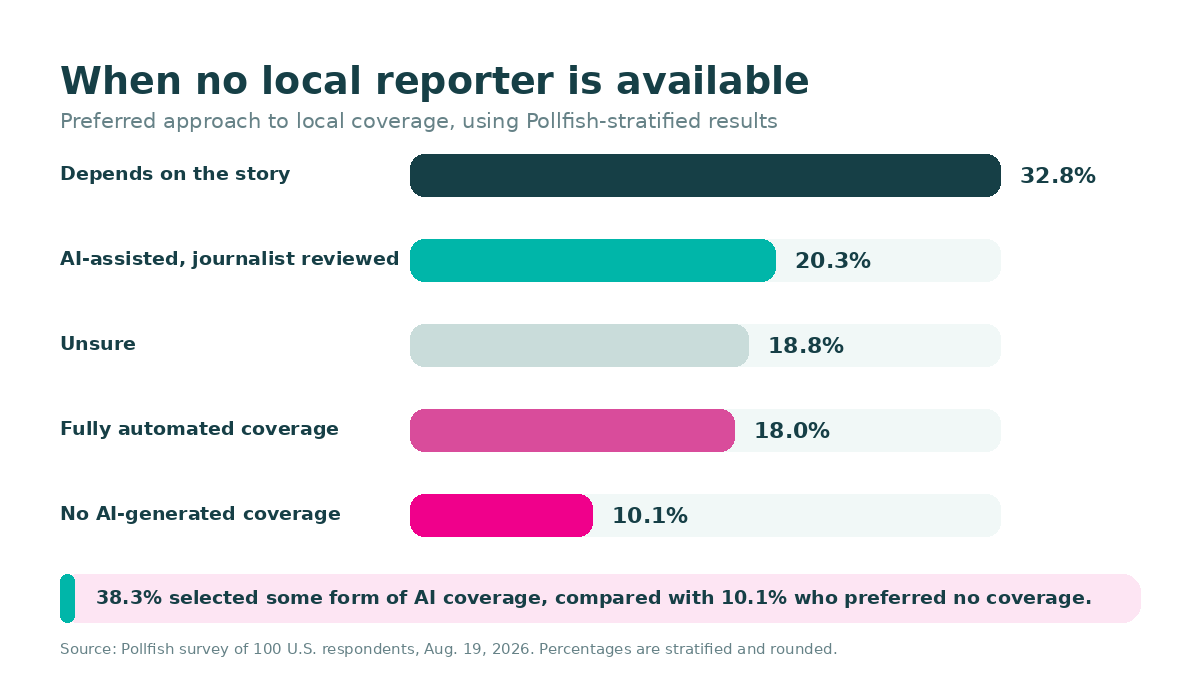
The largest group, 32.8%, said the answer would depend on the story, and another 18.8% were unsure. That means the results are not a blanket endorsement of automated local journalism. They suggest that people may accept more automation when the alternative is an information vacuum, but still want the level of oversight to reflect the risk and complexity of the story.
Axios is betting that it can use AI to scale this baseline coverage to hundreds of smaller cities that have been abandoned by the traditional media. If the experiment works, it could create a new tier of journalism: a high-efficiency, automated layer of "commodity news" that keeps the public informed on basic facts, supported by a smaller number of human journalists who step in when a story requires actual investigation.
Hot Take
Axios's unapologetic embrace of AI may either save or end local journalism as we know it.
Their bold, unapologetic experiment confronts a collapsing industry with technology, raising urgent ethical questions while offering a path toward sustainability.
A New Baseline for the Industry
The relationship between OpenAI and Axios also points toward a new economic model for the training of large language models. For years, tech companies have scraped the web for free, using the work of journalists to train AI without compensation. The Axios deal is an admission that high-quality, verified data has value. By formalizing this relationship, Axios is getting paid for its data while also gaining access to the tools that data helps create.
This could set a precedent for other news organizations. Instead of fighting a losing battle against scraping, media companies might follow the Axios lead and negotiate for a seat at the table. If AI is the future of how people consume information, then journalism must be part of its foundation. A ChatGPT trained on the clinical, fact-checked reporting of Axios is likely to be more reliable than one trained on the unfiltered chaos of Reddit or X.
This doesn't mean the transition will be easy or that it won't result in job losses. The newspaper sector has already seen employment drop by over 75% since 2005. AI will likely accelerate the displacement of copy editors, layout designers, and entry-level researchers. But it also creates a new role for the "AI-augmented journalist"-someone who can manage these tools to produce a volume of work that was previously impossible.
The Survival of the Most Adaptable
Journalism has always been shaped by the technology used to distribute it. The printing press, the telegraph, the radio, and the internet each fundamentally changed the way stories were told and how newsrooms were organized. In each instance, there were those who predicted the end of the profession and those who adapted to the new reality.
Axios is choosing the path of radical adaptation. By positioning themselves as "lab rats," they are acknowledging that the current model is broken and that they are willing to test any solution that keeps the lights on. The partnership with OpenAI is a gamble, but in an industry where 40% of the players have already folded, gambling on the future is often the only way to stay in the game.
The critics may be right that AI will change the nature of journalism, making it feel more clinical and less human. But if the choice is between a bulleted list generated by a human-managed AI and a complete information blackout in 2,000 American counties, the choice is clear. Local news doesn't need to be saved in its 20th-century form; it needs to be reinvented for the 21st. Axios and OpenAI are providing the first real blueprint for what that reinvention might look like, for better or worse.
Frequently Asked Questions
What are some potential ethical concerns regarding the use of AI in journalism?
What counterarguments do critics present against the use of AI in journalism?
How does this partnership reflect broader trends in the media industry?
What does the partnership between Axios and OpenAI imply for local journalism's future?
How can consumers support local journalism efforts to maintain quality reporting in their communities?
Our Perspective
Maybe Axios isn't selling out journalism with AI; it could be reshaping it into something more efficient, potentially making space for nuanced reporting while addressing information gaps.
Sources
- Futurism - Axios Partners With OpenAI to "Automate" Local Journalism
- Columbia Journalism Review - Axios Wants to Save Local News with AI
- Northwestern University Local News Initiative - The State of Local News: 2025 Report
- PRsay by PRSA - Local Journalism Collapse Deeper Than Previously Known, Study Suggests
- Rebuild Local News - New Local Journalist Index Reveals 2026 Data on Local News Crisis
- ContentEngine - Survey finds higher trust in AI-assisted news with journalist review