
Survey finds higher trust in AI-assisted news with journalist review
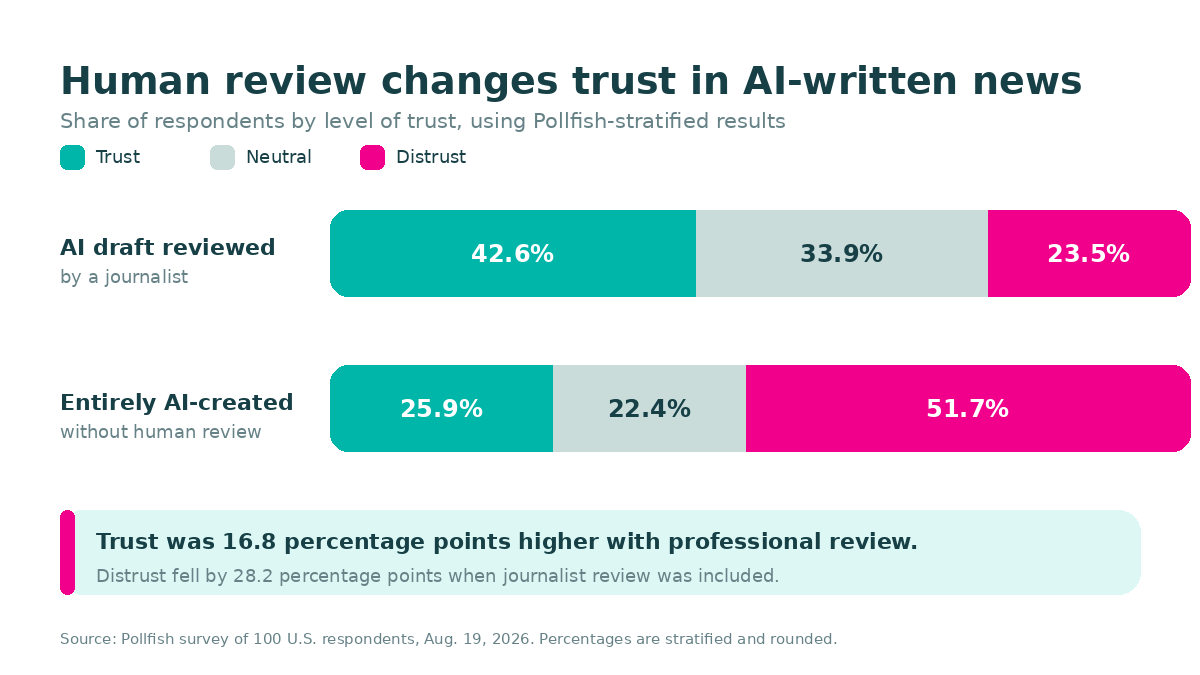
Among 100 U.S. respondents, 43% trusted a journalist-reviewed AI draft, compared with 26% for an entirely AI-created article.

|
Posted: August 20, 2026 | Updated: August 27, 2026 |
A survey of 100 U.S. respondents found a substantial difference in how people assessed AI-assisted news with and without human review. About 43% said they would completely or mostly trust an article drafted by AI and reviewed by a professional journalist, compared with 26% for an article created entirely by AI. Distrust moved in the opposite direction, rising from 24% for a journalist-reviewed draft to 52% for an entirely AI-created article.
Acceptance stops well short of autonomy
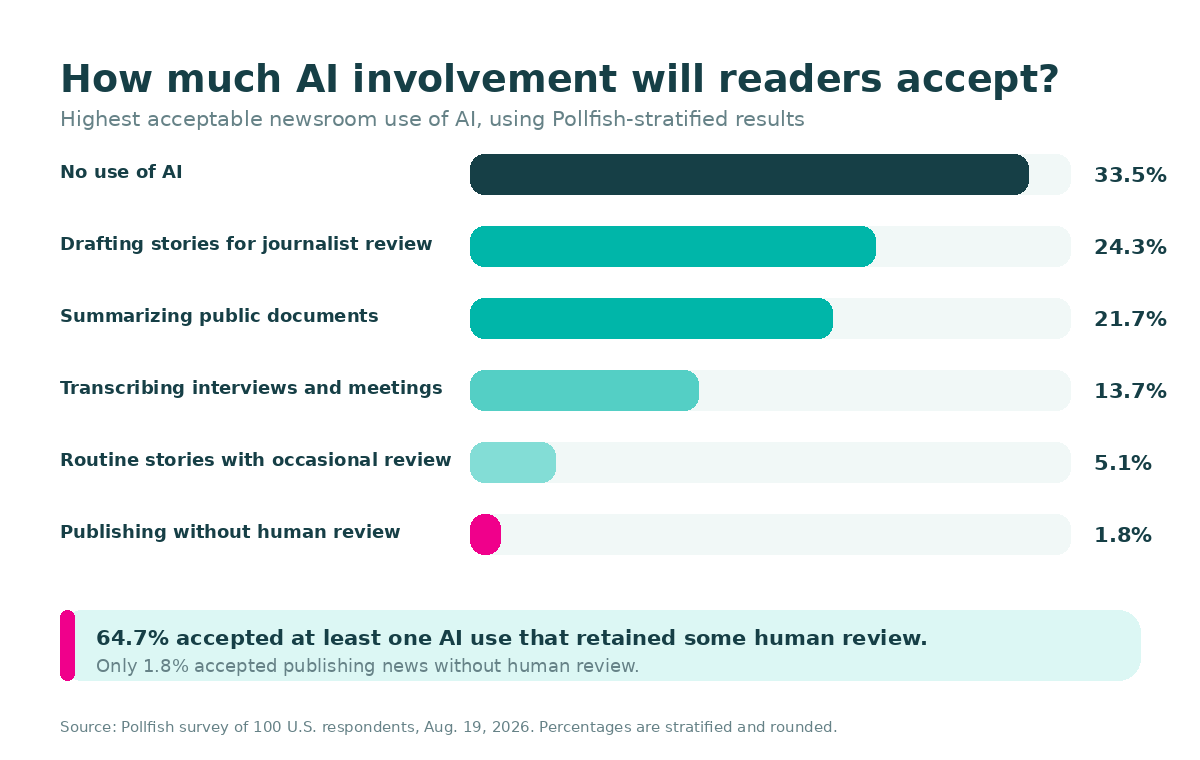
When asked to choose the highest level of newsroom AI they would accept, 33% selected no use of AI.
Another 24% accepted drafting stories for journalist review, 22% selected summarizing public documents and 14% chose transcribing interviews and meetings. Only 5% accepted AI producing routine stories with occasional review, while 2% accepted publishing news without human review.
Taken together, 65% selected at least one use that retained some human review. The results suggest conditional acceptance of newsroom AI, not broad approval for replacing editorial oversight.
No safeguard solved the trust problem alone
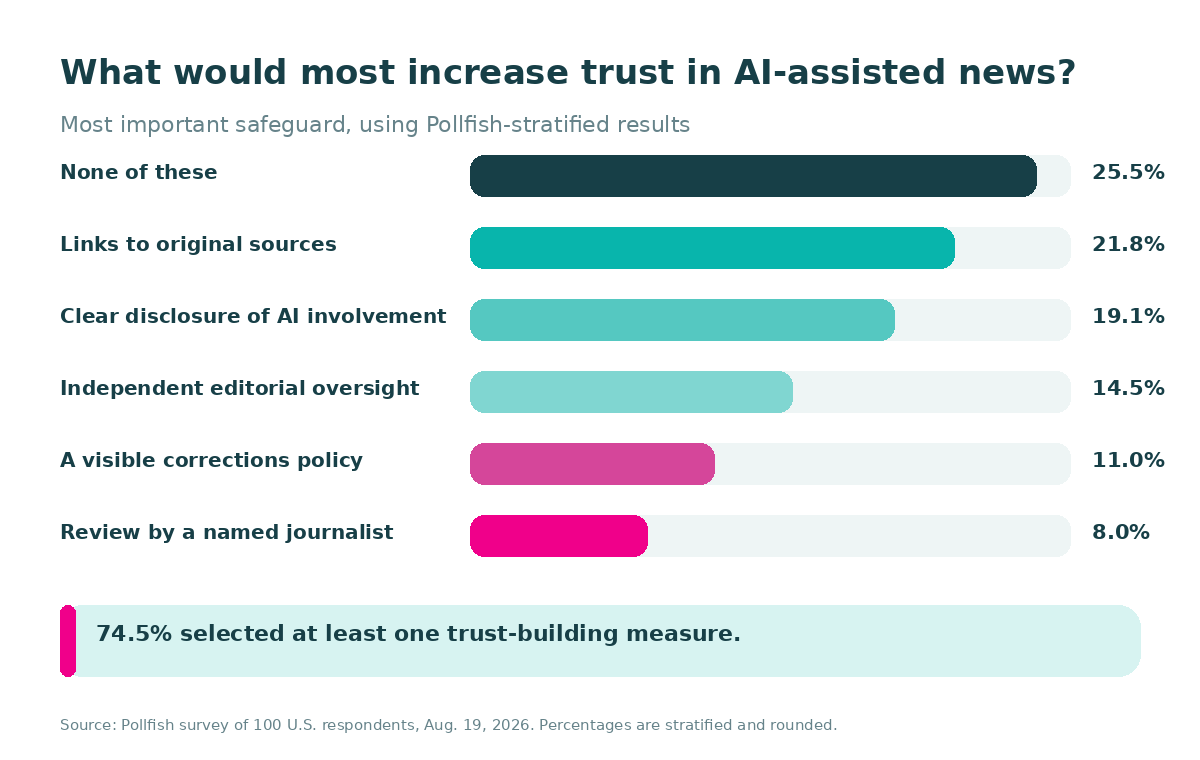
Respondents were also asked which single measure would do the most to increase their trust in AI-assisted news.
About 26% selected none of the listed measures. Links to original sources led the available safeguards at 22%, followed by clear disclosure of AI involvement at 19% and independent editorial oversight at 15%.
A visible corrections policy was selected by 11%, while 8% chose review by a named journalist.
Because respondents could choose only one answer, these results show which safeguard they considered most important. They do not measure total support for each measure.
Local news choices depended on the story
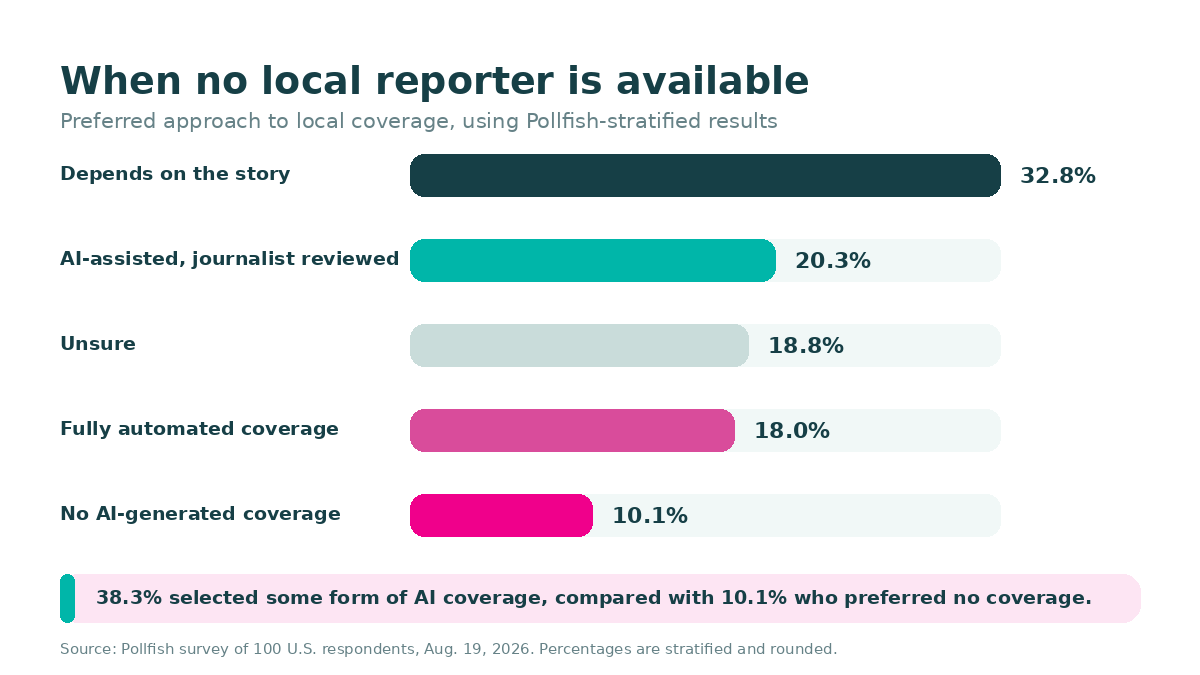
Attitudes shifted when respondents were asked to imagine a community with no local reporter.
About 33% said their preferred approach would depend on the story. Another 20% preferred AI-assisted coverage reviewed by a journalist, while 18% selected fully automated local coverage.
About 19% were unsure. Only 10% said they would prefer no coverage rather than AI-generated coverage.
Overall, 38% selected one of the two AI coverage options. That was nearly four times the share who preferred no coverage, but the largest group still wanted the decision to depend on the type of story.
What the results suggest
The survey did not find broad approval for automated journalism. Instead, it found a narrower opening for AI when journalists remain responsible for reviewing the work and the finished reporting provides readers with transparency and access to original sources.
The contrast between reviewed and unreviewed articles was substantial. Human involvement increased trust, reduced distrust and expanded the range of newsroom tasks respondents were willing to accept.
Survey methodology
The five-question survey was fielded through Pollfish on Aug. 19, 2026, among 100 U.S. respondents.
Results presented here use the post-stratified weights included in the Pollfish export. Pollfish says its U.S. post-stratification generally adjusts age and gender to census benchmarks and may include income when sufficient information is available. The supplied export does not identify the exact variables used to adjust this survey.
Pollfish recruits respondents through opt-in digital experiences. Because this was a small opt-in sample rather than a probability sample, a conventional margin of sampling error is not reported. Weighting can reduce some demographic imbalances, but it does not eliminate potential coverage, nonresponse, wording, order or measurement error.
Percentages in the article are rounded to whole numbers to avoid implying more precision than the survey supports. Charts retain one decimal place from the weighted Pollfish results. Totals may not equal 100% because of rounding.
View the complete survey results and question wording on Pollfish