The Power of Reactive Marketing
How quick thinking and great timing transform cultural moments into momentum.

Posted: January 27, 2026
The Moment Is the Message
Every marketer knows timing can make or break a campaign. You can spend months on creative, research, and media plans, yet still be outshined by a single, perfectly timed post.

Perspective is Key
That is the essence of reactive marketing, even if you have never called it that. It happens when brands do not just advertise, they participate.
Reactive marketing is not a strategy deck or a six-month rollout. It is the art of spotting a cultural spark, acting fast, and doing it in a way that feels so natural to the moment that audiences reward you for it. The cost is minimal. The upside is limitless.
When Speed Outperforms Spend
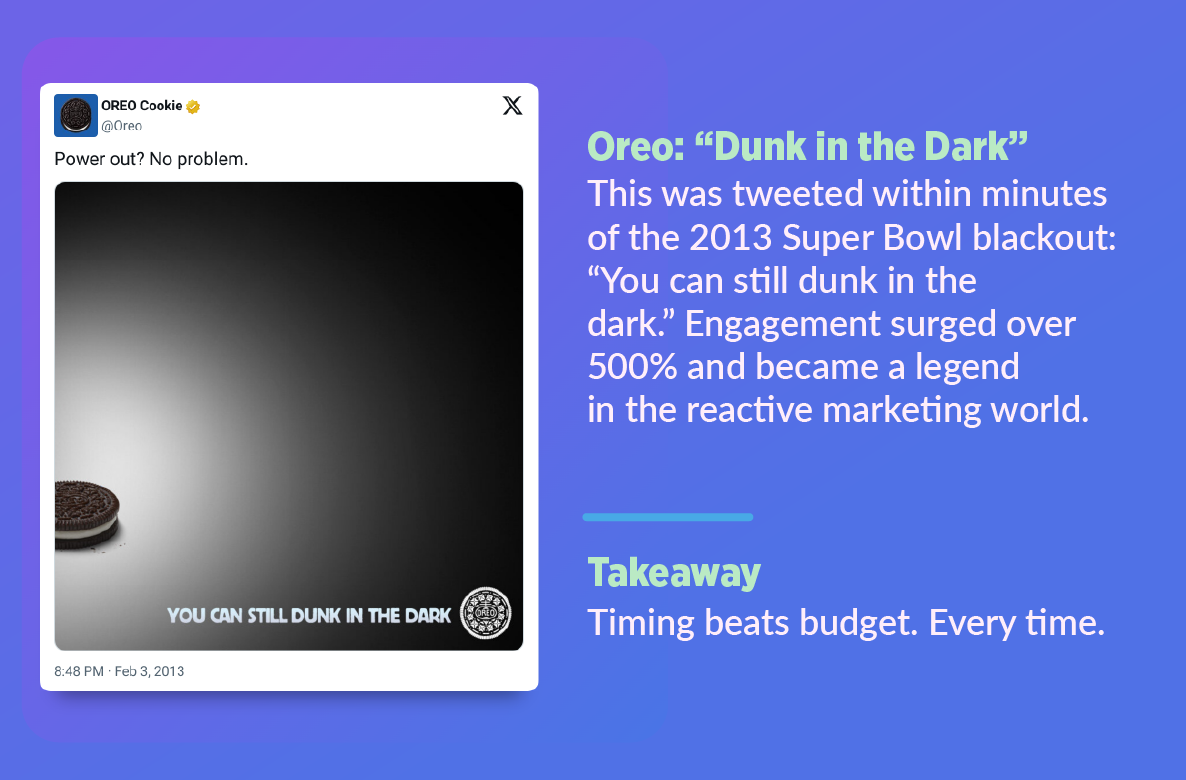
In 2013, at the height of the Super Bowl, the most expensive advertising stage on earth, the lights went out. For 34 minutes, millions of dollars in airtime went dark. That is when Oreo lit up the internet.
While global brands with multimillion-dollar budgets sat in silence, Oreo’s social team recognized an opportunity no media plan could have predicted. Within minutes, they posted a single tweet: “You can still dunk in the dark.”
It was fast, simple, and completely on brand. More importantly, it did what five-million-dollar commercials could not. It captured the conversation. The post drew half a million shares, generated headlines around the world, and instantly became the most talked-about marketing moment of the night.
Oreo did not outspend its competitors. It outpaced them. The brilliance was not only in the copy but in the culture of readiness behind it. The brand had structured itself for speed, with creative, strategy, and approvals all in one room. When the moment arrived, they acted while everyone else was still waiting for a call sheet.
The result redefined what “real-time marketing” meant. Oreo’s post proved that in the attention economy, speed, clarity, and context can outperform production value, planning cycles, and media spend combined.
Quick Thinking, Big Payoffs
Reactive moments now happen daily across industries. Here are a few that mastered the formula.
Ryanair’s Chaos-as-Content Strategy
When flight cancellations filled Twitter with complaints, Ryanair’s social team leaned in, responding to frustrated travelers with self-deprecating humor that went viral. Engagement rose by 65 percent in a single month and the airline proved that acknowledging frustration with wit can drive more goodwill than polished PR.
Duolingo’s Pop-Culture Fluency
When House of the Dragon premiered, the language app released a fake “Learn Valyrian” course. Two million organic impressions later, Duolingo showed how being culturally fluent can turn fandom into funnel activity.
Aviation Gin’s 48-Hour Turnaround
After Peloton's infamous holiday ad drew backlash, Ryan Reynolds' team hired the same actress for a tongue-in-cheek sequel titled "The Gift That Doesn't Give Back." Ten million YouTube views and 1,400 percent more brand mentions later, Aviation proved that empathy and speed can transform another brand's problem into your PR gold.
Specsavers’ Split-Second Sport Spot
During a controversial VAR call at the 2024 UEFA semi-final, Specsavers simply tweeted their iconic line: “Should’ve gone to Specsavers.” Eighty thousand retweets later, they owned the conversation once again, using a brand voice built for timing and restraint.
Guinness – “Welcome Back”
When pubs finally reopened in the United Kingdom after months of lockdown, Guinness did not rush to sell beer. It celebrated the ritual of return. The brand’s ad, composed entirely of black-and-white scenes that resembled a pint, landed exactly as the nation exhaled.


The Math Behind the Buzz
Reactive marketing succeeds because it does not need to buy attention. It joins conversations that already have it.
Campaigns built around trending topics deliver two to four times higher engagement and up to 80 percent lower cost per interaction than scheduled content.
A few of the most famous examples prove the point.
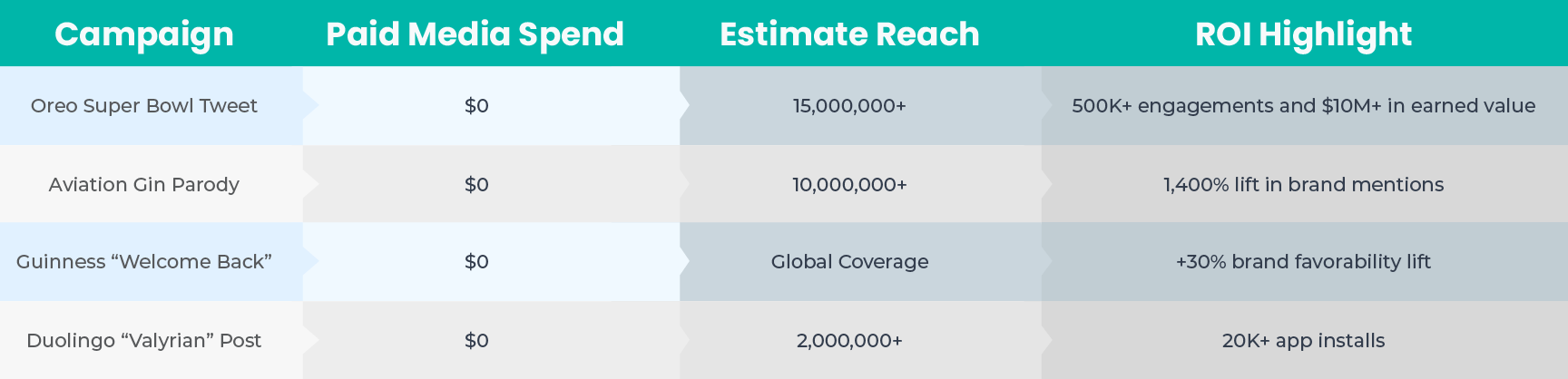
Reactive marketing does not remove costs entirely. Teams, planning, and monitoring all matter. What it does remove is dependency on media spend. These moments outperform paid campaigns not because they are cheaper, but because they are native to attention itself

When the Joke Misses the Room
Every reactive marketer eventually learns that timing without tone is a liability. When brands misread the moment, what should have been clever becomes careless, and the internet never forgets.
Cinnabon’s Carrie Fisher Tribute (2016)
Posted a photo of a cinnamon roll shaped like Princess Leia’s hair the day Fisher passed away. What was meant as a lighthearted nod was received as tone-deaf opportunism. Deleted in under an hour. Lived online forever.
American Apparel’s “Hurricane Sandy Sale” (2012)
Sent an email offering discounts “for those bored during the storm.” The public response was immediate and furious. Using a disaster as a discount hook became a marketing ethics case study overnight.
Kenneth Cole’s “Cairo” Tweet (2011)
During political unrest in Egypt, the designer joked that protests were about the release of his new collection. It sparked international outrage and a swift apology that did not travel nearly as far as the original tweet.
AT&T’s 9/11 Tribute (2013)
A commemorative image featuring a smartphone capturing the memorial lights was intended to be solemn but came off as self-promotional. The backlash reminded brands that not every tribute needs a logo.
Each of these moments had the same flaw. The brand saw attention but not context.
Reactive marketing amplifies empathy as much as cleverness. The difference between a hit and a PR nightmare often comes down to restraint, knowing which moments belong to culture and which deserve silence.
How to Build for Real-Time Wins
▪️Listen first. Track social chatter, search trends, and breaking news continuously. The story finds you when you are tuned in.
▪️Empower judgment. The best teams have autonomy. They do not need three sign-offs to send a tweet.
▪️Stay on-brand. Humor, compassion, irreverence—whatever your tone, consistency prevents backlash.
▪️Preload templates. Speed does not mean sloppy. Having design and copy formats ready lets you move fast and stay polished.
▪️Measure impact. Track engagement, sentiment, and earned value, not just impressions. The best reactive campaigns drive long-term brand lift.

The New Creative Discipline
Reactive marketing is no longer luck. It is a craft. Agencies and in-house teams now maintain real-time listening rooms for live events. Marketers build playbooks for humor, empathy, and timing. Creative directors are as fluent in Reddit as they are in Photoshop.
"
Reactive is not random. It is readiness with rhythm.
The brands winning in 2025 are not simply creating content. They are joining culture in motion. They do not chase relevance, they anticipate it.
How ContentEngine Makes it Possible
That is exactly where ContentEngine fits in. It is built for marketers who understand that opportunity does not wait for a meeting invite.
The platform monitors live data across social, search, and news, surfaces the moments that fit your audience, and drafts brand-ready content instantly.
Instead of reacting late, you will be the one shaping the reaction.