How Reactive and Proactive Marketing Shape the Brands That Win Today
Marketers often debate reactive vs proactive marketing, but the reality is straightforward. The brands that excel are the ones that apply both approaches with intention. Proactive marketing focuses on the long term.

Posted: January 6, 2026

It creates structure for the story a brand wants to tell and keeps the attention on that story through thousands of bits of exposure. Reactive marketing sits in the here and now. It seeks to capture timely opportunities, enter the current discourse, and enables a brand to be a part of the things that their audience cares about in the here and now. Knowing when to use each approach has become a meaningful competitive advantage.
This guide outlines the differences between reactive and proactive marketing, and offers a practical framework for using both effectively within today’s fast moving marketing landscape.
What Reactive Marketing Means Today
Reactive marketing involves responding to events, trends, or cultural moments while they are unfolding. In the past, reactive marketing might have referred to the practice of placing your ads where customers already were, but like the internet itself, the definition has evolved. Today, reactive marketing might take the form of a timely social post during a major sports game, a clever reference to a trending meme, or a quick visual or message that aligns with a topic dominating public conversation. When executed well, reactive marketing feels natural, clever and well timed rather than opportunistic and forced.
"
When executed well, reactive marketing feels natural, clever and well timed
Its effectiveness comes from recognizing a shared moment and reflecting it back through the brand’s voice. Some of the most memorable examples are remarkably simple:
▪️Oreo commenting on the Super Bowl blackout with a reminder that you can still dunk in the dark
▪️IKEA playfully transforming a press conference mishap into a tongue in cheek water bottle
▪️KitKat turning a global Windows outage into a moment to suggest taking a break
Efforts like these resonate because they are delivered promptly, are culturally aware, and stay consistent with the brand’s identity. They create recognition and engagement without relying on heavy production.
What Proactive Marketing Brings to the Table
Proactive marketing operates on a longer timeline. It is structured, strategic, and rooted in planning. It includes campaign calendars, seasonal initiatives, brand storytelling, product launches, and multi channel programs that develop over weeks or months. Proactive marketing is foundational. It builds reputation, clarity, and continuity, ensuring that a brand’s presence remains strong even when the cultural environment becomes quiet or unpredictable.
Where reactive marketing offers immediacy, proactive marketing offers stability. It helps shape the perception of the brand over time, and it provides the consistent message that audiences rely on.
Both forms of marketing support one another. A strong proactive strategy provides the context that allows reactive moments to feel intentional and on brand.
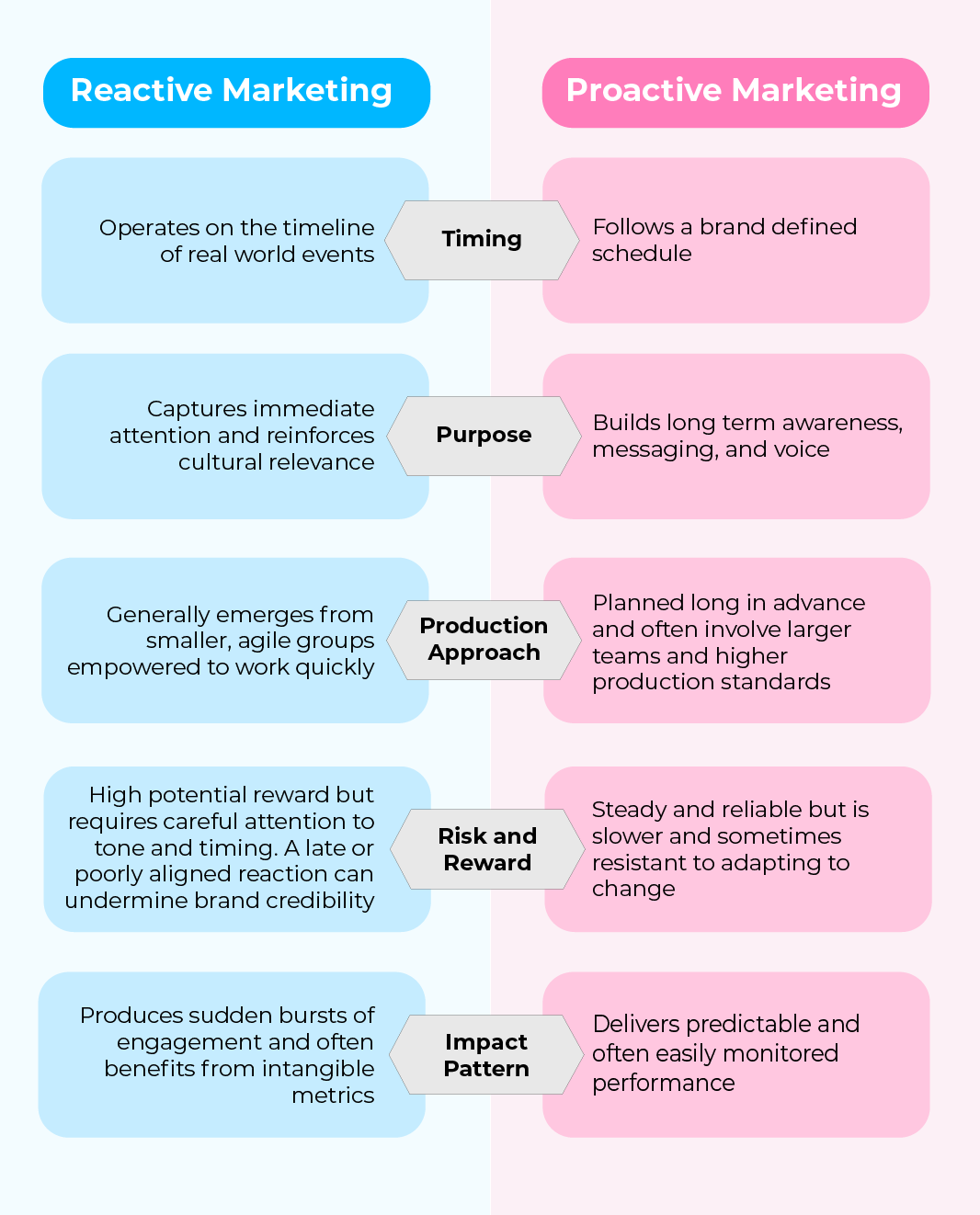
How Reactive and Proactive Marketing Differ
Although both approaches support the same overall strategy, they impact audiences differently.
When Reactive Marketing Works Most Effectively
Reactive marketing performs best when it enhances a moment that already matters to audiences. It is not tied to specific categories such as sports or entertainment, but rather to the underlying conditions that make a reaction meaningful.
It is most effective when:
▪️The brand understands the context of the moment
▪️Timing is aligned with audience interest
▪️The reaction fits the brand’s established voice
▪️The message adds something relevant rather than simply inserting the brand into a trend
The goal is not to always react. The goal is to react with precision and purpose, when it makes the most sense for your brand.
Reactive marketing is not about volume. It is about discernment.
Proactive Marketing is The Bedrock to Build On
Where reactive marketing is all about spontaneity and timing the moment, proactive marketing provides the long term backbone of a marketing campaign. It is the bedrock of all marketing campaigns. It encompasses the long term goals and strategy, the carefully planned out massive campaigns. Its structured and intentional pace make it the perfect foundation for a combined marketing strategy.
▪️Predictable performance and measurable KPIs
▪️Alignment is needed across teams or channels
▪️Campaigns must meet regulatory or brand governance standards
▪️Products or services require education over time
▪️The brand must maintain presence independent of cultural trends
Why Brands Benefit from a Hybrid Approach
The brands that consistently outperform do not choose between proactive and reactive marketing. They integrate the two approaches to reinforce one another. Proactive work sets the foundation and direction. Reactive work provides the energy and immediacy that help a brand feel current.
A hybrid strategy provides:
▪️Reliability along with relevance
Your brand maintains a clear message while responding appropriately to timely developments.
▪️Predictable results with opportunities for standout moments
Foundational campaigns keep performance stable. Reactive content creates spikes that can significantly expand reach.
▪️Agility supported by structure
Your team can move quickly because the strategy beneath them is well defined.
▪️Cultural connection without dilution of brand identity
You remain present in the conversation without compromising your core message.
Imagine a brand executing a long term educational campaign about a new product category. If a cultural discussion emerges that touches directly on that topic, a timely reactive message does more than capture attention. It reinforces the proactive strategy, contextualizes the campaign, and brings additional visibility to the narrative the brand is already telling.
"
Proactive marketing is the steady force that keeps a brand
visible and relevant even when reactive opportunities are limited.
This is the strength of combining both approaches. Reactive marketing gives proactive strategy momentum. Proactive strategy gives reactive efforts meaning.
Great marketing is not defined by choosing between planning and spontaneity. It is defined by the ability to use both well. Brands that succeed are the ones that prepare for the long term while staying attentive to the present, that maintain a steady message but still recognize the value of timely participation. When those two approaches work together, a brand does more than maintain visibility. It builds presence, relevance, and resonance in a way neither strategy can achieve alone.