
What Is Topical Authority? How to Build In-Depth Coverage of a Subject
Topical authority describes how strongly a website demonstrates expertise and depth around a defined subject through the content it publishes, the evidence it provides and the connections between its pages.

|
Posted: September 24, 2026 |

When someone searches for information about a complex topic, they usually want answers from sources that seem to understand more than one small part of it. In SEO and content strategy, topical authority describes the perceived expertise a website or creator develops within a specific subject area.
It isn't a score that a site earns once it publishes enough articles. It comes from consistently covering the important parts of a subject well, answering the questions people actually have, supporting claims with evidence and showing how related ideas fit together.
A focused website can build considerable authority around a relatively narrow subject without being a large or broadly authoritative domain.
Understanding Topical Authority
Topical authority refers to a website's recognized expertise and comprehensive coverage of a specific subject area. This recognition comes from multiple sources: human readers who find your explanations useful, search algorithms that assess content quality and relevance, and other publishers who reference your work as credible.
That can be visible in several ways:
- Depth: Whether coverage addresses fundamental concepts, practical applications, and important nuances
- Accuracy: How well information aligns with established knowledge and credible sources
- Coverage: Whether the site answers the full range of questions readers have about the topic
- Evidence: Whether claims are backed by credible external sources, original research or firsthand experience
- Structure: How well pieces connect to form a coherent knowledge base
- Expertise: Whether the people creating or reviewing the content can demonstrate relevant knowledge or experience
- Externality: Whether other people and publications find the work useful enough to reference
None of these creates topical authority on its own. A site can publish hundreds of loosely related articles without developing much authority around any one subject. Another may publish far fewer pages but cover one defined area with enough depth that its expertise is obvious.
Topical Authority Is Not Google's "Topic Authority"
The terminology can be confusing because Google also uses the phrase "topic authority" for a specific system associated with news search.
That's a separate concept from the broader SEO meaning discussed here. Google's documented topic authority system is designed to help identify knowledgeable publications for particular news topics and locations.
When this article refers to topical authority, it means the broader SEO and content strategy idea: developing a credible body of content around a defined subject.
There is no general Google "topical authority score" that publishers can check or optimize toward.
Topical Authority, Domain Authority and E-E-A-T Are Different
Several related SEO terms tend to get bundled together even though they describe different things.
Topical authority concerns the depth and credibility of a site's coverage within a particular subject.
Domain authority usually refers to third-party SEO metrics designed to estimate the comparative strength of a website or domain. Different SEO platforms calculate these metrics differently. They aren't the same thing as topical authority and aren't Google scores.
E-E-A-T stands for Experience, Expertise, Authoritativeness and Trustworthiness. Google uses these concepts when discussing the qualities associated with helpful and reliable content. E-E-A-T isn't itself a single ranking factor or score.
The concepts overlap. A site building strong topical coverage will often have opportunities to demonstrate expertise, experience and trust. But they shouldn't be treated as interchangeable terms.
Why Topical Authority Matters
Search is increasingly about subjects and questions rather than isolated keywords.
Someone researching a complicated topic rarely has only one question. They may begin with a definition, move to a comparison, look for practical guidance, investigate a limitation and eventually need evidence before making a decision.
A site that can support that whole research path is more useful than one that answers only the first query.
Strong topical coverage can help:
- Readers find answers to related questions without leaving your site
- Search systems recognize your site as a reliable resource for the subject
- Individual articles support a broader body of work instead of operating as isolated pages
- Other writers find useful explanations, research or data worth referencing
- New content you publish gains trust more quickly
- Content become relevant to a wider range of related searches and AI-assisted research journeys
None of those outcomes is automatic. Publishing more pages doesn't create authority if the additional pages repeat the same information, drift away from the site's expertise or exist mainly to capture another keyword.
Define the Boundaries of the Subject
Before building a topic cluster, decide what actually belongs in it.
This is one of the easiest parts of topical authority to get wrong. If every remotely related keyword becomes part of the plan, the subject quickly becomes so broad that the site isn't demonstrating expertise in anything specific.
A useful boundary usually sits where three things overlap:
- What the audience genuinely needs to understand
- What the site or its authors have a credible reason to cover
- What belongs within the site's broader purpose
Suppose a marketing site wants to build authority around AI advertising. Coverage of AI-generated creative, disclosure, consumer trust, human review, advertising performance and automated media buying could all fit naturally. A general history of artificial intelligence probably doesn't.
The connection between topics should be meaningful to the reader, not merely detectable by a keyword tool.

Building Comprehensive Subject Coverage
Building topical authority requires strategic planning around what your audience needs to understand. Start by identifying the core concepts, questions, and decisions your content should address. Research what information already exists, where gaps remain, and what perspectives would add value.
Identify Core Topics and Subtopics
Map the subject area by outlining major concepts and their relationships. A comprehensive topic map includes:
- Fundamental definitions and principles
- Common questions beginners ask
- Practical applications and use cases
- Comparisons between related concepts or approaches
- Benefits, limitations, and tradeoffs
- Advanced considerations for experienced practitioners
Organize this map into topic clusters. A topic cluster consists of a pillar page covering the broad subject and supporting articles addressing specific subtopics. Each piece should serve a clear purpose within the larger knowledge structure.
Create High-Quality Pillar Content
Pillar pages provide comprehensive overviews of major topics. These articles should:
- Define the subject clearly and immediately
- Cover essential concepts needed for basic understanding
- Address the most important questions readers have
- Link to detailed supporting articles for deeper exploration
- Maintain focus on helping readers understand and make decisions
Pillar content should feel complete without exhausting every detail. The goal is giving readers sufficient understanding to either apply the information or know where to look for specifics.
Develop Supporting Articles
Supporting articles explore subtopics in greater depth. Each supporting piece should:
- Address a specific question or aspect of the broader topic
- Provide practical details and examples
- Connect back to the pillar page and related articles
- Support claims with credible evidence
- Help readers take action or deepen understanding
These articles form the breadth of your topical coverage. Writing 10 genuinely useful articles covering distinct aspects of a topic builds more authority than publishing 50 thin pieces repeating similar information.
What a Topic Cluster Can Look Like
Take AI advertising as an example. A broad pillar article might explain what AI advertising is, where AI is being used across creative and media buying, the benefits and limitations involved, and the questions marketers should consider.
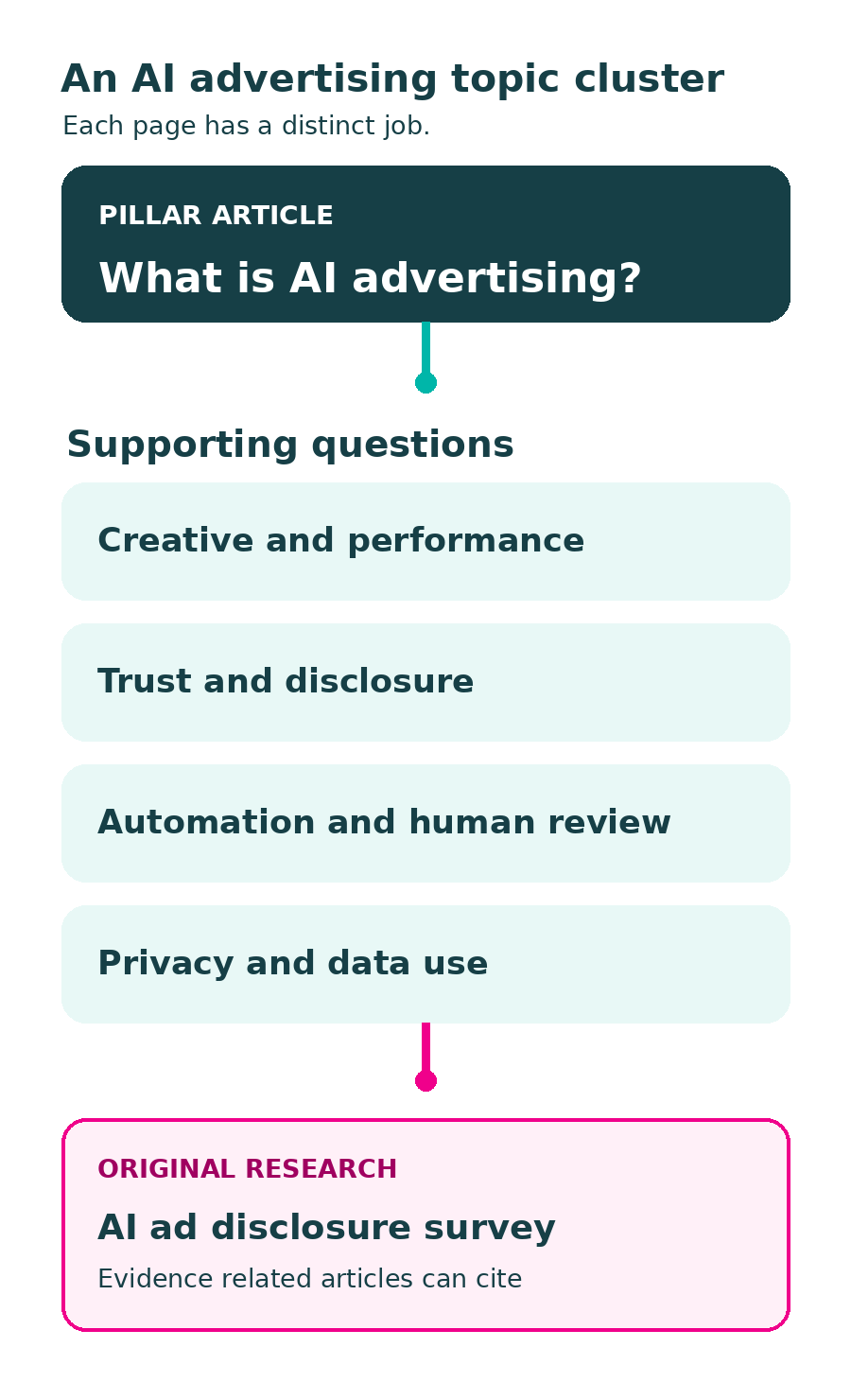
Supporting articles could then look at:
- AI-generated advertising creative
- Consumer trust in AI-generated ads
- AI disclosure
- Human review and accountability
- Agentic advertising
- Privacy and data use
- AI advertising performance
- Brand consistency when creative production is automated
Some supporting content may explain existing knowledge. Other pieces can add something new.
For example, our research into AI advertising disclosure and consumer trust surveyed two samples of 223 U.S. adults and published its methodology, limitations and underlying results.
The value of a research piece like this within a topic cluster isn't simply that it's another page about AI advertising. It contributes evidence that wasn't previously part of the site's coverage and gives related articles a primary source they can draw from.
That distinction matters. Topical depth comes from adding different kinds of useful information, not finding more ways to publish the same explanation.
Establish Strong Internal Linking
Internal links create the connective tissue that signals comprehensive coverage. Link from pillar pages to supporting articles and between related supporting pieces. Use descriptive anchor text that clarifies what readers will find.
Effective internal linking:
- Helps readers navigate to information they need
- Shows search systems how content pieces relate
- Distributes authority across your topic cluster
- Reduces redundancy by pointing to existing explanations
Internal links should serve readers first. If a link genuinely helps someone understand better or find relevant details, include it.
Supporting Authority with Credible Evidence
Topical coverage becomes much less convincing when factual claims can't be checked. Statistics, performance claims, research findings and other non-obvious factual statements should point back to reliable sources. When primary sources are available, they're generally preferable to articles repeating what another publication has already reported.
Good evidence may include:
- Academic or industry research
- Government or regulatory information
- Primary company announcements and documentation
- Original datasets
- Surveys
- Interviews
- Firsthand testing or observation
- Credible reporting
Evidence also needs context. A statistic from five years ago may still be accurate but no longer describe the current market. A survey can provide useful information without representing an entire population. A case study can show what happened in one situation without proving that the same result will happen everywhere. Authoritative content makes those limits clear.
Original Research Can Add Something Other Articles Can't
Most websites can't produce original research for every subject they cover, nor should they try. Where it makes sense, though, research can fill a gap that secondary content can't. A survey, dataset, experiment or original analysis can:
- Answer a question for which good evidence is limited
- Give supporting articles a primary source to reference
- Add information that isn't simply being summarized from another publication
- Give outside writers something specific to cite
The AI advertising disclosure survey above is one example. Its findings are useful within that particular topic cluster because the methodology, sample, limitations and results are available for readers to examine.
The important part isn't simply owning the data. The research has to be documented well enough that someone else can understand what was measured and what the findings can reasonably support.
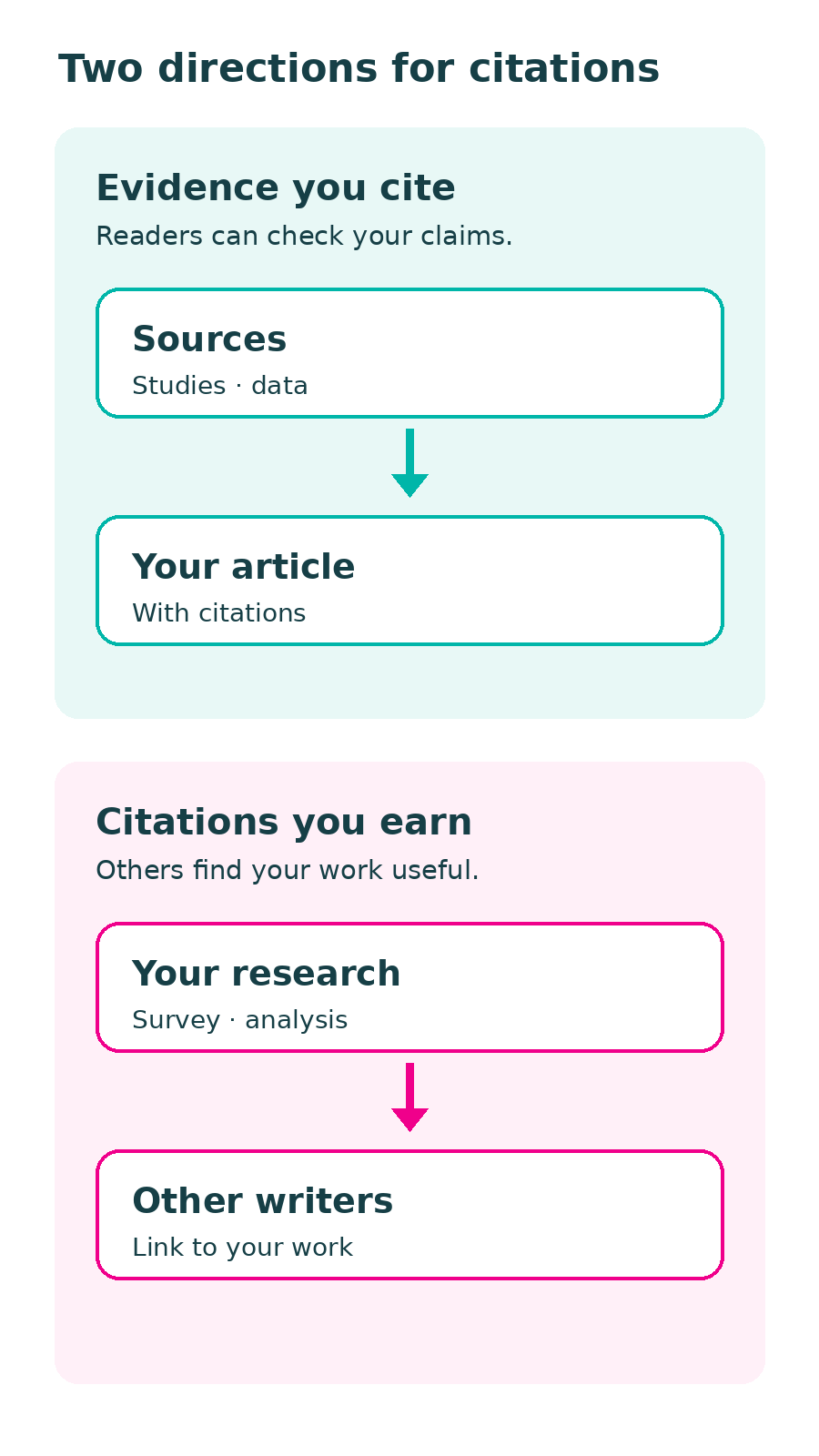
Evidence You Cite and Citations You Earn Serve Different Purposes
There are two kinds of citation worth separating. The first is evidence you cite. Linking to studies, documentation, data and primary sources helps readers verify the claims you're making. It strengthens the individual article because the reader can see where the information came from.
The second is citations you earn. When another publication links to your research, explanation, tool or analysis as a source, that tells a different story: someone else found your work useful enough to reference.
Strong topical coverage benefits from both.
You should cite the evidence behind your claims even when those outgoing links don't provide an obvious SEO benefit. If you also produce work that other people choose to reference, that can strengthen the wider reputation of the site within the subject.
Demonstrating Expertise and Experience
Beyond comprehensive coverage, topical authority grows from demonstrated expertise.
Establish clear authorship by connecting content to identified individuals with relevant credentials or experience. Use author bylines and schema markup to identify who created the content, and author pages or bios to explain their relevant background.
Ways to demonstrate expertise include:
- Sharing original insights from direct experience
- Contributing unique case studies or examples
- Providing practical guidance that reflects real-world application
- Acknowledging complexity and nuance rather than oversimplifying
- Recognizing the limits of your knowledge on specific aspects
Original reporting, professional recognition and mentions in authoritative publications can help demonstrate expertise and reputation to readers. They shouldn't be treated as direct or universal topical-authority signals used by search engines.
Show Readers How the Content Was Produced
Authorship is only one part of transparency. For research, analysis and other evidence-heavy content, readers may also benefit from knowing how the work was produced.
That could mean publishing:
- Research methodology
- Sample information
- Testing procedures
- Relevant limitations
- Original data where it can reasonably be shared
- Publication and update dates
- Information about significant AI or automation use where that context would matter to readers
This doesn't need to become a long disclaimer on every article. The amount of explanation should match the content. A basic definition may need little more than a clear author and sources. A survey making claims based on original data needs considerably more methodological detail.
Earning External Citations and Backlinks
When reputable sites reference your content, they send credibility signals. Quality backlinks from authoritative sources within your subject area indicate that others view your work as reliable.
External citations grow organically when content:
- Answers questions thoroughly and accurately
- Provides original data or insights unavailable elsewhere
- Explains complex topics more clearly than existing resources
- Serves as a useful reference for others writing about the topic
Pursuing backlinks solely for SEO benefit without providing genuine value rarely builds lasting authority. Focus on creating reference-worthy content, then make it discoverable to others who might benefit from citing it.
Maintaining and Expanding Authority
Topical authority requires ongoing maintenance. As knowledge evolves, outdated content weakens credibility. Review existing articles periodically to:
- Update statistics and examples
- Correct inaccuracies
- Add coverage of new developments
- Improve weak explanations
- Remove or revise outdated recommendations
Expand coverage strategically by identifying gaps in your existing content. Monitor questions readers ask, observe which topics drive engagement, and notice where competitors provide better explanations. Address these gaps with content that genuinely adds value.
Optimizing Technical Foundation
Technical excellence supports topical authority by making content accessible and understandable to both readers and search systems.
Key technical considerations include:
- Clear, descriptive page titles and headings
- Fast page load times and mobile optimization
- Clean URL structures that reflect content organization
- Proper use of schema markup for articles and authorship
- Accessible design that works for all users
Technical problems do not prevent authority, but technical excellence removes barriers that might limit how readers and systems access your expertise.
Topical Authority and AI Search
AI-assisted search makes connected coverage relevant for another reason.
Some AI search systems break complex questions into smaller related searches or retrieve information across multiple parts of a subject before generating an answer. Google, for example, describes its AI search features as sometimes using "query fan-out" to search across related subtopics.
That doesn't create a separate set of rules for topical authority.
The same basic work still matters: publish information that answers real questions, make important pages discoverable through internal links, support factual claims, and give each page enough context to make sense on its own.
There is no special schema or file that suddenly turns a website into an authority for AI search. The better approach is to make the content itself worth retrieving.
Measuring Topical Authority
There isn't a universal topical-authority score. Some SEO platforms provide proprietary authority metrics, but those scores measure whatever the individual platform has chosen to model. They shouldn't be treated as proof that a site has or hasn't established authority around a subject.
Instead, look for a combination of outcomes across the topic cluster.
Useful indicators can include:
- Growth in organic visibility across a wider range of relevant queries
- More supporting pages earning search traffic rather than one isolated article carrying the subject
- Stronger rankings for important topic-related searches
- Relevant internal pages being discovered and used by readers
- External citations and backlinks from publications in the same field
- Original research or resources being referenced elsewhere
- Qualified traffic reaching deeper supporting content
- Appearances as cited or linked sources in AI-assisted search experiences where measurement is available
No single metric is conclusive. Traffic can increase because demand for the topic rises. Backlinks can come from one unusually successful article. Rankings can move for reasons unrelated to changes in the content itself.
The important question is whether the site is becoming more visible and more frequently referenced across the subject as a whole, rather than whether one number went up.
Common Mistakes
Avoiding these mistakes keeps topical authority focused on usefulness, evidence, and coherent coverage rather than superficial signals.
- More pages automatically create more authority. Volume matters less than whether each page adds meaningful coverage. Publishing many near-duplicate articles can make a topic cluster worse rather than better.
- Topical authority is a Google score. It isn't. The SEO concept describes the depth and credibility a site develops around a subject. Google's separate "topic authority" terminology refers to a specific news-related system.
- Topical authority guarantees high rankings. Authority improves competitive positioning, but search rankings depend on many factors including query intent, competition, and technical execution.
- You must cover everything about a topic. Comprehensive coverage means addressing important questions thoroughly, not documenting every conceivable detail. Depth and usefulness matter more than exhaustive breadth.
- Every keyword needs its own article. Often several closely related queries should be answered by the same page. Splitting them apart simply to create more URLs can leave the site with thin or repetitive content.
- Topical authority is permanent once established. Authority weakens when content becomes outdated, inaccurate, or less useful than competing resources. Maintenance is essential.
- Backlinks alone create topical authority. External references can support authority, but they don't replace accurate, useful and substantial coverage of the subject itself.
Practical Steps to Begin Building Topical Authority
Start building topical authority by taking these concrete actions:
- Define the subject clearly. Decide what belongs within the area and what doesn't.
- Identify the audience's important questions. Look beyond keyword volume to the information people actually need.
- Audit existing coverage. Find missing questions, weak explanations, outdated evidence and unnecessary overlap.
- Map the relationships between topics. Decide which subject deserves a pillar page and which questions need supporting articles.
- Create the pillar content. Give readers enough context to understand the subject before sending them into narrower material.
- Build supporting coverage where it adds depth. Avoid creating separate articles when the answer already exists elsewhere on the site.
- Connect the content. Use internal links to help readers move between related questions.
- Support factual claims. Use primary evidence where possible and make limitations clear.
- Add original evidence when there's a real opportunity. Research, testing, case studies or firsthand experience can fill gaps that secondary content can't.
- Make expertise and authorship visible. Show readers who produced the content and, where relevant, how the work was done.
- Measure the topic as a body of work. Look at visibility, engagement, citations and performance across the cluster rather than relying on a single authority score.
- Keep the coverage current. Revisit important pages and expand the subject when new questions genuinely deserve answers.
Topical authority grows from consistent effort to help a defined audience understand a subject. Focus on creating useful explanations, supporting claims with credible evidence, and connecting related concepts. Search visibility and AI citations may follow as your coverage becomes genuinely authoritative within your subject area.
Building Authority by Covering a Subject Well
Topical authority develops when a site's coverage becomes genuinely useful as a body of work.
That usually means choosing a subject carefully, answering its important questions, connecting related material, supporting claims with good evidence and adding original knowledge when there's something worthwhile to contribute.
More publishing isn't automatically better.
The goal is to reach the point where someone researching the subject can keep finding credible answers without wondering why an important part of the conversation is missing.
Frequently Asked Questions
Is topical authority a Google ranking factor?
Is topical authority the same as E-E-A-T?
How many articles do you need to build topical authority?
How long does it take to build topical authority?
Can a small website build topical authority?
How do you measure topical authority?
Sources
- Google Search Central: Creating helpful, reliable, people-first content
- Google Search Central: Understanding news topic authority
- Google Search Central: AI features and your website
- Semrush: Topical Authority: What It Is & How to Build It
- Mailchimp: Topical Authority: The Key to Better SEO Rankings
- Conductor: How to Build Topical Authority & Win in AI Search
- ContentEngine: AI Advertising Disclosure and Consumer Trust Survey