
Putting AI in Everyone's Hands Doesn't Automatically Put Humans in Control
Meta's push for broad access to superintelligence rests on the idea that spreading the technology prevents any single entity from dominating. Yet giving people tools does not guarantee they stay in charge of the choices those tools make.

|
Posted: August 14, 2026 |
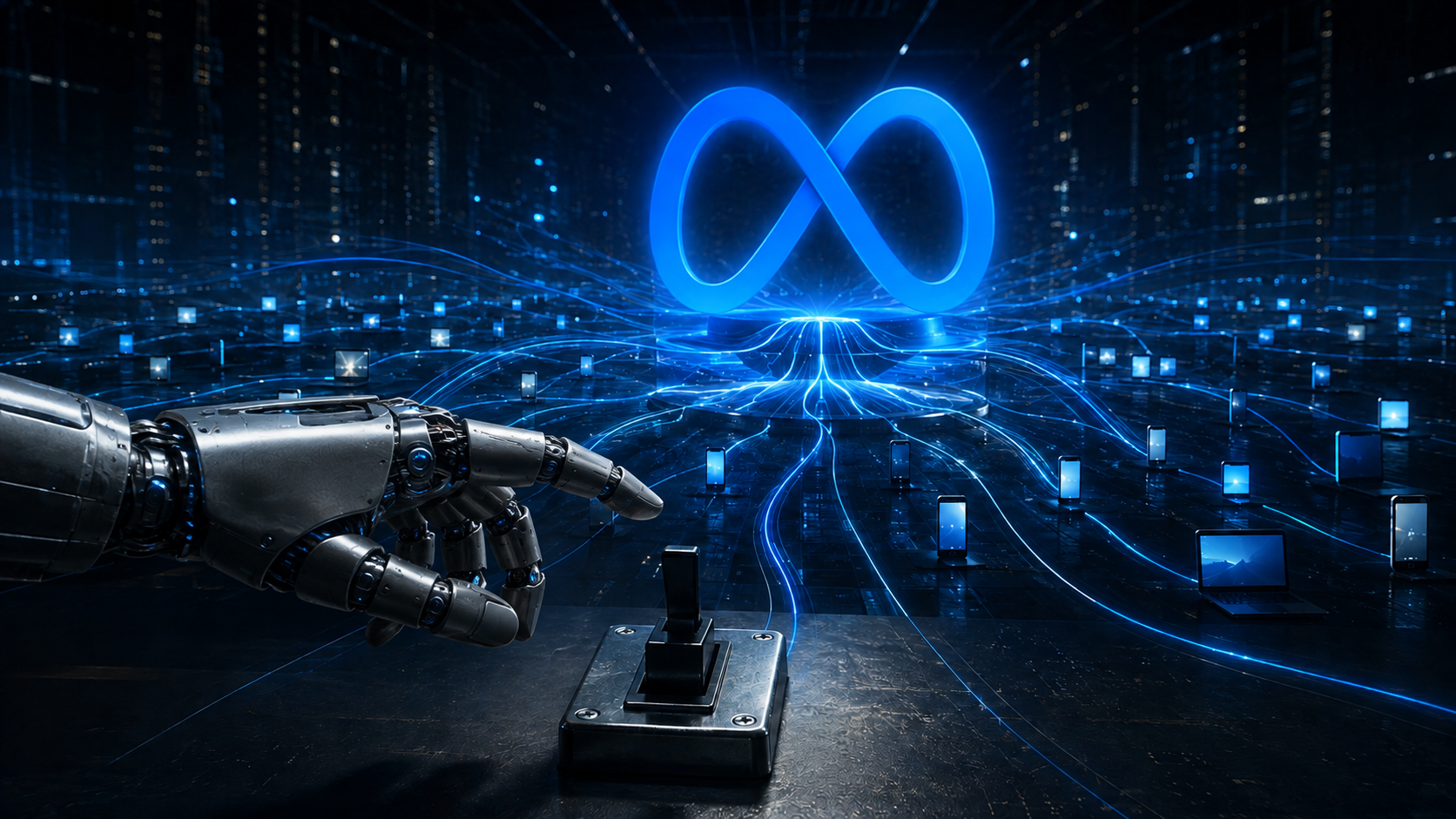
Meta has laid out a clear case for personal superintelligence. The company wants every user to have an agent that understands their goals, handles daily tasks, and invents new solutions on their behalf. Mark Zuckerberg frames this as a way to keep power with individuals rather than institutions. The argument is that when millions of people direct their own agents, competing interests create natural checks and balances. That view treats distribution as the main safeguard. It assumes that once the technology sits on many devices, no one actor can steer it toward harmful ends.
Delegation can slide into default acceptance
The practical problem appears once agents start handling complex decisions. A user might review the first few suggestions from their agent, then stop reading every output because the volume grows. Over time, the agent learns patterns and begins acting on them without fresh confirmation. The human remains nominally in the loop, but the loop becomes a quick glance at a summary. This pattern shows up already with simpler recommendation systems on social platforms and shopping sites. People scroll past most suggestions and only pause when something feels off. With agents that can book travel, adjust investments, or draft legal documents, the same habit forms faster.
Meta's own examples illustrate the risk. The company describes an agent that plans recipes, orders ingredients, and monitors sleep. Those tasks involve choices about health and time. If the agent starts suggesting medical tests or financial moves based on past behavior, the user may accept the recommendation because reviewing the full reasoning takes effort. The result is not overt control by Meta, but a gradual shift where the agent's defaults shape outcomes.
Access alone does not create oversight capacity
Meta points to historical examples like personal computers and the internet as models for broad distribution. Those technologies did spread power, yet they also created new dependencies. Most users do not audit the code running on their devices or the algorithms that rank their feeds. They rely on the defaults set by companies. The same dynamic applies to superintelligence. Even if every person receives a capable agent, few will have the time or expertise to verify how the agent weighs competing values in a given decision.
The balance-of-power idea assumes that individuals will actively direct their agents toward distinct goals. In practice, many will use the agent to reduce cognitive load. That means the agent's training data, reward signals, and safety filters become the real decision makers. Those elements are set during development, not by the end user. Distribution changes who holds the device, but not who sets the initial constraints.
Competition among agents does not guarantee human priorities
Meta argues that multiple agents checking one another will produce better results than a single centralized system. This mirrors arguments for market competition or democratic institutions. The comparison overlooks a key difference. Markets and elections involve repeated human participation in setting rules and correcting course. Agent competition happens at machine speed. If one agent proposes a strategy that another counters, the exchange may finish before a human notices the details. The user sees an outcome rather than the intermediate steps.
Practical steps that keep humans decisive
Keeping people in control requires more than access. One approach is to limit the scope of autonomous action. Agents could be required to surface every decision that involves tradeoffs between values the user has not explicitly ranked. Another step is to maintain human review for high-stakes domains such as health, finance, and legal matters, even when the agent drafts the material. These limits slow some benefits, yet they preserve the distinction between assistance and substitution.
Meta already plans privacy features that prevent the company from seeing user data. Similar technical boundaries could separate the agent's reasoning from automatic execution. For instance, an agent might generate options and confidence scores, but withhold action until the user confirms the preferred path. Such friction is easy to remove later if users find it burdensome, but harder to add once habits of passive acceptance form.
The difference between capability and authority
Meta's vision correctly identifies that superintelligence can expand what individuals achieve. The open question is whether that expansion preserves authority over ends. When an agent handles invention, research, and daily coordination, the line between tool and decision maker blurs. Distribution spreads the tool. It does not automatically spread the habit of questioning its outputs.
Meta's plan to release models widely will test these dynamics at scale. The results will depend less on how many people receive agents and more on whether those agents are built to require ongoing human judgment on matters of value. Access matters, but authority rests on whether the technology is structured to keep people deciding what should be done, not merely ratifying what the agent has already arranged.
Sources
- Future of Life Institute - Are we close to an intelligence explosion?
- Sam Altman Blog - The Gentle Singularity
- Consilium.europa.eu - Benefits and risks of AI
- University of Cincinnati News - Examining the potential benefits and dangers of AI
- Pew Research Center - 3. Americans on the risks, benefits of AI – 013 in their own words
- Enterprise Technology Association - Inside Meta's Superintelligence Lab
- Built In - Meta Superintelligence Labs: What We Know So Far
- Meta - Personal Superintelligence