
Survey: The Impact of AI Responses on Search Behavior and Satisfaction
A September 2026 survey of 100 U.S. respondents reveals that users are incorporating AI summaries and chatbots into their search routines while maintaining strong preferences for access to underlying sources and human-written content.

|
Posted: September 15, 2026 | Updated: September 17, 2026 |
The rise of AI-generated search responses has sparked urgent questions about the future of digital discovery. Will users abandon traditional search results for algorithmic summaries? Do they trust machine-generated answers enough to skip website visits entirely? A ContentEngine survey fielded on September 14, 2026, offers clear evidence that the transformation underway is more nuanced than simple displacement. While AI summaries command substantial attention and chatbots have entered research workflows, the dominant pattern in this 100-respondent sample is hybrid use rather than wholesale replacement. The results matter deeply to digital marketers because they suggest that website traffic, source credibility, and access to detailed content remain central to user expectations even as AI tools reshape the search interface.
AI Summaries Attract Attention Without Eliminating Clicks
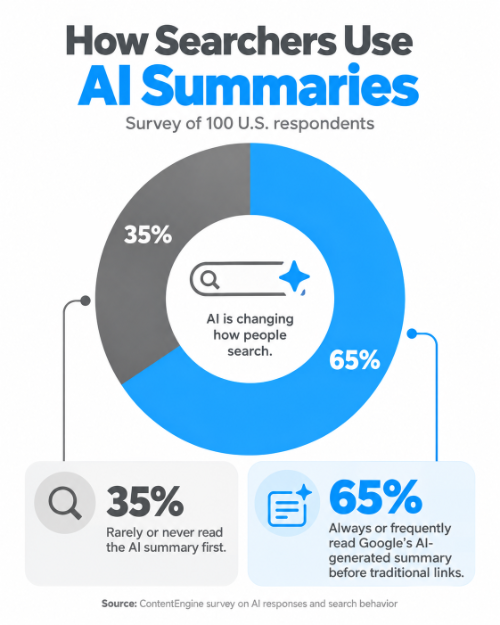
The survey establishes that AI-generated summaries have become a routine first stop for most respondents. Sixty-five percent report always or frequently reading Google's AI-generated summary before looking at traditional links. Twenty-six percent say it is the first thing they look at, and another 39 percent use it to decide whether they need to scroll down. The stratified estimate, which adjusts for sample composition, confirms this pattern at 65.9 percent.
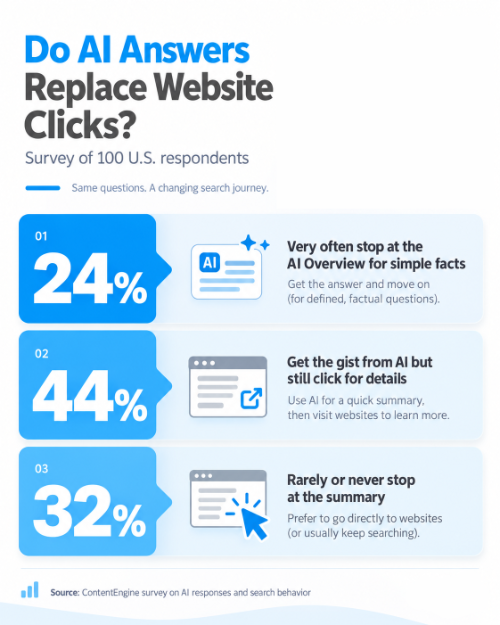
This high engagement might suggest that AI summaries are drawing users away from websites. The reality is more complicated. When asked how often an AI Overview removes the need to visit a website, only 24 percent select "very often," describing themselves as rarely clicking websites for simple facts anymore. The largest group, at 44 percent, reports getting the gist from AI but still clicking for details. Another 21 percent rarely find the summary sufficient and almost always click a link to verify information, while 11 percent never trust the summary enough to stop searching.
The 44 percent who get the gist and still click represent a critical insight for marketers. These users are not bypassing websites; they are using AI summaries as a filtering mechanism before engaging with sources. The survey also cannot measure actual traffic changes or the proportion of searches ending without a click. It records respondents' self-reported frequency judgments, not search logs or click-through rates. The data therefore resist the conclusion that two-thirds of users no longer visit websites. Instead, they point toward a layered search process in which summaries serve as a starting point rather than a final destination for many users.
Trust Remains Limited and Conditional
Trust in AI-generated responses is far from universal. When asked how much they trust AI-generated search responses, 40 percent say they trust them about the same as a standard website. This represents the single largest response category and establishes parity with ordinary web content as the modal position. Combining response categories reveals that 35 percent express skepticism or no trust, compared with 25 percent who trust AI responses more than standard websites or trust them completely. The stratified estimates shift these figures slightly to 34.5 percent skeptical and 29.0 percent expressing higher or complete trust, but the overall pattern holds.
The survey also documents a strong association between trust and usage patterns. Among the 25 respondents selecting higher or complete trust, 24-or 96.0 percent-always or frequently read AI summaries first. Among the 35 expressing skepticism or no trust, 11-or 31.4 percent-do so. This means that nearly one-third of skeptical respondents still engage with AI summaries regularly, suggesting that utility can override wariness for certain tasks or that users read summaries while maintaining reservations about their accuracy.
For digital marketers, these trust figures carry practical implications. AI summaries are not yet regarded as authoritative replacements for credible websites. The plurality of respondents assign them roughly the same trust as any other online source, and more than one-third remain actively skeptical. This creates ongoing demand for verification, detailed information, and trusted brand sources. Marketing strategies that emphasize expertise, transparency, and depth can leverage this persistent skepticism. Content that serves as the detailed destination after an AI summary can capture users who want confirmation or context beyond what a synthesized answer provides.
Chatbots Enter Research Workflows Without Dominating Them
The survey asked whether respondents have shifted complex research toward AI chatbots such as ChatGPT, Gemini, or Perplexity. Sixty-nine percent report at least some use of chatbots for this purpose. The stratified estimate rises to 72.1 percent. This is a substantial majority and indicates that chatbots have entered mainstream research behavior within this sample. However, the distribution of usage intensity reveals that chatbots complement rather than replace traditional search.
Only 9 percent make AI chatbots their primary research starting point. The largest group, at 40 percent, uses traditional search and AI chatbots equally. Another 20 percent primarily use Google but occasionally check an AI chatbot. Combining these categories, 60 percent describe an explicitly mixed approach that preserves a central role for conventional search engines. Thirty-one percent rely exclusively on traditional search-engine results.
These figures mean that the 69 percent reporting chatbot use should not be interpreted as 69 percent abandoning Google or other search engines. Instead, chatbots appear to function as supplementary tools for certain tasks, used in parallel with or as a follow-up to traditional search. The survey does not isolate which chatbot platforms respondents use, what types of complex research prompt chatbot use, or how often chatbots deliver satisfactory answers. It documents adoption without measuring displacement.
For marketers, the implication is that visibility in both traditional search results and potential chatbot training data matters. Users who research complex topics may consult multiple sources and formats. Content that ranks well in conventional search and also appears in high-quality, authoritative contexts stands the best chance of reaching users across their hybrid research workflows. The relatively small proportion of chatbot-first researchers also means that traditional search optimization remains essential rather than optional.
Query Length Is Shifting for a Substantial Minority
When asked how typical search-query length has changed over the past 18 months, 19 percent of respondents report significantly longer queries, describing full sentences or questions. Another 23 percent report slightly longer queries, using three or four words instead of one or two. Combining these groups, 42 percent say their queries have become longer. Forty-five percent report no change, and 13 percent say their queries have become shorter.
The stratified estimate increases the longer-query share to 49.0 percent, nearly reaching a majority. This is one of the findings most affected by sample adjustment, highlighting the difference between raw respondent counts and weighted estimates. Even with adjustment, the appropriate interpretation is that about half of respondents perceive an increase in query length, rather than a clear majority shift.
The survey also establishes a link between longer queries and satisfaction. Among the 42 respondents reporting longer queries over the past 18 months, 34-or 81.0 percent-express positive satisfaction with searches containing five or more words. Among the 58 whose queries stayed the same or became shorter, 34-or 58.6 percent-select a positive response. This 22.3-percentage-point difference within the sample suggests that those adopting longer queries find them useful, though the survey cannot prove that lengthening a query caused better results.
When asked directly about satisfaction with longer, more specific searches, 34 percent say they are much more satisfied and find exactly what they need faster. Another 34 percent are somewhat satisfied, noting relevant results but sometimes clutter. Combining these categories, 68 percent express positive satisfaction with searches of five or more words. The stratified estimate is 70.9 percent. Only 6 percent report dissatisfaction, saying too many words seem to confuse the search engine.
These findings matter to marketers because they indicate that a meaningful portion of users are searching with greater specificity. Content optimized for long-tail queries and natural-language questions can capture this segment. However, the substantial share reporting no change in query length-45 percent unweighted-also means that keyword-focused optimization remains relevant. The survey separately asked whether keywords or conversational questions are more effective. The leading response, at 47 percent, is that effectiveness depends entirely on the topic's complexity. Only 28 percent favor conversational questions, and 25 percent favor specific keywords. The pattern is one of diversification rather than uniform conversion to conversational search.
The Preferred Future Preserves Links and Human Authorship
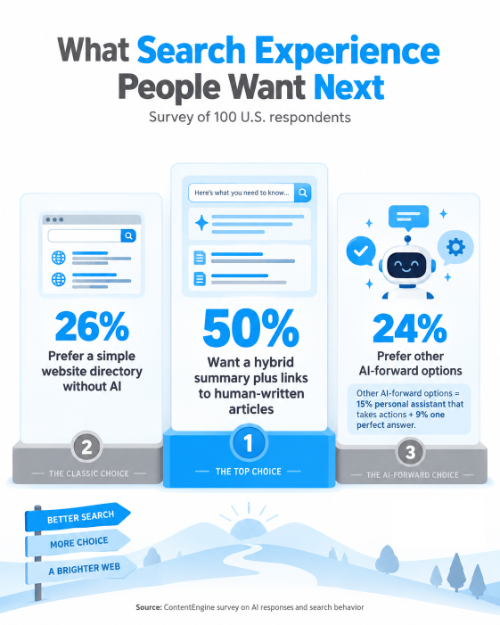
The survey presented four options for the future of search and asked respondents to select their preferred experience. Exactly 50 percent choose a hybrid experience: a summary that still prioritizes links to human-written articles. The stratified estimate increases this preference to 55.6 percent, making it a clear majority. Twenty-six percent prefer a simple website directory without AI interference. Fifteen percent want a personal assistant that takes actions such as booking a flight, and 9 percent favor a computer that provides one perfect answer.
Combining the hybrid and website-directory preferences, 76 percent-or 77.9 percent stratified-choose options that explicitly preserve a central role for website links. These are not identical visions. The directory preference implies rejection of AI involvement, while the hybrid model embraces summaries alongside links. Nevertheless, both options maintain pathways to underlying sources and human-created content.
The cross-tabulation between AI-summary reading and future preference reveals an important nuance. Among the 65 respondents who always or frequently read AI summaries first, 42-or 64.6 percent-prefer the hybrid future with links to human-written articles. Among the 35 who rarely or never read summaries first, only 8-or 22.9 percent-prefer that option. This means that even frequent AI-summary users favor continued access to articles. Engaging with AI does not imply wanting websites to disappear.
For digital marketers, this is perhaps the most consequential finding in the survey. The audience for AI-enhanced search remains an audience that values access to detailed, human-authored content. The hybrid model aligns with user expectations better than a vision of search as a single-answer oracle. Marketers should therefore focus on strategies that make their content both summary-compatible and compelling as a click destination. Structured data, clear value propositions, and content depth all become more important when users can preview a summary and then decide whether to visit the source.
Demographic Patterns and Limitations
The survey documents some variation by age within the sample. Among respondents aged 18 to 34, 56.7 percent report longer queries over the past 18 months, compared with 34.0 percent of those aged 35 to 54 and 39.1 percent of those aged 55 to 62. The youngest group is also the most likely to prefer the hybrid future, at 63.3 percent, while the oldest group shows the highest preference for a website directory without AI, at 39.1 percent. However, chatbot use does not decline linearly with age. Among the oldest group, 73.9 percent report at least occasional chatbot use for complex research, compared with 57.4 percent in the middle age group. This contradicts a simple narrative of younger users driving all AI adoption.
Gender differences in the sample are modest for most measures. Frequent AI-summary reading is nearly identical: 64.3 percent of women and 65.9 percent of men. Higher or complete trust is reported by 19.6 percent of women and 31.8 percent of men, a difference that should not be generalized beyond this sample without additional evidence.
The survey carries important limitations that constrain interpretation. The sample consists of 100 respondents, all from the United States, with ages ranging only from 18 to 62. Fifty-three percent are from the South, and the export does not document the recruitment process, sampling frame, or weighting methodology. It is therefore inappropriate to generalize these findings to all Americans, all adults, or all internet users. The results describe this sample and suggest hypotheses for further research rather than establishing population-level facts.
The survey also measures self-reported perceptions at a single point in time. It does not include search logs, click data, or historical records. It cannot establish actual traffic changes, measure objective answer quality, or isolate causal effects of AI features on behavior. Some question designs combine multiple concepts, such as mixing frequency with reasons for clicking or bundling AI summaries with links and human authorship in the hybrid-future option. These features limit the precision of interpretation but do not invalidate the observed patterns.
Strategic Implications for Digital Marketers
The survey results resist the conclusion that AI-generated search responses are eliminating the need for websites or that users have transferred their trust and attention away from human-created content. Instead, they point toward an emerging search environment in which AI summaries function as a layer between the query and the click rather than as a replacement for the destination. Users engage with summaries, but most still want access to sources. They adopt chatbots for research, but typically in combination with traditional search. They experiment with longer queries when those queries deliver better results, but they have not abandoned keywords.
For marketers, this environment demands dual optimization. Content must be structured and authoritative enough to inform AI summaries while remaining compelling enough to attract clicks from users who want more than a synthesized answer. The survey shows that trust in AI responses remains conditional and that even frequent users prefer a future in which links to human-written articles stay prominent. This creates ongoing opportunities for brands that invest in depth, credibility, and user value.
The preference for hybrid search also suggests that visibility alone is insufficient. If half or more of users read an AI summary before deciding whether to scroll, then the summary itself becomes part of the brand-exposure pathway. Marketers must consider how their content is represented in those summaries and whether the summary creates sufficient interest to drive a click. The 44 percent who get the gist from AI but still click for details represent a segment that values both efficiency and thoroughness. Content that promises and delivers additional insight beyond what a summary can provide will capture that segment.
Finally, the limited trust in AI responses and the meaningful minority that prefers a directory without AI interference underscore the continued value of brand reputation and direct relationships. Users who are skeptical of algorithmic answers will seek out sources they recognize and trust. Marketers who build authority and maintain direct channels to their audiences position themselves to benefit from this skepticism. The transformation of search is real, but it is not a wholesale migration away from the websites, brands, and content that users have relied on. It is a reconfiguration in which AI summaries coexist with traditional results, and user expectations include both synthesis and access to underlying sources.
The ContentEngine survey captures a moment of transition rather than a final state. The patterns it documents-high engagement with AI summaries, conditional trust, hybrid research workflows, and strong preference for continued access to human-written content-define the current landscape for digital marketers. Success in this environment requires understanding that AI integration does not mean AI replacement and that users value both the efficiency of summaries and the depth of destinations. The challenge for marketers is to remain visible and valuable in both contexts.
Source: September 14, 2026 Survey on The Impact of AI on Search Behavior