
Your Brand’s Fast Reaction Isn’t Impressing Anyone: Two-Thirds Prefer a Post That Adds Value
U.S. adults prioritize relevance and value when evaluating company participation in current events, with clear boundaries emerging around different types of topics and posting behaviors.

|
Posted: September 30, 2026 | Updated: October 1, 2026 |

A September 2026 survey of 250 U.S. adults ages 18 to 64 examined public expectations for company participation in trending topics and current events. Conducted through Pollfish on September 29, 2026, the survey used post-stratified respondent weights to approximate the U.S. adult population within that age range. The weighted mean respondent age was 40.8 years. A weighted 96.2% of respondents reported using social media at least weekly. All percentages presented reflect weighted results unless otherwise noted.
Key Findings: When Brands Join the Conversation, Value Beats Speed
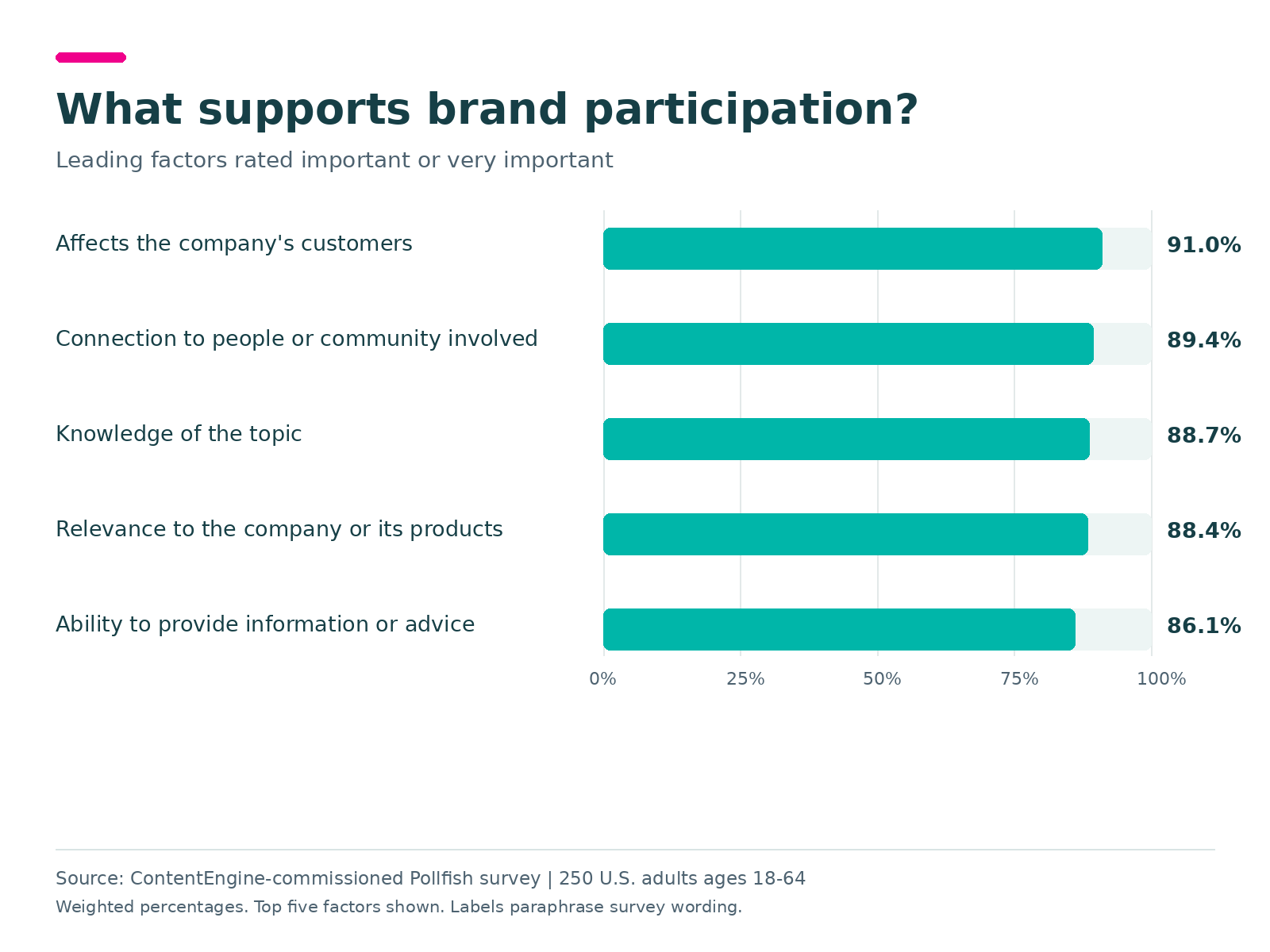
- Customer relevance was the most widely supported consideration. 91.0% said it was important or very important that a trending topic affects a company’s customers. A real connection to the people or community involved (89.4%), topic knowledge (88.7%), direct relevance to the company or its products (88.4%), and the ability to provide useful information or advice (86.1%) also received broad support.
- Industry and community conversations received the broadest acceptance. 91.4% considered company participation in industry developments appropriate or very appropriate, and 89.3% said the same about local community events. Political events (51.4%) and internet jokes or memes (50.8%) produced much more divided responses.
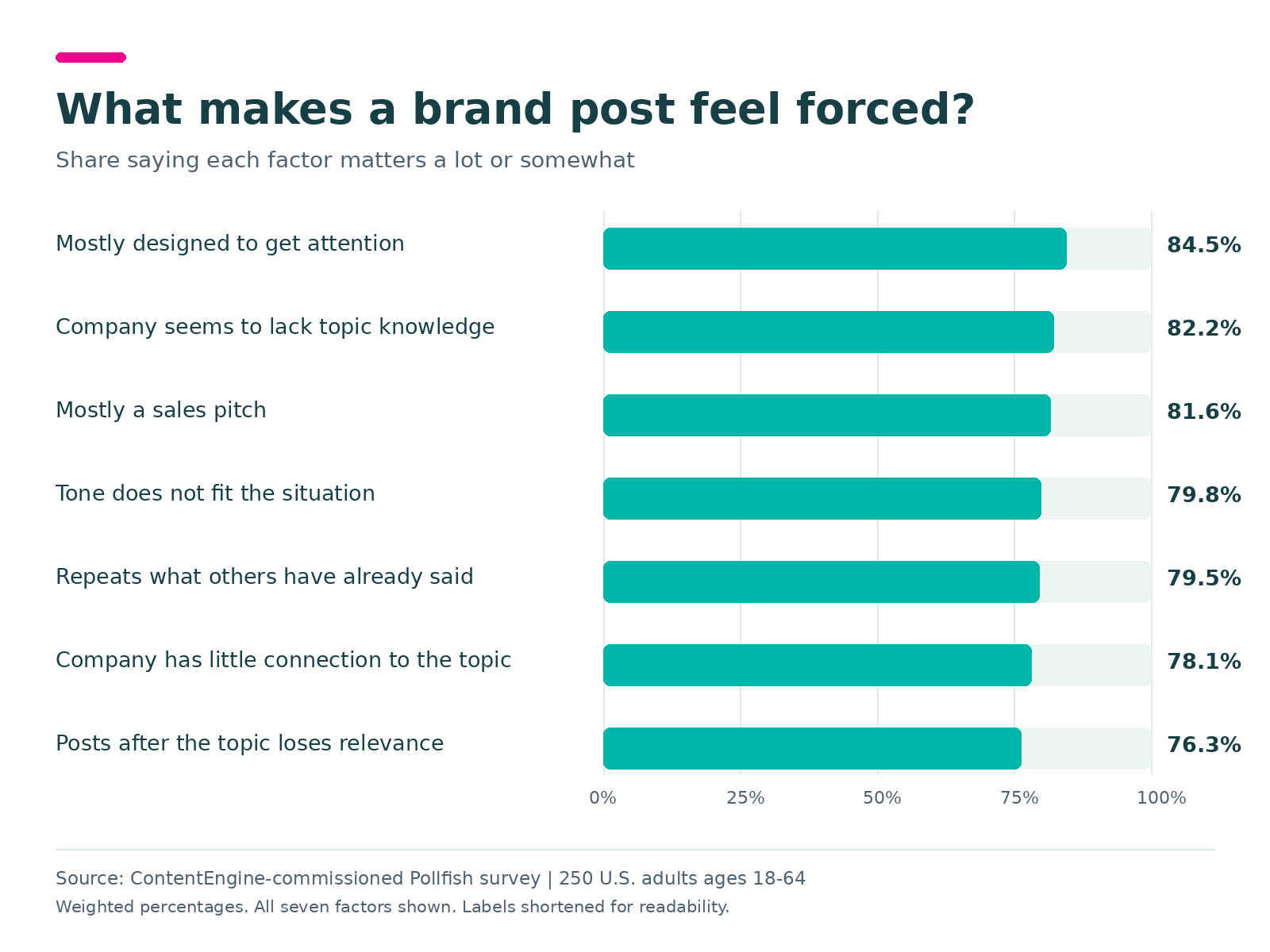
- Attention seeking, weak knowledge and sales-focused posts were the most common reasons participation felt forced. 84.5% said posts mainly designed to attract attention would feel forced or out of place at least somewhat, while 82.2% said the same about companies that appeared to lack knowledge of the topic and 81.6% about posts that felt mostly like sales pitches.
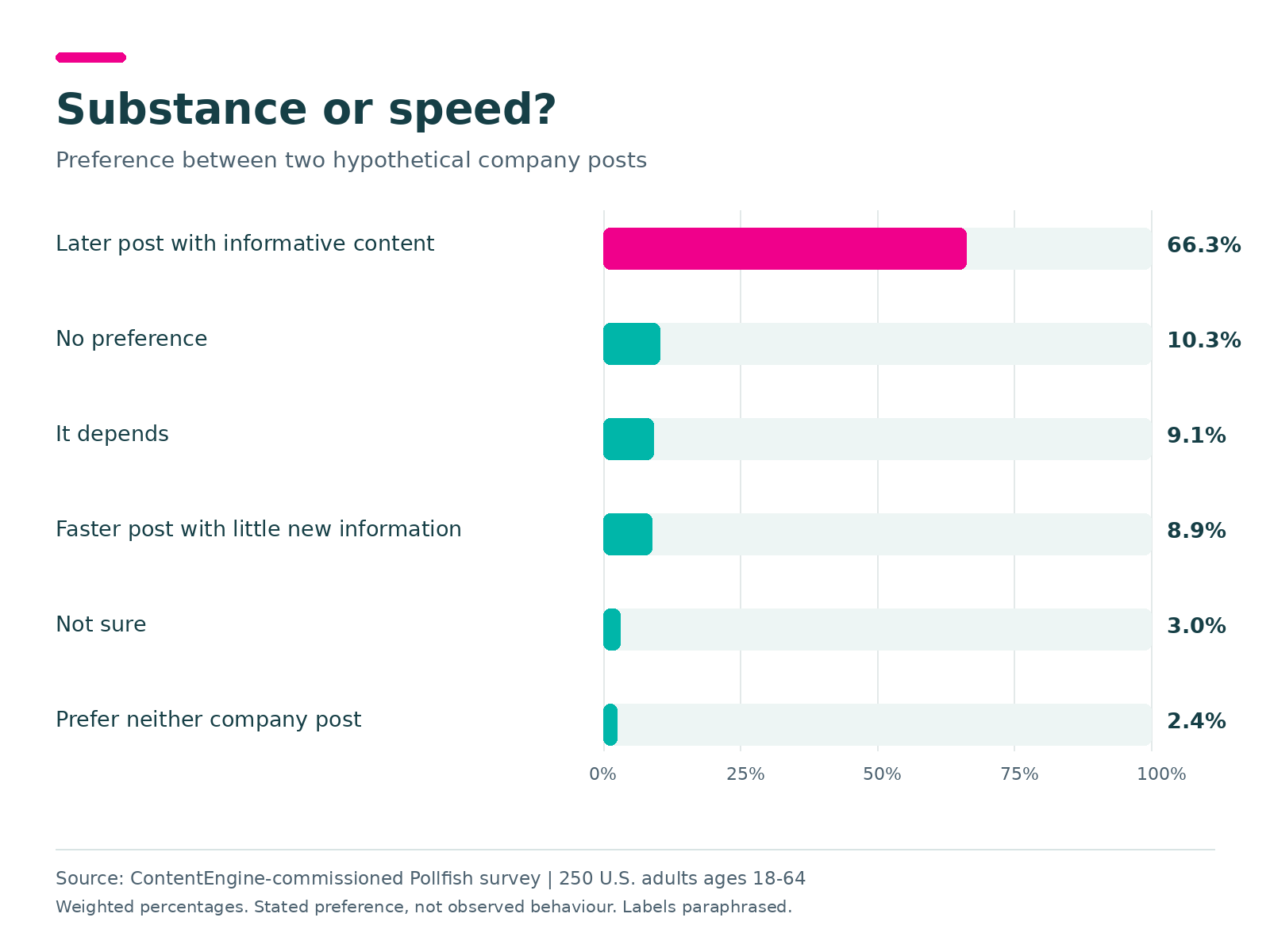
- Respondents valued substance over speed. When choosing between a company that posted quickly but added little new information and one that posted later with something more informative to contribute, 66.3% preferred the latter. Only 8.9% preferred the faster post.
- A weaker topic connection did not prevent respondents from accepting a post when the company had something worthwhile to contribute. 55.7% considered it appropriate for a company with only a loose connection to a topic to post when it had information or advice to contribute. When the company had a strong connection but little new to add, 48.9% considered participation appropriate.
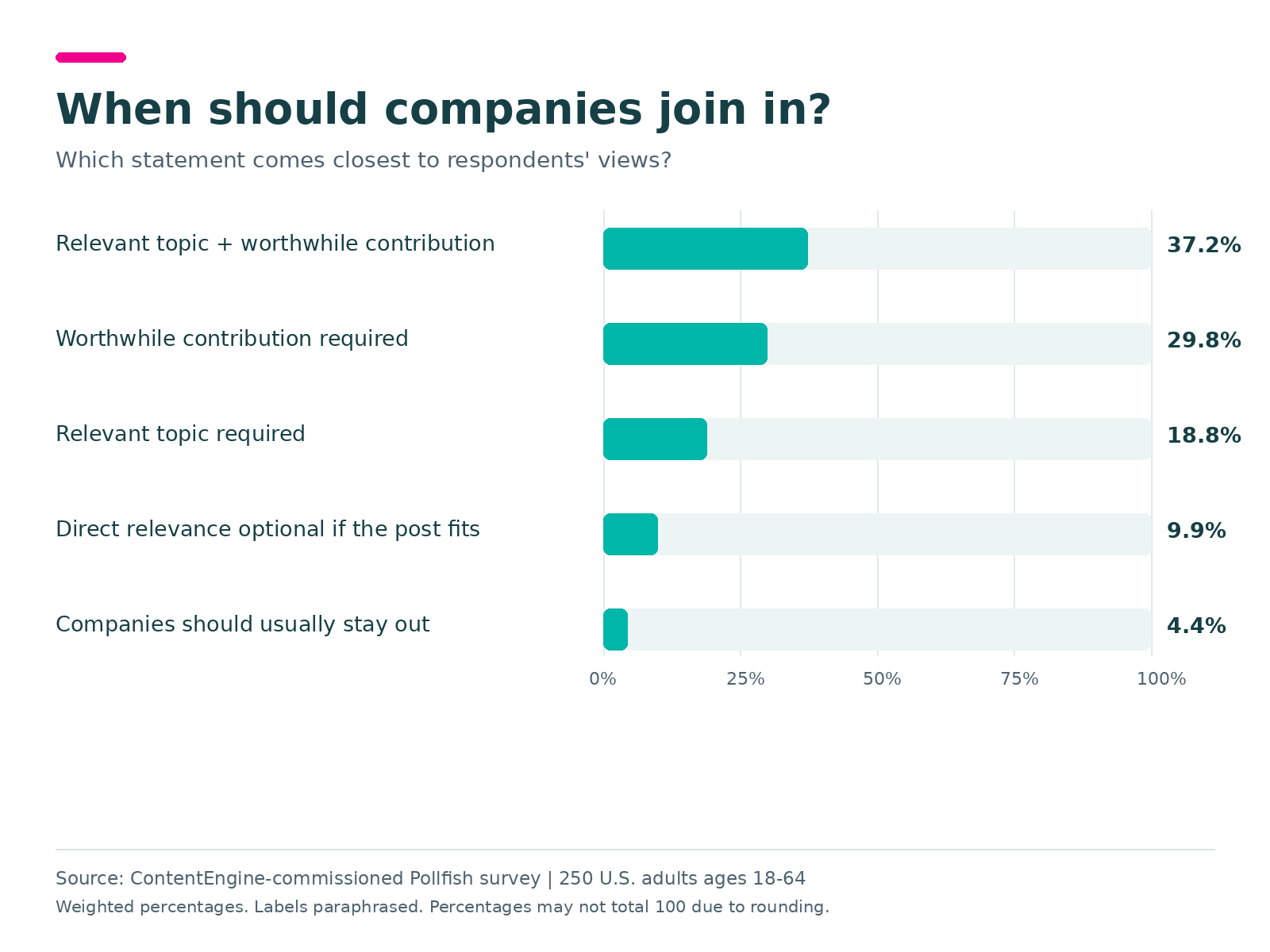
- Few respondents said companies should generally avoid current conversations. 37.2% said companies should participate only when a topic is relevant and they have something of value to add, while another 29.8% prioritized the contribution itself over direct relevance. Only 4.4% said companies should usually stay out of trending topics and current events.
- The largest demographic differences concerned the types of conversations companies could join. For example, 69.8% of respondents ages 18–34 considered company participation in political events appropriate or very appropriate, compared with 19.7% of those ages 55–64. For internet jokes or memes, the corresponding figures were 67.3% and 26.3%.
Factors That Support Company Participation
Respondents identified several factors as important when evaluating whether a company should post about a trending topic or current event. The highest-rated factor was whether the topic affects the company's customers, with 91.0% rating this important or very important. Close behind, 89.4% said it was important or very important that the company has a real connection to the people or community involved, and 88.7% said the company should know a lot about the topic.
Additional factors received substantial support:
- Topic is related to the company or what it sells: 88.4% rated important or very important
- Company can share useful information or advice: 86.1%
- Company has something original or entertaining to add: 79.3%
- Company has talked about similar topics before: 78.2%
Demographic patterns in these factors were modest. Younger respondents (ages 18-34) rated having something original or entertaining to add as important or very important at 84.2%, compared with 81.2% among ages 35-54 and 67.0% among ages 55-64. Women were more likely than men to rate having a real connection to the people or community as important or very important (94.2% versus 84.5%).
Topics Considered Appropriate for Company Participation
The survey asked respondents to rate how appropriate it is for companies to join conversations about seven types of topics. Industry-related and community topics received the broadest acceptance:
- Developments in the company's industry: 91.4% rated appropriate or very appropriate
- Local community events: 89.3%
- Sporting events: 77.9%
- Emergencies or tragedies: 77.5%
- Entertainment and popular culture: 75.2%
- Political events: 51.4%
- Internet jokes or memes: 50.8%
Age differences were pronounced for several topic types. Among respondents ages 18-34, 84.4% considered company participation in entertainment and popular culture appropriate or very appropriate, compared with 78.7% of those ages 35-54 and 52.2% of those ages 55-64. For political events, 69.8% of those ages 18-34 considered participation appropriate or very appropriate, compared with 51.3% of those ages 35-54 and 19.7% of those ages 55-64. Internet jokes or memes showed a similar pattern: 67.3% among ages 18-34, 48.7% among ages 35-54, and 26.3% among ages 55-64.
Gender differences also emerged. Men were more likely than women to consider participation in political events appropriate or very appropriate (61.9% versus 41.3%) and in emergencies or tragedies (84.7% versus 70.4%).
Behaviors That Make Posts Feel Forced or Out of Place
Respondents identified seven factors that would make a company's post about a trending topic or current event feel forced or out of place. The most widely cited factor was when the post seems mostly designed to get attention, with 84.5% saying this would make the post feel forced or out of place a lot or somewhat. Other frequently cited factors included:
- Company does not seem to know much about the topic: 82.2% said a lot or somewhat
- Post feels mostly like a sales pitch: 81.6%
- Tone does not fit the situation: 79.8%
- Company is repeating what others already said: 79.5%
- Company has little connection to the topic: 78.1%
- Company posts after topic is no longer very relevant: 76.3%
These patterns held relatively consistently across demographic groups, with most subgroup differences falling within a narrow range.
Connection Versus Contribution: Two Hypothetical Scenarios
Two scenarios tested how respondents evaluate trade-offs between topic connection and substance. In the first scenario, a company has only a loose connection to a trending topic but has valuable information or advice to share. In this case, 55.7% rated such participation very or somewhat appropriate, while 12.6% rated it very or somewhat inappropriate. Another 18.8% selected neither appropriate nor inappropriate, and 7.8% said it depends.
Acceptance varied by age. Among respondents ages 18-34, 58.9% rated this scenario appropriate, compared with 58.1% of those ages 35-54 and 45.3% of those ages 55-64.
The second scenario reversed the trade-off: a company has a strong connection to a trending topic but has little new or useful to add. Here, 48.9% rated participation very or somewhat appropriate, and 18.6% rated it very or somewhat inappropriate. Another 22.5% selected neither appropriate nor inappropriate.
Age differences were larger in this scenario. Among respondents ages 18-34, 66.2% rated participation appropriate, compared with 39.8% of those ages 35-54 and 36.8% of those ages 55-64.
Preference for Value Over Speed
When asked to choose between two companies posting about the same trending topic-one posting quickly but adding little new information and another posting later but sharing valuable information-66.3% preferred the more useful post. Only 8.9% preferred the faster post. Another 10.3% said they had no preference, 9.1% said it depends, and 2.4% said they would prefer neither company post.
Regional variation was present. In the Midwest, 79.4% preferred the more useful post, compared with 67.8% in the Northeast, 64.4% in the West, and 59.8% in the South.
General Views on When Companies Should Participate
The survey presented five statements reflecting different views on when companies should join trending topics and current events. The most frequently selected response, chosen by 37.2% of respondents, was that companies should only post when the topic is relevant to them and they have something worthwhile to add.
Another 29.8% said companies should participate when they have something of value to contribute, even if the topic is not directly relevant to the company. Together, these two responses accounted for 67.0% of weighted responses and both placed emphasis on the quality of the company’s contribution.
An additional 18.8% said companies should only post when the topic is relevant to them, regardless of whether they have anything new to add. Another 9.9% said companies can participate even when the topic is not directly relevant, as long as the post fits the situation. Only 4.4% said companies should usually stay out of trending topics and current events.
Responses that explicitly required relevance to the company accounted for 56.0% of weighted responses.
Age differences were also present. Among respondents ages 55–64, 43.6% selected the response requiring both relevance and a worthwhile contribution, compared with 36.7% of those ages 35–54 and 34.3% of those ages 18–34.
Gender differences followed a similar pattern. Among women, 42.5% selected both relevance and a meaningful contribution, compared with 31.9% of men. Men were more likely to say that having something of value to add was sufficient on its own, at 36.8% compared with 23.0% of women.
Regional differences were also observed. In the Northeast, 49.0% selected both relevance and a meaningful contribution, compared with 39.8% in the Midwest, 32.9% in the South, and 31.6% in the West.
Who We Surveyed
The survey included 250 U.S. adults ages 18 to 64. After weighting, 36.9% of respondents were ages 18–34, 41.9% were ages 35–54, and 21.2% were ages 55–64. The weighted gender split was 50.8% women and 49.2% men.
Respondents came from across the United States, with 20.2% in the Northeast, 20.5% in the Midwest, 42.6% in the South, and 16.5% in the West. The sample was also highly active on social media: 86.8% reported using social media daily or almost daily, and 96.2% used it at least weekly.
The original Pollfish results are available here.
Methodological Context and Limitations
The survey was conducted through Pollfish, an online survey panel, on September 29, 2026. The sample consisted of 250 completed responses from U.S. adults ages 18 to 64. The median survey completion time was 114 seconds, and the mean completion time was approximately 127 seconds.
Pollfish applies post-stratified weights to approximate the demographic composition of the U.S. population within the surveyed age range. All substantive percentages in this report use those weights. The sum of respondent weights is approximately 250.
Because the survey was conducted through an online panel rather than a probability sample drawn directly from the U.S. population, a conventional probability-sampling margin of error has not been assigned. The survey design does not support causal claims about why respondents answered as they did.
Demographic subgroup results are descriptive weighted estimates. Unweighted subgroup bases vary substantially. Smaller demographic groups, individual income ranges, and geographic subgroups have greater sampling variability than full-sample results. These subgroup findings should not be presented as precise estimates of population differences without additional statistical analysis.
The survey asked about hypothetical scenarios and general attitudes. It did not measure actual behavior or reactions to specific company posts. Question wording, response options, and the order of questions may influence how respondents answered. The survey population was limited to U.S. adults ages 18 to 64 who use online survey panels; results do not represent individuals outside that population.
Frequently Asked Questions
What do consumers expect when brands post about trending topics?
Is posting quickly more important than adding value in reactive marketing?
What makes a brand’s response to a trending topic feel forced?
Which topics do consumers consider appropriate for brands to discuss?
Can a brand join a conversation outside its immediate area of expertise?
Should brands stay out of trending topics and current events?
How was the brand participation survey conducted?
Further Reading
- In polarized times, when should corporations speak out?
- Should your business speak out on heated social, political, and moral issues?
- When Brands Should Speak, and When Silence Speaks Louder
- The role of social media in brand engagement
- It's Good to Talk. But Consumers Want Meaningful Conversations with Brands
- Social media silence: How to know when your brand should stay quiet