AI Recommendations Are Shaping the Future of Conversions
AI tools may send less traffic than search, but the visitors they influence often arrive closer to a decision and convert at a much higher rate.

|
Posted: July 13, 2026 |
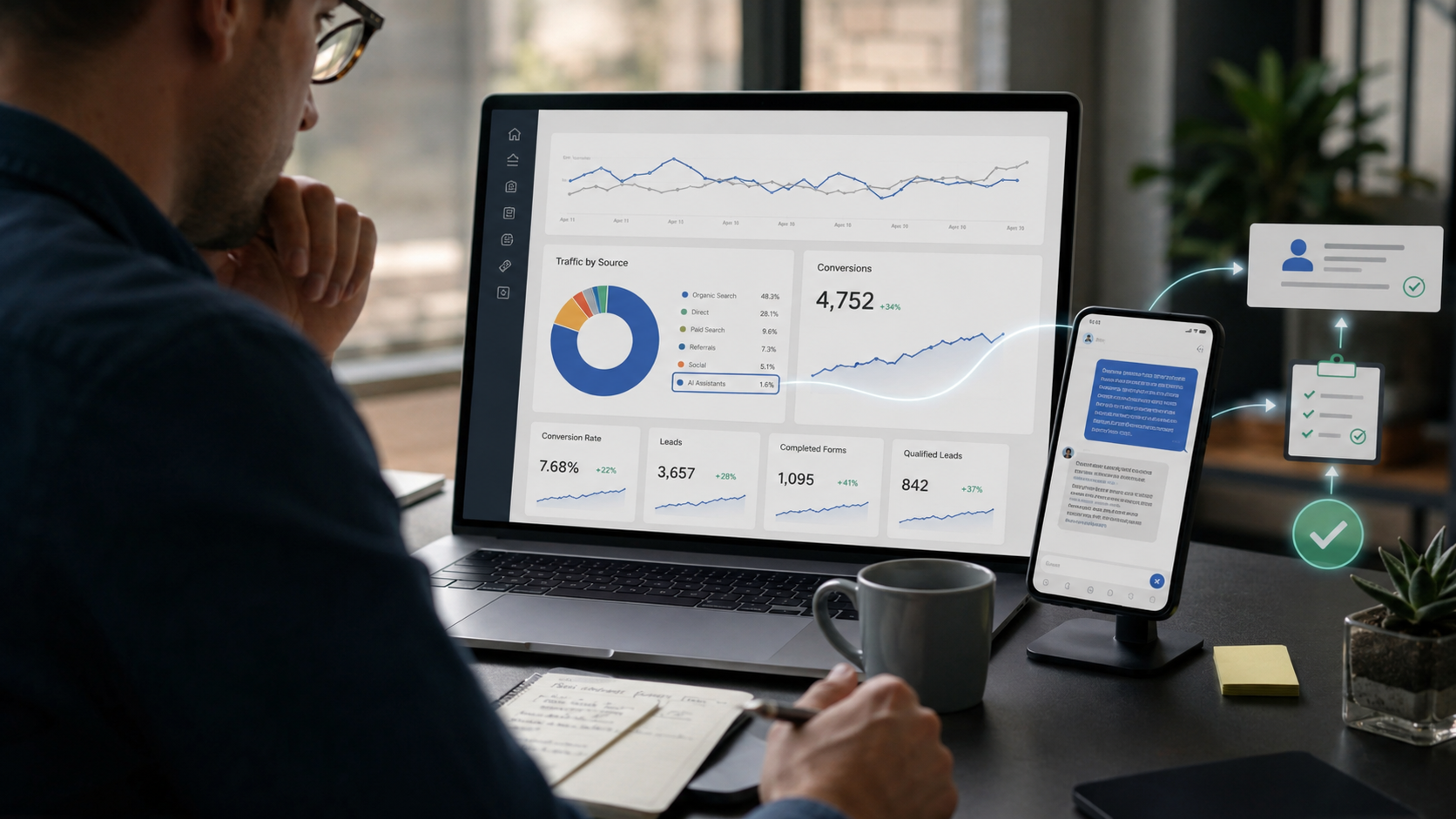
A small amount of traffic from ChatGPT, Gemini, Perplexity, and other AI tools is starting to produce an unusually large share of conversions for some businesses.
The volume is still modest. Microsoft Clarity found that AI referrals accounted for less than 1 percent of traffic across more than 1,200 publisher and news sites. Ahrefs reported a similarly small share in its own data. But the people who do arrive through these tools often convert at a much higher rate than conventional search visitors.
Ahrefs found that AI search visitors converted 23 times more often than its traditional organic search visitors. Microsoft Clarity measured a lower but still meaningful three-times conversion rate across the sites it studied. Semrush has reported that the average AI search visitor can be worth 4.4 times more than a conventional organic visitor.
The exact multiple varies by study, business and conversion type. The pattern is more important than any one number: AI tools may send fewer people, but those people often arrive much closer to making a decision.
Andy Crestodina, co-founder and CMO of Orbit Media Studios, recently broke down why. His nine-step analysis follows a buyer from an initial AI prompt through to a completed contact form. It shows how much of the research and comparison process can now happen before the visitor reaches a company's website.
The Buyer Arrives After the Comparison
A traditional search visitor might enter a short phrase, open several results and compare the options manually. Someone using an AI assistant is more likely to describe the entire problem.
They may explain their job, the type of supplier they need, the technical requirements, the location, the budget and the qualities that matter most. The AI assistant then researches the request and returns a condensed answer.
That changes the role of the website.
The visitor may no longer be arriving to discover which companies exist. The AI has already narrowed the field, described the differences and possibly recommended one or two providers. By the time the visitor clicks, they may be looking for confirmation rather than beginning their research.
This helps explain the higher conversion rates. The AI referral isn't necessarily a better visitor by chance. It may be a visitor who has already completed several stages of the buying process elsewhere.
AI Systems Search Differently
Crestodina's analysis also looks at the hidden searches behind an AI response. For many research-heavy prompts, an AI assistant doesn't simply submit the user's exact wording to a search engine. It can rewrite the request into several narrower searches, collect information from those results and combine the findings into one response. This is commonly called query fan-out.
Research from Peec AI examined five million query fan-outs collected from ChatGPT, Perplexity and Grok during April 2026. It found that ChatGPT frequently added commercial terms such as "best," "reviews" and the current year when rewriting prompts.
That matters because a company may perform well for the broad phrase it monitors in its SEO software while remaining absent from the more specific searches the AI actually runs.
A buyer might ask for a reliable contamination-control supplier with engineering support and products in stock. The resulting searches could focus separately on supplier reviews, inventory availability, filtration expertise, industry certifications and regional service. A generic service page may not provide enough evidence to appear across those searches. This doesn't mean marketers need to chase every possible AI-generated phrase. It does mean they need to understand the questions buyers ask when they are comparing providers, not just the short keywords associated with a product category.
Visibility and Recommendation Are Different Problems
Being mentioned in an AI answer is nice, but it isn't the same as being recommended. A company can appear in a list of options while a competitor gets the stronger description, the supporting evidence and the final endorsement. Measuring mention volume alone can miss that difference.
AI systems need material they can use to justify a recommendation. A website that says it provides "industry-leading solutions" gives the system very little to work with. A website that names the industries it serves, publishes detailed case studies, explains its inventory, shows relevant certifications and includes verifiable customer results gives it far more.
The same evidence also helps human buyers. Testimonials, reviews, pricing information, client examples, awards and years of experience aren't special tricks for manipulating AI. They are the proof people have always used to decide whether a business is credible.
The difference is that this proof may now influence whether the business reaches the buyer's shortlist in the first place. John Jantsch, quoted in Crestodina's article, puts the shift plainly: buyers and AI tools are increasingly selecting rather than simply searching. A company therefore needs to offer enough credible evidence to become the recommended choice, not merely one of the pages the system discovers.
AI's Influence Is Easy to Miss in Analytics
Even businesses receiving AI-influenced leads may not see the full effect in their referral reports. A visitor who clicks a citation in an AI answer can usually be identified as referral traffic from that platform. But many journeys don't include a direct click. Someone may see a company recommended in ChatGPT, open a new tab and search for the brand on Google. They may type the URL directly, return several days later or share the recommendation with a colleague who visits from another device.
In those cases, analytics may classify the visit as branded organic search or direct traffic. The AI recommendation disappears from the recorded journey.
Similarweb research found that brands recommended by ChatGPT were 2.5 times more likely to receive a website visit within the following seven days. It also found that 55.9 percent of AI-influenced visits arrived through search, rather than a clearly identifiable chatbot referral.
Looking only at sessions attributed directly to ChatGPT or Perplexity will therefore understate AI's contribution. Crestodina suggests adding an "AI assistant" option to the "How did you hear about us?" field on contact forms. It won't produce perfect attribution, but it can expose leads that referral reports miss.
Businesses can also look for changes in branded search, direct traffic, high-intent landing page visits and sales conversations. None of these proves that AI caused the visit, but together they provide a more realistic picture than chatbot referrals alone.
The Conversion Numbers Need Context
The reported conversion range is wide. Ahrefs measured a 23-times advantage for AI search visitors in its own conversion data. Microsoft Clarity found AI referrals converting at three times the rate of other channels across more than 1,200 publisher and news sites. Semrush reported an average value 4.4 times higher than traditional organic traffic.
These figures aren't directly comparable. They examine different websites, audiences, time periods and conversion actions. A signup for an SEO product isn't the same as a subscription on a news site or a lead for an industrial supplier.
AI traffic also remains a small sample for many companies. A handful of high-value conversions can make the rate look dramatic. Marketers shouldn't paste the 23-times figure into a forecast and assume it will apply to their business. They should treat it as a reason to separate AI traffic in analytics, inspect the landing pages involved and compare lead quality over time.
The practical question is whether AI-influenced visitors are more qualified, more likely to reach commercial pages and more likely to become real opportunities. That can only be answered with a company's own data.
Write for the Way Buyers Describe Their Problems
Crestodina calls his content approach "prompt reverse engineering." The basic idea is to examine how a real buyer would describe the request to an AI assistant, then make sure the website answers the important parts of that request in clear language. A buyer may identify themselves as a mechanical contractor, explain that they need contamination-control components and specify that inventory and engineering support are important. A useful supplier page should state plainly whether it serves mechanical contractors, what components it carries, whether products are ready to ship and what technical support is available.
Many websites hide these details behind slogans. Phrases such as "engineering tomorrow's possibilities" may sound polished in a brand presentation, but they don't help a buyer or an AI system determine what the company sells, whom it serves or why it should be trusted. This isn't a reason to flatten every page into awkward keyword copy. It is a reason to stop making visitors decode the offer.
The strongest pages usually combine straightforward descriptions with credible evidence:
- Who the company serves
- What problem it solves
- Where and how it operates
- What makes the offer credible
- What the buyer can expect next
Those details should appear in the page text, not only inside graphics, award badges or diagrams that a crawler may not interpret reliably.
Evidence Gives AI Something to Cite
Content that introduces original information has an advantage because it gives AI systems a reason to cite the source. NP Digital research published in 2026 found original research and comparison content performing particularly well in AI citations. That makes sense. A generic article summarizing familiar advice can be paraphrased without attribution. A study containing proprietary data, a documented experiment or a detailed comparison is harder to replace without referencing the original source.
Companies don't need a large research department to produce useful evidence. They can publish anonymized customer patterns, internal benchmarks, small surveys, implementation findings, pricing comparisons or detailed case studies. The methodology needs to be clear. A weak survey wrapped in a dramatic headline isn't more credible because it contains percentages.
Useful evidence should explain what was measured, when it was measured, how large the sample was and what the findings do not prove. Those limits make the research more trustworthy, not less.
Recommendation Systems Can Be Manipulated
Where recommendations influence buying decisions, businesses will try to influence the recommendations. The emerging generative engine optimization industry already includes legitimate work, such as improving technical access, clarifying website copy and earning mentions from credible sources. It also includes less defensible tactics, such as publishing biased comparison pages that rank the publisher's own product first.
This creates a familiar problem. Search optimization eventually produced low-quality pages designed more for rankings than readers. AI optimization could produce its own version of the same clutter.
A business may gain temporary visibility by manufacturing flattering comparisons or flooding the web with repetitive mentions. That doesn't make the underlying offer more credible, and platforms will continue adjusting how they identify manipulative content.
The safer long-term approach is less exciting: explain the offer clearly, publish evidence, earn independent reviews and make claims that can survive scrutiny.
What Businesses Should Measure Now
AI search is important enough to monitor, but too unsettled for one universal playbook. Start by separating identifiable AI referrals in analytics. Compare their conversion rates, landing pages and lead quality with organic search and other channels. Add a self-reported attribution option to lead forms, then watch branded search and direct traffic for changes that referral data may not capture.
Review the prompts buyers are likely to use when researching the category. Check whether the website answers those questions directly and whether its claims are supported by evidence. Finally, examine how the company appears across several AI tools. Results vary between platforms and can change between similar prompts, so a single screenshot doesn't establish reliable visibility.
AI assistants are taking over part of the comparison process that once happened on search result pages and company websites. That makes clear language and credible proof more important, not less.
A business doesn't need to appear in every AI answer. It does need to understand why it would deserve a recommendation when the right buyer asks.
Sources
- Microsoft Clarity - AI Traffic Converts at 3x the Rate of Other Channels (Study)
- cnvcmo.com - AI Search Traffic: Unlock 5x the Conversions of Google
- peppercontentinc.substack.com - Does AI Search Really Convert Better Than Organic Search? - AI Native
- The Wall Street Journal - How brands manipulate ChatGPT to dominate AI search results
- Peec AI - What ChatGPT actually searches for: 5 million fanout queries analyzed
- Similarweb - Your analytics are lying: Similarweb traces AI recommendations to real traffic
- Semrush - Semrush: 36 brands win AI visibility everywhere, 1,200 vanish on one
- NP Digital - Original research tops AI search citations at 82%, NP Digital survey finds