
Information Gap Analysis for SEO and AI Visibility
AI visibility has made search more conversational, yet the winning material still begins with a familiar premise: give people information they genuinely need. Information gap analysis gives content teams a practical way to find those needs before the rest of the internet arrives with 37 near-identical summaries.

|
Posted: November 6, 2026 | Updated: November 17, 2026 |
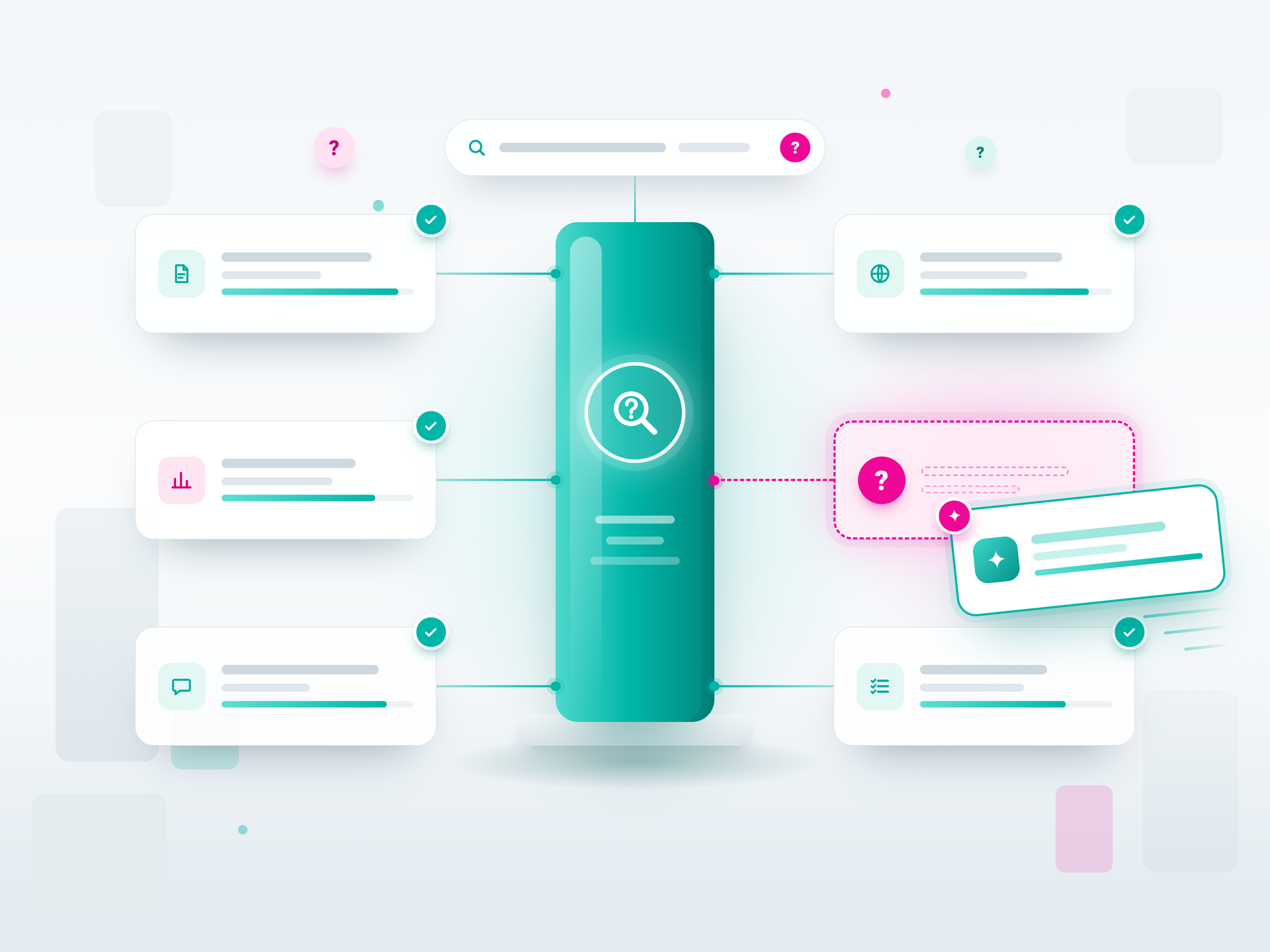
Google's guidance for generative AI features places helpful, reliable, people-first content at the center of visibility. That guidance applies across AI Overviews, AI Mode, and traditional blue-link results, which is convenient for teams already tired of maintaining separate playbooks for every new search surface. ContentEngine's Information Gap Analysis, or IGA, supports that shared objective by identifying questions, guide topics, and survey themes where search results provide thin, weak, or hard-to-find answers. The result is a research-led route toward content with a reason to exist.
Google treats AI visibility as Search work
Google's documentation is unusually direct on this point. The established foundations of SEO remain relevant for its AI search experiences. A page that is eligible to appear as a supporting link in AI Overviews or AI Mode must be indexed and eligible to appear in Google Search with a snippet. In other words, the technical and editorial basics that help a page compete for blue links also help make it available for AI-driven discovery.
Google's guide to AI features in Search and its guidance for generative AI optimization emphasize useful, original, clearly structured material. Search systems need content they can crawl, understand, and assess in the context of a user's query. AI experiences need the same thing, with an added premium on an answer that can meaningfully support a synthesized response.
This places the content opportunity in a fairly sensible location. Brands benefit when they publish information that answers a specific question thoroughly, reflects real expertise or first-hand knowledge, and adds a useful perspective beyond the currently available summaries. The bar is less mysterious than it sometimes appears. It simply demands more than repainting the same answer in a new shade of beige.
Google also advises publishers to create content for people, grounded in expertise and clear purpose. Its helpful content guidance describes a ranking environment designed to prioritize reliable information that benefits users. An IGA-led workflow fits this direction because it starts with evidence of an unmet information need, then gives the content team a concrete brief for filling it.
Synopsis
Information Gap Analysis shifts SEO from rephrasing what already ranks to finding questions the web has not answered well. Because Google’s AI features still depend on conventional indexing and technical eligibility, the foundation remains sound SEO; the advantage comes from adding unique, useful information that retrieval systems can cite. By mapping audience questions, auditing the live results, scoring weak answer coverage, and publishing clear evidence-led responses quickly, teams can improve both classic organic visibility and their chances of appearing in AI-generated search experiences.
How ContentEngine's Information Gap Analysis works
Every ContentEngine AutoDraft session begins with a subject, event, or source URL. The platform generates related research, perspectives, and an Information Gap Analysis. For the IGA, ContentEngine uses query fan-out to investigate likely audience questions, potential how-to topics, and themes suitable for public opinion research.
For each query, the system samples search listings and examines whether the returned pages contain relevant information. It also evaluates answer coverage and considers the quality and authority of the sources. The resulting IGA score represents the relative size of the information gap. Questions with weak coverage receive higher scores because they present stronger opportunities for a useful contribution.
The IGA interface gives a content team several signals:
- The number of pages sampled for each question, guide topic, or survey theme.
- The number of sampled pages containing relevant information.
- Weak, moderate, or strong answer coverage for individual listings.
- A combined score reflecting relevance, depth, quality, and source authority.
This method distinguishes a crowded-looking results page from a well-answered question. Search results can be plentiful and still provide thin coverage. Several pages may repeat the same high-level statement, cite the same secondary source, or omit the practical detail that motivated the search. Quantity is a remarkably convincing disguise for completeness.
The analysis also avoids treating every missing answer as automatically valuable. A commercially useful opportunity still needs audience relevance, plausible demand, brand expertise, and a reason for the information gap. ContentEngine's event targeting, brand settings, research summaries, and search forecasts supply additional context for that decision. The IGA identifies informational scarcity; editors determine where that scarcity intersects with a credible contribution.
The value of an information gap
An information gap emerges when people are likely to ask a question and the available search results leave them with incomplete, generic, scattered, outdated, or poorly supported answers. The issue may concern an emerging event, a specialized implementation detail, a buyer concern, a comparison criterion, or a practical question that has not yet accumulated a healthy supply of useful pages.
Search has a remarkable capacity to produce dozens of pages that circle a question with great confidence and very little intent to land. A person researching the subject still needs a direct explanation, credible evidence, context, and perhaps a decision framework. That distance between the question and the available answer is where content has room to earn attention.
The Hard Truth
In AI search, being the tenth summary is worse than being absent.
Generative systems can synthesize consensus without rewarding every source that repeats it. The durable opportunity is to publish the missing fact, not another version of the familiar one.
Keyword volume remains useful as one demand signal, though it has limits. It often highlights topics after they become crowded, especially in well-covered commercial categories. Information gap analysis adds another lens: answer quality. It asks whether the search landscape serves the audience well enough today and identifies areas where a publisher can provide needed, hard-to-find information.
That distinction matters for SEO and AI visibility alike. A blue-link result gains traction when it serves search intent better than neighboring results. An AI experience has stronger reason to surface a supporting page when that page contributes an answer, evidence, or perspective that improves the response. Both outcomes benefit from genuine information gain.
Give Google a page it can access and understand
A useful answer still needs a functioning home. Google's technical requirements describe the baseline conditions for indexing: Googlebot can access the page, the server returns an HTTP 200 success status, and the page contains indexable content. Those fundamentals deserve attention because even the finest answer has limited visibility while trapped behind a crawl barrier or a server error. Googlebot has many talents, yet archaeological excavation is outside the job description.
Teams should also make the page's purpose evident through accurate titles, descriptive headings, logical internal links, and readable body content. The opening paragraphs should establish the central topic. Supporting sections should answer the related questions that naturally follow. Links to deeper first-party resources can provide additional context where they genuinely help the reader.
Structured data can help Google understand page details and support eligible Search features when it accurately reflects visible page content and follows Google's guidelines. It works best as a faithful description of the page, maintained with the same care as the page itself. A schema label attached to a vague answer remains a vague answer with better paperwork.
FAQ content can be particularly effective when it addresses real unanswered questions with concise, complete responses. ContentEngine uses IGA data in its FAQ tool so that generated FAQ blocks draw from questions where search coverage suggests an opportunity. The answers should still receive editorial review, source verification, and appropriate updates.
Original contribution is the durable visibility asset
Google's guidance favors content that brings unique value. The same principle applies whether a person clicks a blue link or encounters a supporting source in an AI-generated response. The page needs a discernible contribution: a verified fact, a useful explanation, a proprietary data point, an expert interpretation, a real-world example, a clear process, or a well-supported perspective.
For a brand covering a fast-moving event, speed can matter, though speed alone produces a familiar assortment of rushed takes and missing context. ContentEngine's Events page helps teams identify pre-screened, brand-relevant news items and adjust targeting through keywords. The workflow then carries an event into AutoDraft, where research, perspective selection, and IGA results help shape an informed response.
This is especially useful when current events trigger a burst of questions. A product update may prompt customers to ask about compatibility, cost, security, migration, or operational impact. A new law may create questions about deadlines, eligibility, process changes, and risk. A market shift may cause buyers to seek plain-language interpretation. The first published answer can earn attention, while the most useful published answer has a stronger chance of retaining it.
A careful human review stage remains central. Generative systems can accelerate research organization and drafting, while subject experts provide factual accountability, judgment, brand awareness, and lived experience. ContentEngine positions perspective selection and research inside the drafting workflow for this reason. The result has a better chance of sounding like a considered publication instead of a committee of autocomplete suggestions.
Connect IGA findings to a practical publishing workflow
ContentEngine's workflow begins with event discovery or a manually entered topic or URL. Its AutoDraft environment preloads a Research Summary, Browse Perspectives, and the Information Gap Analysis. A content team can use those inputs to select a narrow, valuable topic and an angle grounded in the brand's actual expertise.
The Draft Content tool then supports web, social, and email formats. For a web article, the team can use the IGA question as the page's central problem, select a perspective that contributes useful interpretation, and ensure that the draft includes support from credible research. ContentEngine's content card breaks drafts into sections and associates them with relevant keywords, search forecasts, and an objective statement describing the section's original value.
Once the substance is ready, ContentBuilder provides a block-based environment for styling the page, adding media, applying metadata, and producing reusable sections. It can export HTML or publish through an integrated CMS. This part of the process matters because accessibility, page structure, metadata, and on-page clarity all support a healthy Search presence. Content quality and publishing quality tend to travel together, even when project plans attempt to schedule them on separate planets.
The workflow also accommodates maintenance. IGA results can inform a new article, a page expansion, a support center update, a timely email, or a new FAQ section on an established resource. As search results and audience needs evolve, teams can revisit the subject, assess newly covered areas, and locate the next unanswered question. Reactive marketing becomes considerably more useful when reaction includes research.
Measure visibility with a wider lens
Google advises site owners to use Search Console to understand performance in Search. Traffic from Google AI features is included in the overall Web reporting, making the Performance report an important source for observing impressions, clicks, queries, and landing pages. Teams can evaluate IGA-led pages by looking for growth in relevant query clusters, stronger page visibility, improved qualified engagement, and downstream outcomes such as subscriptions, inquiries, trials, or purchases.
Measurement benefits from a time horizon that matches the subject. A response to a developing event may earn demand quickly and fade as the story settles. An evergreen hard-to-find answer may build gradually as internal links, external references, and Search understanding mature. Both can be valuable when the intent and business role are clear.
Qualitative evidence belongs in the review as well. Sales teams, support teams, community managers, and subject matter experts often hear the questions that search reports understate. Their observations can reveal where readers remain confused after consuming existing content. Those questions are excellent candidates for the next IGA analysis and for updates to pages already performing well.
A disciplined path to SEO and AI visibility
The strongest content programs make useful discovery a repeatable habit. They monitor relevant events, identify questions with incomplete coverage, choose topics tied to genuine expertise, develop a distinct perspective, publish pages that Search can access, and refine their work using performance data. Each step reinforces the others.
ContentEngine's Information Gap Analysis gives teams a structured way to locate the information that audiences need and struggle to find. That focus aligns closely with Google's stated preference for unique, helpful, reliable content and supports the same underlying visibility work across AI features and blue-link results. Search changes quickly. The appetite for a clear, credible answer remains stubbornly consistent, which is one of the more reassuring habits on the internet.
Common Mistakes
These errors turn an otherwise promising information-gap workflow back into generic content production.
- Mistaking volume for opportunity — High-volume keywords can be saturated with adequate answers, making another general guide difficult to distinguish.
- Ignoring technical eligibility — Original content cannot surface in Google AI features if crawlers are blocked, pages fail, or text is not indexable.
- Burying the answer — Critical facts hidden under lengthy setup copy are harder for people and retrieval systems to locate quickly.
- Letting automation make unsupported claims — AI-assisted drafts without expert review can sacrifice accuracy, specificity, and trust.
Why IGA can improve blue-link SEO
Blue-link SEO benefits when a page matches a meaningful query, satisfies the associated intent, and offers a stronger experience than competing results. IGA supports all three conditions by identifying where current pages leave work unfinished.
A high-gap question can become a focused article, a section within a larger guide, a comparison page, a research project, or a visible FAQ. Because the topic arises from observed answer weakness, the resulting content has a clearer purpose than a page built solely around a broad keyword. The headline, opening answer, subheadings, supporting evidence, and internal links can all reflect the specific need.
Gap-driven content also expands topical coverage in a disciplined way. A brand can build a cluster of pages around real follow-up questions, with each page contributing distinct information. Relevant internal links can connect broad resources to specialized answers, helping readers and crawlers understand the relationship between them. This produces a more useful knowledge structure than a collection of near-duplicate articles aimed at slight variations of the same phrase.
Google's people-first guidance reinforces the value of this approach. Content should demonstrate experience, explain the source of its claims, and deliver enough information for the reader's goal. An IGA supplies the editorial brief with a concrete deficiency to solve. Subject-matter experts can then add first-hand examples, original observations, constraints, calculations, screenshots, or tested steps.
The method may also uncover lower-competition opportunities. Pages answering specific and underserved questions can earn visibility without immediately challenging the most established domains for a broad head term. Over time, strong specialized resources can attract links, references, returning visitors, and branded searches. Those outcomes develop authority through usefulness, an arrangement that appears almost suspiciously sensible.
Build the answer around the actual question
A strong IGA score should lead to a serious editorial decision. The first task is to establish what the question means for the intended audience. A query such as how a particular regulation affects small manufacturers calls for a different answer than a query about the regulation's policy history. The wording may look similar in a keyword report. The user need is doing much heavier work.
The page should state the answer early, then provide the reasoning, evidence, caveats, steps, examples, and relevant next actions. This sequence helps readers assess relevance quickly and gives search systems a clean path through the material. Clear heading structure, descriptive section titles, and direct language all make the page easier to interpret.
Google's generative AI optimization guide repeatedly emphasizes unique, compelling, and useful content. First-hand experience can be especially valuable here. A software company can share implementation data, product constraints, observed outcomes, lessons from customer onboarding, or a detailed technical walkthrough. A professional services firm can provide a documented methodology, anonymized patterns from client work, and expert interpretation of a developing issue. A community publisher can add insights from its audience, current conversations, and relevant polling.
These additions transform a page from an answer-shaped object into an answer with substance. They also create material that other pages have less ability to reproduce, which is generally good news for any team hoping to avoid competing in a copy-paste regatta.
ContentEngine's Browse Perspectives feature supports this work by presenting research-backed angles such as a strong stance, neutral explanation, devil's advocate view, or comparison-based insight. The selected perspective gives the page an editorial center of gravity. That matters because an information gap can be filled with a dry reference answer, a practical guide, an expert analysis, or a response to a timely event. The best choice depends on the brand's relevant knowledge and the audience's immediate need.
FAQs can capture gaps when they remain substantive
ContentEngine feeds high-scoring IGA questions into ContentBuilder's FAQ tool. This allows a page to include concise answers to relevant questions that competing resources cover poorly. Such sections can improve navigation, address follow-up intent, and give search systems clearly labeled passages to interpret.
An effective FAQ answers real questions with enough detail to be useful. It can link to a deeper section or dedicated resource when the subject requires more explanation. The language should reflect how the audience frames the issue while retaining accurate terminology and context.
A large block of shallow questions offers limited value. Rephrasing the same keyword six times creates an impressive quantity of headings and a less impressive quantity of information. The IGA helps avoid that pattern by tying FAQ selection to observed answer scarcity.
Structured data, when used, must match visible content and follow Google's applicable guidelines. Markup can clarify page meaning and support eligible search features, but it cannot compensate for weak answers. The prose still has to perform the unfashionable task of being helpful.