
Why Analytics and Targeting Are a Game Changer
If you’re not carefully tracking user interactions, you may be leaving more conversions on the table than you think.
✒️ Paul Rigden
Every business, brand, and website is different. Your products and services, user experience and visual style all impact how users perceive and interact with you online. Websites that seem very similar superficially may face very different problems from a marketing perspective. A confusing navigation experience, missing call to action, or unclear page objectives can all be hidden problems draining your marketing budgets and ROI. Everyone’s got problems, and sometimes the hardest ones to diagnose are your own.
Analytics and targeting are the key to finding and fixing the hard-to-find issues plaguing your digital brand.
The Life of a Digital Detective
Really making the most of analytics and targeting is about events. Since every website’s user experience is different, defining which events are significant, and why they’re significant, is a little different for everyone. Every page on your website has a conversion rate of some kind, whether that’s buying a product, subscribing to a newsletter, or even just engaging with web content rather than bouncing immediately. Each user experience involves choices between trackable events, whether that’s what product to click on, or simply tracking what piece of content or site element they engage with next. All these conversions present a goal to optimize towards, and all these choices present an opportunity for you to better understand what users are (or aren’t) interested in.
"
All these conversions present a goal to optimize towards, and all these choices present an opportunity for you to better understand what users are (or aren't) interested in.
Just like a detective, you should optimize your website by starting with a hunch. How can you drive a higher on-page conversion rate? Maybe it’s something as simple as increasing the size of a button or the placement of a call to action, but maybe it’s something as deep as presenting the user with different options all together, like a different product list or web content. In these cases, targeted email lists can be a great way to make sure you put your best foot forward with every user. By bucketing users into engagement groups, you can present them with a more targeted and optimized experience through email marketing.
The Marketing and Analytics Services You’ll Need
If “Reactive Marketing” is the engine, analytics and targeting are the steering wheel and dashboard. Without them, you can still publish great content and post smart social takes, but you’re guessing about why things worked, who they worked on, and what to do next. The good news is you don’t need a giant enterprise stack to get real value. You need a clean, connected set of tools that answer three questions:
- What are people doing on my site?
- Which actions matter (and which are noise)?
- How do I follow up with the right message to the right person?
That’s the core of the “digital detective” mindset: define meaningful events, track them reliably, and turn patterns into targeted follow-up campaigns.
The foundation starts with event tracking. This is where tools like Google Analytics 4 (GA4), Mixpanel, or Amplitude shine. GA4 is often enough for many brands, but product-led or content-heavy businesses usually outgrow “pageview thinking” fast. You’ll want to track actions like: newsletter signup starts vs completions, scroll depth, clicks on key links, product page views after reading an article, and “return visits within 7 days.” These are the breadcrumbs that reveal intent.
Then you need tag management (usually Google Tag Manager). Think of it like a control room that lets you deploy tracking without constantly touching your site code. It also helps keep tracking organized so you don’t end up with the analytics version of spaghetti. Event tracking and tag management are core to fundamentals of identity and segmentation. It’s one thing to know “someone clicked,” and another to know “this person consistently reads posts about X, clicked Y product twice, and bounced when the pricing page loaded.”
Finally, you need email infrastructure that supports targeting, automation, and personalization. Mailchimp can work at the start, but as soon as you want smarter journeys (behavior-based triggers, dynamic content blocks, or deeper segmentation), platforms like Klaviyo, Customer.io, or similar tools become the difference between “newsletter blasting” and real lifecycle marketing.
Put it together, and you get a loop that looks like this:
Track → Learn → Segment → Target → Measure → Improve.
That loop is how you turn attention into conversions without sounding like a pushy marketer.
SaaS tech stack checklist (the practical version):
- Analytics: GA4 or Mixpanel/Amplitude (event-based analysis)
- Tag manager: Google Tag Manager (clean tracking deployment)
- CRM: HubSpot / Pipedrive / Salesforce (where leads and customers “live”)
- Email service provider: Mailchimp / Klaviyo / Customer.io (segmentation + automations)
If you’re able to successfully use these technologies together, you’ll be ahead of 80% of marketers. The reality is, most people in the industry don’t realize how much a strong analytics game brings to the table.
Why Analytics Work
Analytics work for the same reason detective work works: because patterns exist, and patterns tell the truth faster than opinions do.
Most marketers don’t suffer from a lack of ideas. They suffer from a lack of clarity. They post content, run campaigns, tweak landing pages, and test new hooks—then they rely on gut feel to decide what mattered. That’s fine when you’re small and scrappy. But once you’re publishing consistently, your intuition becomes a bottleneck. Analytics turn your marketing from “vibes” into a repeatable system.
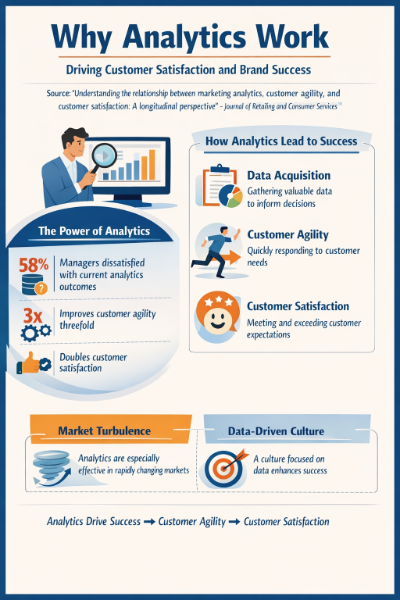
There's no lack of research showing the clear link between platform analytics and customer satisfaction (1)
Here’s what analytics do when they’re implemented properly:
They expose leaks.
A page can look great and still underperform because the CTA is unclear, the load time is slow, or the navigation creates decision fatigue. Analytics catch this by showing where users drop off, what they ignore, and what they obsess over. That’s how you find the silent conversion killers.
They separate reach from results.
A post going “semi-viral” feels good, but you need to know whether that traffic actually moves. Does it lead to email signups? Product page views? Repeat visits? If the answer is no, you don’t need more traffic—you need better alignment between content and conversion points.
They make targeting real.
If someone binge-reads three articles about a topic, it’s a no-brainer to follow up with more of that topic. If someone clicks your pricing page twice, that’s a signal to offer a clearer next step. And if someone only reads and never converts, that’s a signal too: they may need a softer conversion path like a newsletter, a “starter guide,” or a limited-time offer tied to the content they already like.
And this isn’t just theory. Countless studies show the link between strong analytics and customer satisfaction. That’s not because analytics magically create demand. It’s because analytics reduce waste: fewer bad bets, fewer blind spots, and faster iteration.
Analytics make your content strategy sharper, not just your ad strategy.
You learn which topics create repeat visits. Which angles produce deeper scrolling. Which headlines create product curiosity. Which writers (or AI prompt styles) actually keep attention. Over time, you stop treating content like a slot machine and start treating it like a compounding asset.
And once you have segmentation working, email becomes the conversion multiplier. Instead of sending everyone the same newsletter, you send different “best of” content to different people based on what they already proved they care about. That’s how reactive marketing becomes a funnel instead of a feed.
Analytics work because they turn your audience into a map. And when you can see the map clearly, you stop wandering—and start building paths that convert.
Next - Get Over your Guilt for Using AI, and Learn How Using It In Content Marketing is a Bit Like Making A Mix Tape
Still hesitant about using AI in your creative process? You shouldn’t be. In many ways, using AI in marketing is a lot like making a mixtape. It’s all about selecting, remixing, and sequencing content to create something uniquely yours.