If Your Ad Knows It's About to Rain Before You Do, Has Targeting Gone Too Far?
Most people use the weather as an excuse to avoid social obligations or explain a bad mood. Google, however, has decided to turn the sky into a massive, data-driven sales funnel.

|
Posted: September 11, 2026 |
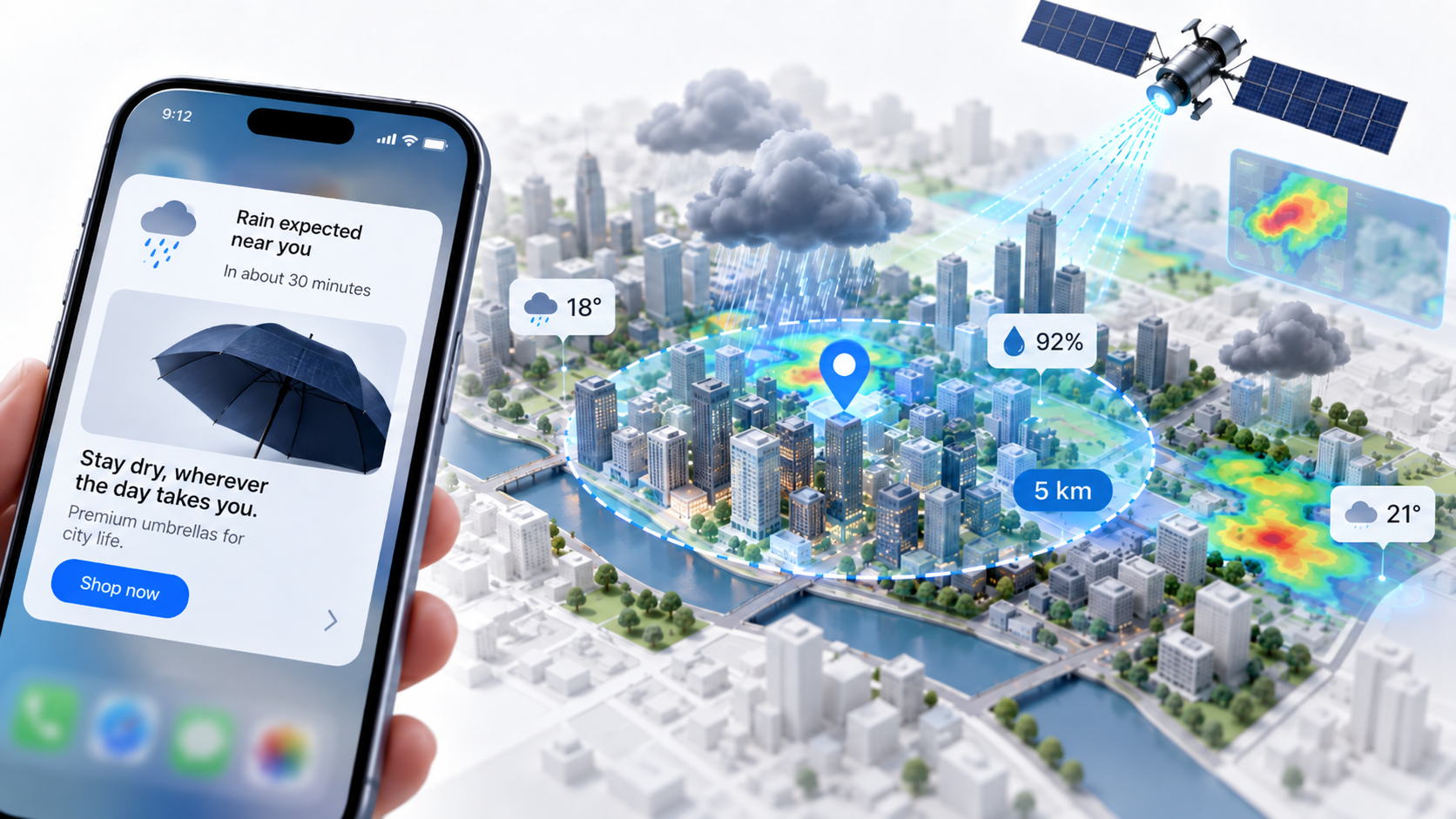
The old joke in Wyoming, and various other places that take pride in their erratic climates, is that if someone doesn't like the weather, they should simply wait a minute. It is a charming sentiment that relies on the inherent unpredictability of the atmosphere. But Google DeepMind doesn't particularly care for charm when there is a 5-kilometer grid of atmospheric data to be parsed. With the rollout of WeatherNext 3, the tech giant is moving away from the era of "checking the window" and into a period of predictive behavioral modeling that knows when a person is going to be cold, wet, or humidified before the person in question has even noticed a cloud. This isn't just about knowing whether to pack an umbrella; it's about a future where an advertisement for a waterproof trench coat arrives on a smartphone exactly fourteen minutes before the first raindrop hits the pavement.
The Five-Kilometer Microscope
To understand why this matters to anyone who isn't a professional meteorologist, one has to look at the sheer granularity of the data. WeatherNext 2, the previous iteration of Google's weather-focused AI, operated on a 25-kilometer grid and updated every six hours. In the world of global weather patterns, 25 kilometers is a decent resolution. In the world of "should I buy an iced latte right now," it is practically useless. A 25-kilometer square can cover an entire city, parts of the suburbs, and a significant chunk of a nearby forest. It doesn't tell a brand much about the specific consumer standing on a specific street corner.
WeatherNext 3 shrinks that grid to 5 kilometers. It also shifts to an hourly update cycle using raw, real-time satellite data. This is five times sharper than its predecessor, providing a global weather picture that is less of a blurry smudge and more of a high-definition map. For a developer or a researcher, accessing this via BigQuery or Google Cloud Storage is a windfall of data. For a fast-food franchise, it is a surgical tool. If a 5-kilometer pocket of a city experiences a sudden, unpredicted spike in temperature, the AI can instantly trigger a creative adjustment. The digital billboard that was promoting hot coffee for the morning commute can, within the hour, pivot to promoting a nitrogen-infused cold brew for the people in that specific, sweltering neighborhood.
Synopsis
Google has developed an advanced AI weather forecasting model that utilizes real-time satellite data to provide highly localized and precise weather predictions. This model supports detailed updates in short intervals and enhanced resolution, allowing businesses to tailor advertising in real time based on changing weather conditions. The forecasts can influence consumer behavior predictions and enable dynamic ad adjustments, such as promoting different products according to sudden weather changes. These advancements aim to transform how advertisers respond to weather-driven consumer needs globally.
The Psychology of the Barometer
Weather has always been the original influencer. It is the second biggest influence on consumer behavior after the state of the economy, and yet it is often the most overlooked. Research suggests that on sunny days, people are three times more positive and significantly more open to new messages. There is a documented 12% increase in the ability to remember specific details of an advertisement if that ad matches the consumer's current environmental mindset. It is much easier to sell a dream of a tropical vacation to someone staring at a grey, sleet-covered street than to someone who is already enjoying a mild spring afternoon.
Google's blog post points out that weather influences billions of decisions every day. Some of these are trivial, like choosing between a sweater and a jacket. Others are foundational to the global economy. Wind speeds and moisture levels at a 25-kilometer atmospheric resolution dictate clean energy production and the stability of agricultural supply chains. If the AI can predict a drought or a heatwave hours or days before the traditional models catch on, it isn't just targeting ads for sunscreen; it is predicting shifts in the price of wheat and the demand for air conditioning units.
Anticipatory Consumption and the Death of the Guess
The real shift here is from reactive advertising to predictive behavior. Traditionally, weather-based marketing was a simple "if/then" statement. If it is raining, show an ad for an umbrella. If it is snowing, show an ad for a shovel. This is functional, but it's also a bit late. By the time a consumer is standing in a downpour, they have likely already solved their umbrella problem or have decided to just be wet and grumpy.
The smartest marketers have already begun moving toward "Moment Marketing." The crafts retailer Michaels, for instance, used to increase its advertising on rainy days, assuming that people would want indoor projects. However, after looking at the data, they shifted their strategy to advertise three days before a rainy forecast. They realized that people don't decide to start a knitting project once the rain starts; they plan for the boredom that the rain will bring. Google's new model makes this kind of foresight automated and accessible at a massive scale.
Sears Automotive discovered a similar trend with car batteries. It turns out that five-year-old car batteries tend to die after three consecutive days of sub-zero temperatures. By interrogating historical weather data and layering it over the current forecast, a brand can activate ads on the fourth day of a freeze, precisely when the consumer is most likely to be staring at a car that won't start. This is no longer just "relevance"; it is a form of digital clairvoyance.
Myth vs. Reality
There are common misconceptions about weather-based advertising and the true capabilities and implications of Google's new weather model.
Myth
- Weather-based ads are just basic seasonal promotions.
- Hyper-local weather targeting invades consumer privacy excessively.
- Weather data is too imprecise for effective advertising.
- Consumers don’t react strongly to ads linked to weather changes.
vs.
Reality
- Modern weather advertising uses AI-driven, real-time data for precise targeting beyond seasonal assumptions.
- Responsible use of weather targeting balances helpfulness with privacy, prioritizing transparency.
- Advances like WeatherNext 3 provide highly granular, accurate forecasts that enable relevant ad adaptations.
- Data shows weather-based advertising can significantly boost engagement and sales by matching consumer mood and needs.
The Creative Pivot in Real Time
If the data is the engine, the "creative adjustment" is the steering wheel. Google's AI doesn't just tell a brand that it's humid; it allows the brand to change the ad's messaging in real time. Humidity data can trigger ads for anti-frizz hair products or athletic gear designed for moisture-wicking. High wind speeds combined with sudden rain can instantly trigger ads for local hardware stores selling emergency tarps, or ride-share apps offering a dry ride home during a downpour.
This level of automation means that a marketing team doesn't have to sit around watching the Weather Channel to decide when to flip the switch. The system sees the 5-kilometer grid, detects the moisture, and swaps the image of a sun-drenched beach for an image of a cozy living room. It is efficient, it is effective, and it is almost entirely invisible to the consumer who just thinks it's a "coincidence" that they're seeing an ad for soup right as the temperature drops ten degrees.
When Useful Becomes Unsettling
This brings us to the inevitable tension at the heart of hyper-local targeting. Better weather data undeniably makes advertising more timely and useful. If you are actually looking for a raincoat, seeing an ad for one is helpful. However, there is a point where relevance starts to feel a bit too much like surveillance. If an ad suggests a very specific emergency tarp because the wind speed at your exact GPS coordinate is currently 40 miles per hour, the question shifts from "is this helpful?" to "who is watching the anemometer?"
The smartest use of this predictive marketing will be the kind that feels helpful without making the consumer wonder if there's a Google drone hovering just outside their peripheral vision. People generally like convenience, but they are increasingly wary of the "uncanny valley" of digital targeting-the moment when an algorithm knows their needs better than they do. There is a fine line between a brand that understands the context of its audience and a brand that feels like it's stalking the clouds to find a weakness in a consumer's resolve.
Our Perspective
Better weather data can make advertising more timely and useful, but there is a point where relevance starts to feel unsettling. If marketers can predict what consumers are likely to need based on hyper-local conditions and behavioral signals, the question is no longer whether the targeting works. It’s whether people are comfortable with how much the ad seems to know about them. The smartest use of predictive marketing will be the kind that feels helpful without making consumers wonder who, exactly, is watching the forecast.
The End of Third-Party Cookies and the Rise of the Atmosphere
One of the reasons weather-based advertising is seeing such a massive resurgence is the ongoing death of the third-party cookie. As privacy regulations tighten and tech companies move away from tracking individual users across the web, marketers are looking for "clean" signals that don't rely on personal identity. Weather is the ultimate unbiased signal. It doesn't require knowing a person's name, their browsing history, or their political leanings. It only requires knowing where they are.
By using location data and relative, accurate weather information, brands can create campaigns that feel personalized without being invasive. It's a way to achieve "addressable" advertising-sending the right message to the right person-without needing to know exactly who that person is. In a world where people are increasingly protective of their digital footprint, the weather provides a loophole. It is a contextual signal that predicts a mindset without needing a login.
Navigating the Meteorological Future
The goal for brands in this new era is to use the data to legitimize their communications. A message that delivers timely information in a tone that resonates with the consumer's mood will always perform better than a generic blast. If it's a dark, gloomy day, a "fear-based" ad for insurance or dental health might actually resonate more than a cheerful one, because the weather has already primed the consumer for a more somber perspective.
Google DeepMind's WeatherNext 3 is essentially a tool for syncing a brand's pulse with the rhythm of the planet. It allows for a level of coordination that was previously impossible, turning the atmospheric chaos into a predictable series of marketing opportunities. Whether consumers will embrace this level of "relevance" or find it a bit too close for comfort remains to be seen. But for now, if you find yourself suddenly craving a specific brand of iced tea the moment the sun breaks through the clouds, you can probably thank a 5-kilometer grid and a very busy satellite. The sky is no longer just the sky; it's a very large, very accurate, and very persistent department store window.
Key Takeaways
- Weather influences consumer behavior and purchasing decisions deeply, making it a critical factor in advertising strategies.
- Google's WeatherNext 3 model provides hyper-local, real-time weather data enabling highly targeted and dynamic ad campaigns.
- Weather-based advertising enhances relevance and conversion by matching ads to a consumer’s immediate environment and mood.
- Precision in weather forecasting brings both opportunity and ethical challenges around privacy and consumer trust.
- Successful campaigns blend technological sophistication with subtlety, respecting privacy while maximizing usefulness.
Sources
- TechCrunch - Google's latest AI weather model gives you no excuse to forget your umbrella
- Engadget - Google's new AI weather model uses live satellite data for higher-resolution forecasts
- MediaPost - Google Advanced AI Weather Forecasts Will Change Advertising
- Celtra - Weather-Based Advertising: How to Boost Engagement & ROI - Celtra
- The Weather Company - The complete guide for weather-triggered advertising
- WeatherAds - The Complete Guide to Weather Based Marketing | WeatherAds