AI-Generated Ads Outperform Human Designs, but at What Cost?
A new study shows AI-generated advertising visuals delivered better click-through rates than work from professional designers. The win raises a bigger question: whether performance gains justify the trust deficit that comes with automated creative.

|
Posted: August 26, 2026 |
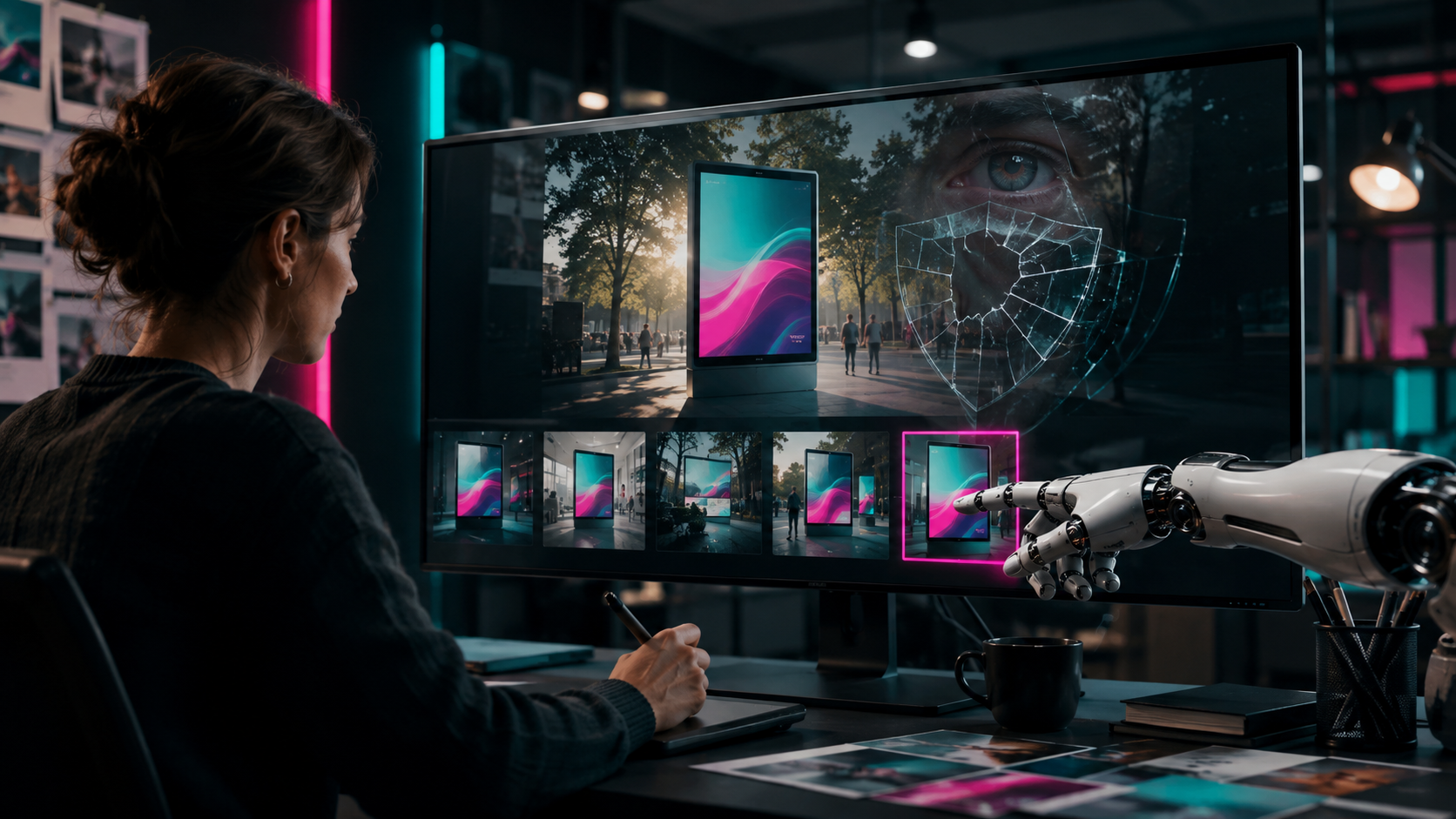
AI tools have been marketed as assistants for human creativity, not replacements. That framing held until real performance data started coming in. Research published in Marketing Science shows that AI-generated ads, when optimized through active learning, can beat human-designed visuals on key metrics like click-through rates and campaign consistency. The study, led by Remi Daviet of INSEAD and Yohei Nishimura of the Wisconsin School of Business, tested AI-generated backgrounds for an outdoor activities company's Instagram campaign. The AI portfolio recorded a mean click-through rate of 0.98%, compared to 0.65% for a professional human designer and 0.78% for an AI benchmark optimized only for aesthetics.
The results weren't marginal. Statistical analysis showed the AI system beat the human designer's batch in 99.59% of samples. A follow-up test 18 months later, during a high-stakes booking season, confirmed the durability of those gains. The AI portfolio hit a 3.38% click-through rate versus 3.24% for the company's contemporary human-designed work.
"Our findings challenge the common assumption that generative AI is useful mainly for rapid ideation or aesthetic polish," Daviet said. "When performance prediction and brand alignment are jointly optimized through active learning, the resulting visuals can deliver higher average returns and lower creative risk than traditional processes."
The study didn't just measure output quality. It also flagged something agencies and brands have quietly worried about: AI-generated creative showed lower variance in performance. That means less risk, more predictability and fewer duds that waste budget. For performance marketers, that's appealing. For creative teams used to defending intuition and taste, it's unsettling.
Synopsis
A study published in Marketing Science found that an AI system using active learning to generate visuals for an Instagram campaign outperformed both human designers and aesthetics-optimized AI models in click-through rates. The AI-generated ads maintained brand alignment and delivered higher average returns with lower risk, with results confirmed in a follow-up test 18 months later. The research suggests that generative AI, when integrated with performance prediction and brand alignment, can exceed traditional human and AI design methods in digital advertising.
The Trust Problem That Performance Can't Fix
Better metrics don't resolve the skepticism consumers already have about AI-generated advertising. A 2023 survey found that nearly 60% of consumers felt comfortable with brands using AI in ads. By 2024, that figure dropped to 46%. A separate study later that year showed nearly two-thirds of consumers felt uneasy about how AI is being used in advertising, with skepticism highest among Gen X and Baby Boomers.
That discomfort isn't about image quality or engagement rates. It's about authenticity. AI-generated creative can feel cold, formulaic or uncanny, especially when brands skip human oversight. According to research cited by consulting firm BCG, 69% of consumers feel manipulated when brands use AI for advertising without disclosing it. The issue isn't whether the ad works in the moment. It's whether it erodes trust over time.
The backlash mirrors what happened when brands tried to scale influencer marketing without vetting partnerships or when programmatic ads appeared next to offensive content. Performance went up, but perception took a hit. In advertising, reputation compounds. A few misaligned campaigns can cancel out months of careful brand building.
"The real conversation isn't AI vs. humans-it's AI and humans working together," Yang Han, CTO and co-founder of StackAdapt, said in an industry report. "AI excels at data-driven tasks, automation, and predictive analytics, but it lacks human intuition, creativity, and ethical judgment."
Delayed Disclosure Comes With a Trust Penalty
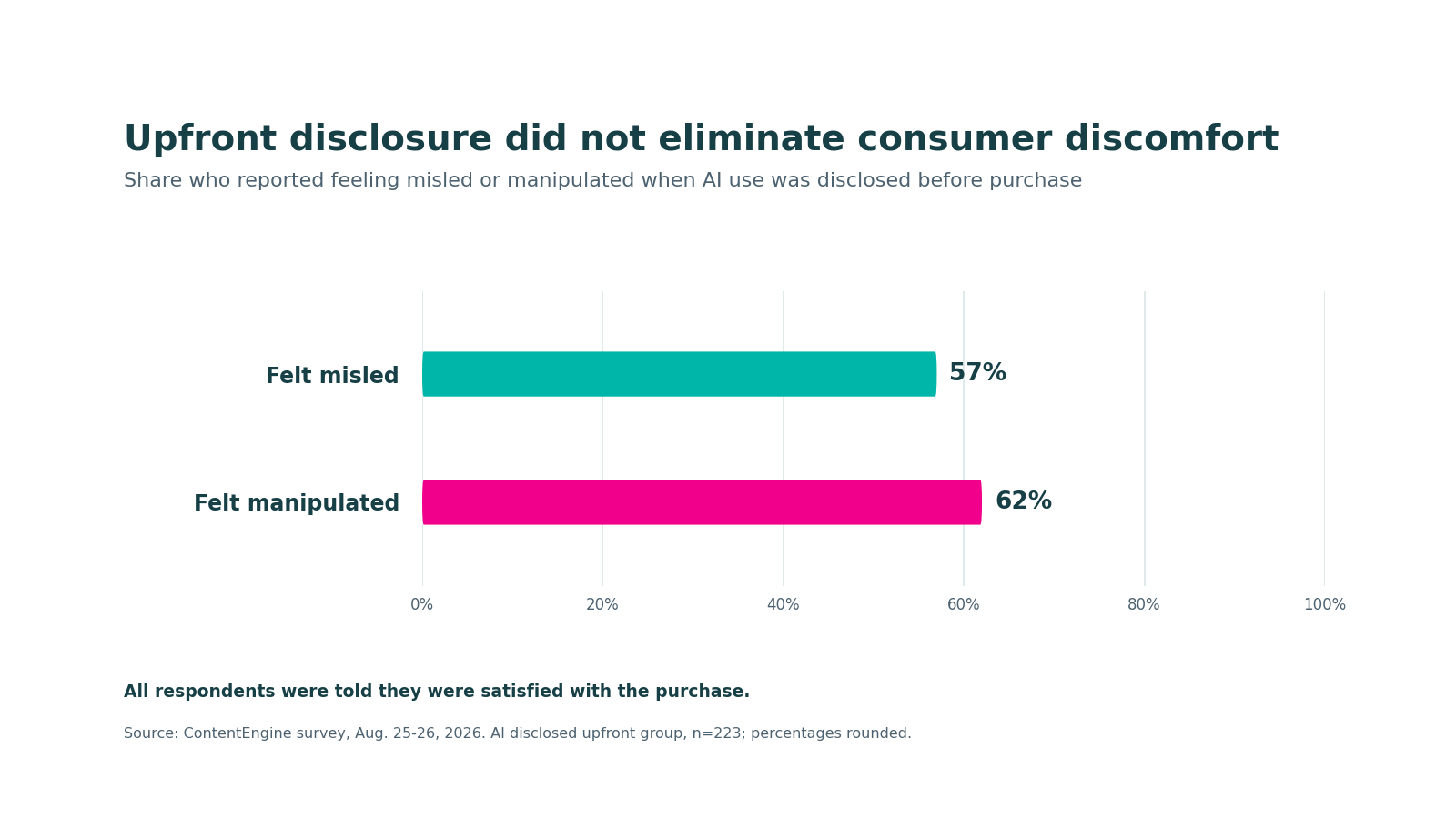
ContentEngine conducted a survey of 446 U.S. adults to examine whether the timing of an AI disclosure changes how consumers respond to an advertisement. One group was told upfront that the ad was created entirely with AI. Another learned after making a satisfactory purchase that the ad was AI-generated and had not disclosed it.
The second group reacted more negatively despite being satisfied with the product. Trust in the advertiser fell from 77% among those informed upfront to 65% among those who learned afterward. Willingness to buy from the advertiser again declined from 80% to 67%, while the share who felt misled increased from 57% to 70%.
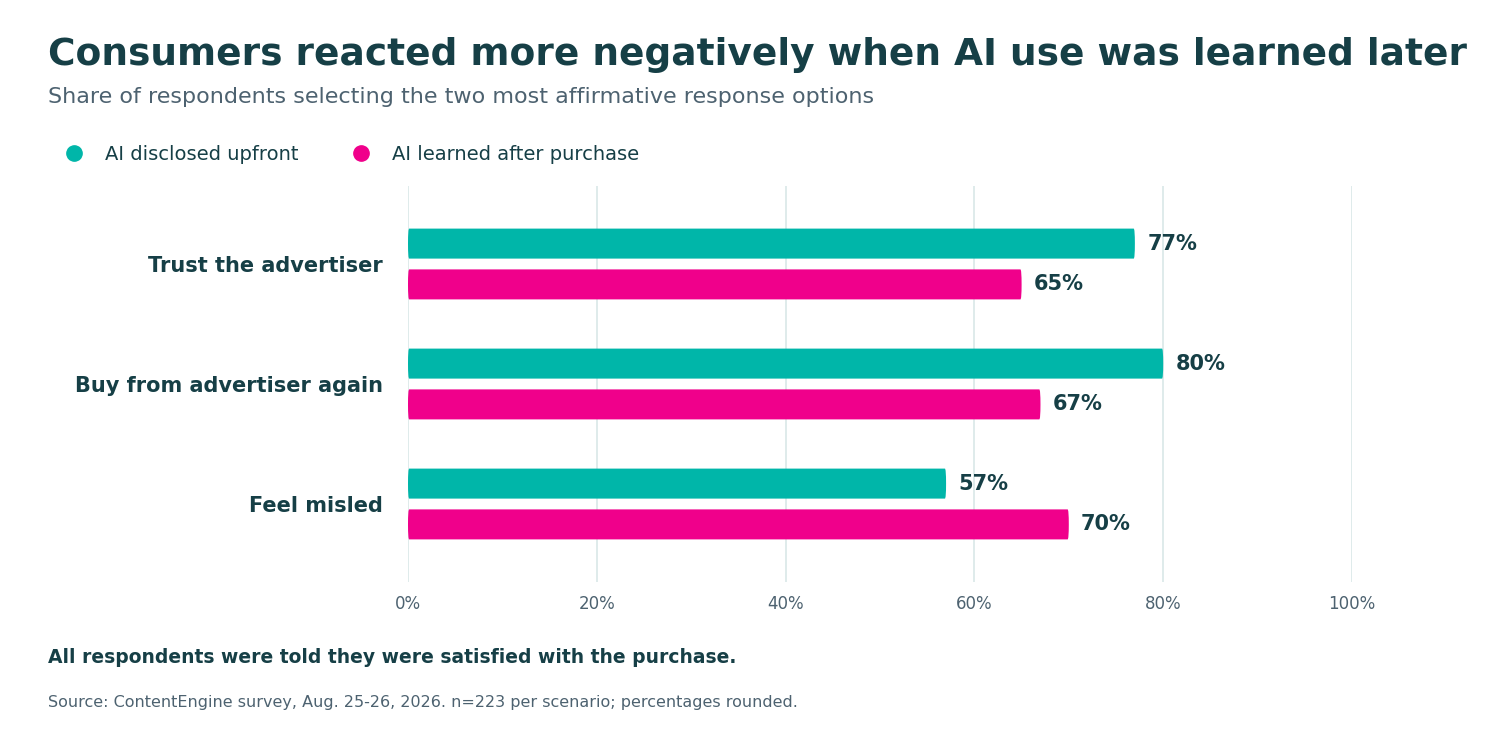
The findings point to a cost that advertising performance alone may not capture. An AI-generated ad can persuade someone to buy a product they ultimately like, yet still damage the advertiser’s relationship with that customer if the use of AI is revealed later.
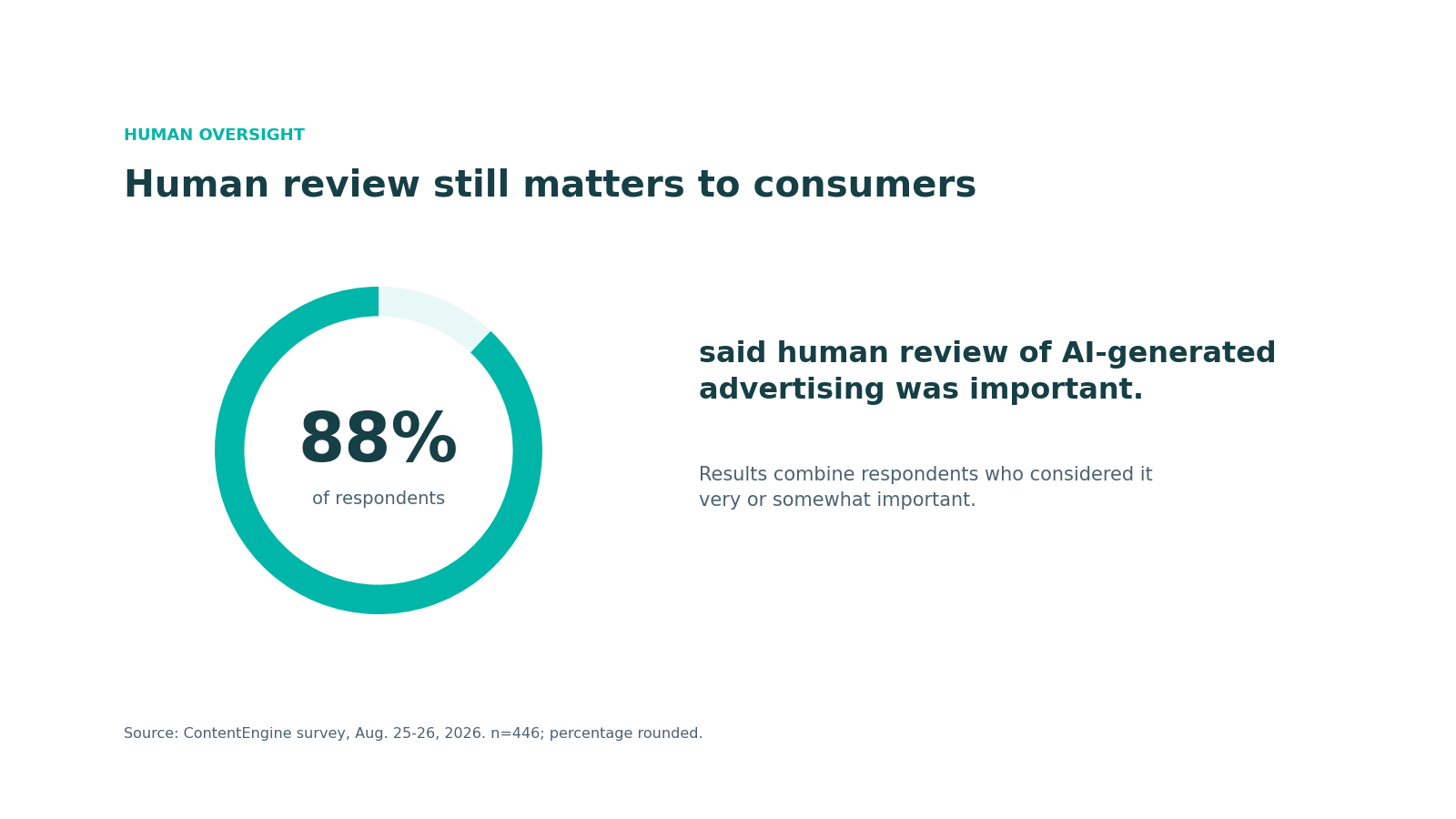
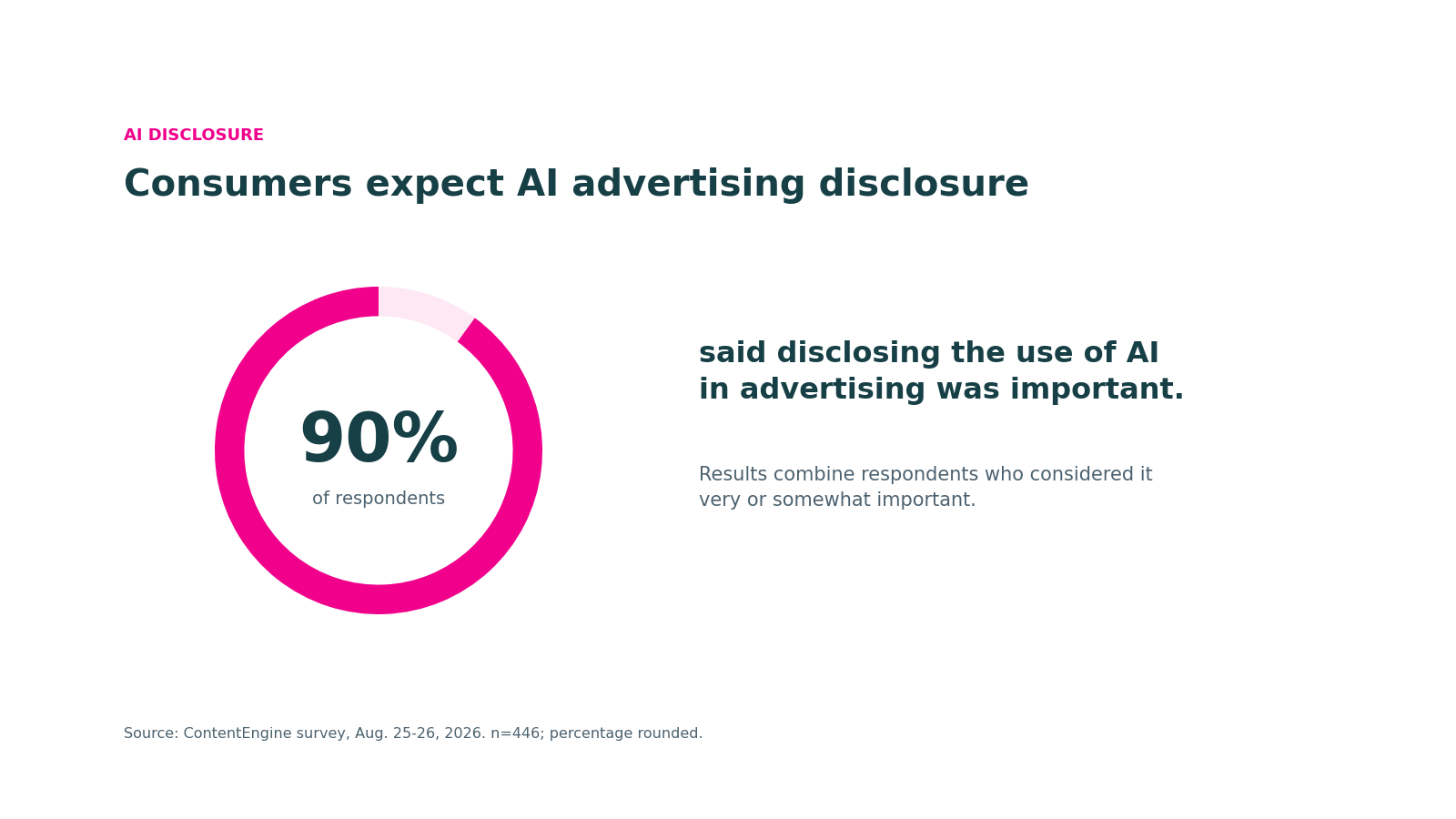
Across both groups, 90% said disclosing AI use in advertising was important, while 88% considered human review important. For advertisers, the practical takeaway is straightforward: disclose material AI involvement before the purchase decision and keep people accountable for the final work.
When AI Outperforms Designers, Who Owns the Creative?
The Marketing Science study highlights a technical achievement: an active-learning engine that balances performance prediction with brand alignment. That's not the same as replacing designers. The system required human input to define brand standards, vet outputs and approve what went live. The AI didn't design ads on its own. It generated options within guardrails, and humans made the final calls.
But the study also shows that once those guardrails are set, AI can outperform human designers in measurable ways. That shifts the role of creative professionals from primary authors to curators and editors. For some, that's a productivity boost. For others, it's a demotion.
Te'Shawn Dwyer, a manager at StackAdapt's in-house Creative Studio, described the dynamic in practical terms. "AI can help in the ideation phase, like storyboarding multiple concepts quickly," Dwyer said. "But when brands skip human curation, the results can feel cold and impersonal."
The tension isn't just philosophical. It's economic. If AI can generate high-performing creative at scale, agencies face pressure to lower rates or shift services toward strategy and oversight. Freelance designers and junior creatives, who often handle production work, may find fewer opportunities. A LinkedIn survey found that 54% of marketing decision-makers worry that overreliance on AI could erode the human creativity that helps ads resonate with audiences.
That fear isn't unfounded. AI-generated content tends toward the statistically average. It optimizes for patterns that have worked before, which can lead to safe, repetitive visuals that blend into feeds. James Targett, creative project manager at StackAdapt, noted that AI-generated copy often outperforms client-supplied and internally written content. But he added that the best results come from using AI "to generate volume quickly, then refining the best outputs with a human touch."
Myth
- AI-generated ads lack the ability to truly align with brand values.
- Human designers always produce superior creative results.
- AI in advertising is widely accepted by consumers without skepticism.
vs.
Reality
- AI dynamically integrates brand alignment with performance criteria, producing on-brand, high-performance creatives.
- AI-generated ads outperformed human designs in 99.59% of comparisons during live campaigns.
- Consumer comfort with AI in ads dropped from 60% in 2023 to 46% in 2024, with skepticism rising particularly among older groups.
What Happens When AI Becomes the Default
The bigger risk isn't that AI replaces designers. It's that brands start treating creative as a pure optimization problem. When performance metrics become the only measure of success, advertising loses the qualities that make it memorable: risk-taking, cultural relevance, emotional resonance. AI can identify what worked yesterday, but it can't predict what will capture attention tomorrow.
That's especially true in categories where decisions require explanation, not just exposure. B2B software, financial services, healthcare and other high-consideration categories have struggled with traditional digital ads because banner placements and keyword-driven formats don't allow for nuance. Conversational AI interfaces, where users can ask follow-up questions and weigh tradeoffs, offer a new way to participate in the consideration process. But those interfaces depend on trust. If consumers believe the recommendations are influenced by paid placements without disclosure, the format loses credibility before it scales.
Industry data suggests brands are moving faster than governance structures can keep up. According to a 2025 study from StackAdapt and Ascend2, 32% of agencies cited data privacy and compliance as their biggest concern about using AI in advertising. Another 27% flagged brand safety, AI bias and ad fraud. Yet a report from the Interactive Advertising Bureau found that while over 70% of marketers have encountered an AI-related issue, such as hallucinations, bias or off-brand content, fewer than 35% plan to increase investment in AI governance or brand integrity oversight in 2026.
That gap between adoption and oversight creates risk. AI systems trained on biased data can perpetuate stereotypes. Generative models can produce visuals that violate brand guidelines or appear in unsafe contexts. Without regular audits and human review, those issues can go unnoticed until they become public.
The Playbook for Brands That Want Both Performance and Trust
The Marketing Science study offers a path forward, though it's not as simple as flipping a switch. The active-learning engine used in the research didn't just generate images. It tested them, learned from performance data and refined its outputs over time. That process required clear objectives, brand standards and ongoing human oversight. It wasn't automation for automation's sake. It was a system designed to solve specific problems: finding high-performing visuals while staying on-brand.
That approach aligns with guidance from organizations like Kantar and the International Association of Privacy Professionals, which emphasize clear governance and human involvement in AI-driven creative. Brands that succeed with AI tend to follow a few core principles. They use AI to support specific campaign objectives, not as a shortcut to replace strategic thinking. They train AI models on brand guidelines, tone of voice and visual identity. They test continuously and use humans to review the results. They make AI feel seamless, not distracting. If generative AI creatives draw attention to themselves rather than the message, that's a sign further refinement is needed.
Transparency also matters. Consumers don't necessarily object to AI-generated content. They object to feeling manipulated. A study on AI-personalized ad copy found that when ads were tailored to individual personality traits, consumers responded positively, even knowing the content was generated by AI. The difference was disclosure. When brands were upfront about using AI, trust remained intact.
Hot Take
AI isn't just a tool for idea generation; it can outperform human creatives in live campaigns—but at the risk of eroding brand authenticity.
This duality demands brand managers to cautiously balance AI's efficiency with preserving consumer trust through human curation.
What the Data Actually Shows
The performance gains from AI-generated creative are real, but they're not universal. Internal data from StackAdapt shows that campaigns using dynamic creative optimization, which adapts creative based on audience and context, deliver a 32% higher click-through rate and a 56% lower cost per click compared to static campaigns. A case study from outdoor media agency Vallo Media found that using AI to dynamically tailor product ads based on shopper behavior drove a 60% lift in click-through rate and generated 30% of total ad-attributed revenue with just 12% of campaign budget.
Those results reflect specific use cases where AI was applied with clear intent and oversight. They don't mean AI is better at all creative tasks or that human designers are obsolete. They mean that when AI is used to solve well-defined problems, such as generating variations at scale or optimizing for specific performance signals, it can deliver measurable improvements.
The challenge is figuring out where AI adds value and where it introduces risk. A McKinsey study found that 24% of marketing and sales teams reported revenue gains of 6% or more from AI over the past year. But adoption remains uneven. A survey from StackAdapt and Ascend2 found that only 39% of agencies have significantly integrated AI into day-to-day workflows, and 18% have barely started.
The limiting factor isn't technology. It's knowing how to use it without undermining the qualities that make advertising work in the first place.
The Real Question Isn't Whether AI Can Win
The Marketing Science study proves AI can outperform human designers on specific metrics under specific conditions. That's important, but it doesn't settle the bigger question: whether brands should optimize for performance at the expense of trust, creativity and cultural relevance. The answer depends on what kind of advertising a brand wants to build and what kind of relationship it wants with its audience.
If the goal is to maximize short-term click-through rates, AI offers a clear path. If the goal is to build a brand that feels human, memorable and differentiated, AI can help, but only if humans stay in control of the creative vision. The risk is that as AI becomes more capable, brands treat it as a substitute for judgment rather than a tool to extend it.
Nishimura, co-author of the study, put it plainly: "For brand managers and advertising agencies, understanding how to navigate the vast space of AI-generated possibilities is essential. Strategies that treat generative AI as a simple production tool risk missing both the performance gains and the consistency that a purpose-built search-and-alignment system can unlock."
The lesson isn't that AI is better than humans. It's that AI changes the nature of creative work, and brands that don't adapt will fall behind. The ones that adapt without losing sight of why advertising matters in the first place will have an edge. The ones that chase performance without considering trust may win in the short term and lose in the long run.
Our Perspective
AI-generated ads can now outperform human designs on key performance metrics, but better results don’t erase the trust issues surrounding AI in creative work. The question for brands is whether stronger performance is enough to justify the potential hit to authenticity, perception and trust.
Key Takeaways
AI-generated ads can outperform human designs
Demonstrated by higher click-through rates even after extended campaign periods.
Integration of brand alignment with performance metrics is key
AI balances brand safety with engagement for consistent outcomes.
Ethical concerns persist
The partnership raises questions over conflicts of interest, editorial independence, and AI's impact on journalistic standards..
Human oversight remains essential
To maintain emotional nuance and authenticity in AI-created advertising.
Consumer trust in AI advertising is declining
Especially among older demographics concerned about authenticity.
Governance and ethical guidelines are needed
To mitigate risks like bias, privacy concerns, and brand safety issues in AI ad use.
Sources
- TechXplore - AI-generated ads outperform human designers in live campaign, advantage holds 18 months later
- ContentEngine - Adults Told About AI-Generated Ads Later Expressed Lower Trust
- Marketing Science - Leveraging Generative Artificial Intelligence to Create Visual Content in Digital Advertising
- iab.com - AI Adoption Is Surging in Advertising, but is the Industry Prepared for Responsible AI?
- stackadapt.com - AI in advertising: How to use it the right way in 2026
- bcg.com - How AI Is Reshaping Modern Advertising
- kantar.com - Rethinking AI-generated advertising: how real people really react
- iapp.org - The ethical use of AI in advertising