
AI Is Creating Two Kinds of Creators. Which One Are You?
AI is dividing the creator economy. Learn how creators are using AI to scale content, stay authentic, and avoid falling behind.

Posted: April 15, 2026

The creator economy is now worth over $200 billion and growing fast. Facebook alone paid creators nearly $3 billion in 2025, a 35% increase that demonstrates how much money is flowing towards those who can navigate this industry. More than 80% of creators are already using AI in their workflows.
That is not just a trend. It is a turning point.
The creator economy is splitting into two groups: those who are using AI to scale, and those who are struggling to keep up without it.
The New Divide in the Creator Economy
AI is no longer just a helpful tool. It is quickly becoming the baseline.
If you are not using it, you are not competing on equal footing. You are operating at a disadvantage.
This is where the divide begins.
"
Creators who win are not the most automated.
They are the most intentional.
On one side are creators who are embracing AI. They are producing more content, experimenting faster, and learning what works in real time. On the other side are creators who are holding onto traditional methods, often in the name of authenticity, but finding it harder to maintain reach, consistency, and growth.
The uncomfortable reality is this: the market is already adapting, whether creators choose to or not.
How AI Is Reshaping Content Creation
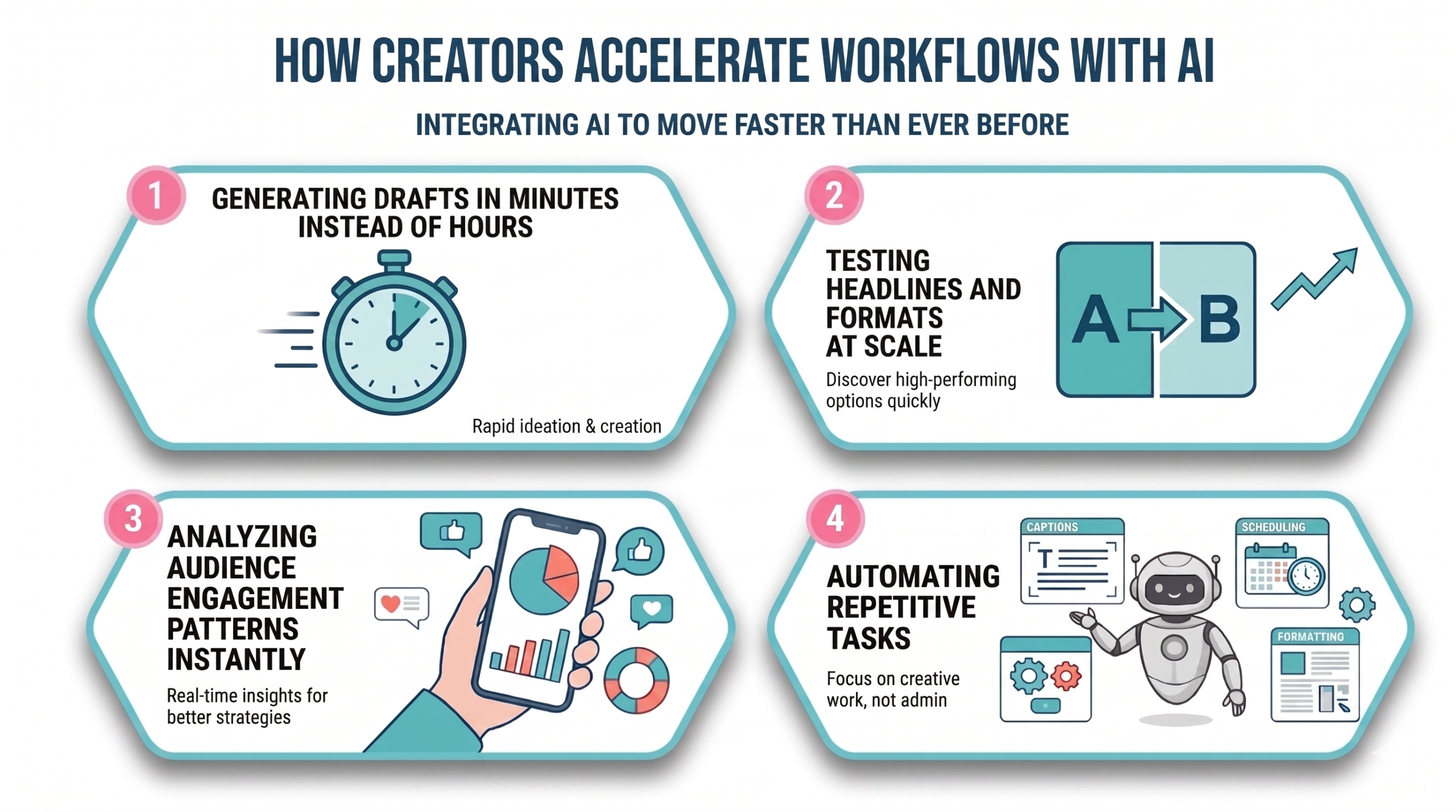
Creators who integrate AI into their workflows are moving faster than ever before.
They are:
- Generating drafts in minutes instead of hours
- Testing headlines and formats at scale
- Analyzing audience engagement patterns instantly
- Automating repetitive tasks like captions, scheduling, and formatting
A single creator can now produce what once required an entire team.
This is not about replacing creativity. It is about removing friction.
The result is simple. Creators who use AI are able to focus more on strategy, storytelling, and audience connection, while producing significantly more content.
The Authenticity Paradox
But there is a real tension here.
The same tools that increase speed and output can also dilute what makes content feel human.
Audiences still value voice, perspective, and authenticity. AI cannot replicate lived experience, opinion, or emotional nuance.
The most successful creators understand this.
They are not blindly automating everything. They are using AI as a support system, not a replacement. They combine speed with intention. They edit, refine, and inject their own perspective into everything they publish.
They are not choosing between efficiency and authenticity. They are building both into their process.
The Risk of Falling Behind
Some creators are choosing to avoid AI entirely.
Their concern is valid. They do not want their work to feel generic or automated. They want to preserve originality.
But avoiding AI does not stop the landscape from changing.
Platforms are becoming less predictable. Organic reach continues to decline. Algorithms increasingly reward consistency, speed, and engagement patterns that are difficult to maintain manually.
At the same time, income streams are shifting. Audience ownership is becoming critical. Creators who rely entirely on platforms without building direct relationships through newsletters, communities, or owned channels are becoming more vulnerable.
This is the real risk.
Creators who reject AI are not just avoiding a tool. They are opting out of the systems that now shape visibility, growth, and monetization.
The Creators Who Will Win
The creators who succeed in this new environment are not the fastest or the most automated.
They are the most adaptive.
They:
- Use AI to increase leverage, not replace their voice
- Treat content as an evolving system, not a one time effort
- Experiment constantly and learn from data
- Build direct relationships with their audience
They understand that AI is not the advantage. How you use it is.
A Better Way to Use AI
Most creators do not need more tools. They need a better way to use them.
The goal is not to automate creativity. It is to remove the busywork that gets in the way of it.
That is where platforms like ContentEngine come in.
ContentEngine helps creators stay on top of real time trends, generate relevant content ideas, and draft posts across web, email, and social, all while keeping their unique perspective at the center.
Instead of starting from a blank page, creators start with momentum.
Instead of chasing trends, they respond to them with context and intent.
The result is content that is both timely and authentic.
The question is no longer whether to use AI. The real question is will you use AI intentionally to amplify your voice, or will you let it shape the landscape without you?