Meta Just Beat Google. Here’s What That Means for Content
The shift from search to feed-based discovery is already reshaping how content is created, distributed, and consumed.

Posted: April 14, 2026

The digital advertising landscape is experiencing its most significant power shift in over a decade. According to Emarketer's latest forecast, Meta will capture $243.46 billion in net worldwide ad revenues in 2026, edging past Google's projected $239.54 billion. This isn't merely a changing of the guard between two tech giants—it's a clear signal that audiences have fundamentally altered how they discover information, engage with brands, and consume content. For community owners, content creators, and marketers, this shift demands immediate attention and strategic recalibration.
The implications extend far beyond Silicon Valley's balance sheets. Meta's ascendance reflects a broader migration of attention from search-based discovery to social-driven content consumption. People are increasingly bypassing traditional search engines and news websites, instead relying on algorithmically-curated feeds, short-form video, and community-driven platforms to stay informed and entertained. This behavioral shift carries major consequences for anyone building an audience, creating content, or trying to reach customers online.
The Content Consumption Revolution Driving Meta's Dominance
Meta's projected 24.1% growth rate in 2026—more than double Google's 11.9%—isn't happening by accident. It's being fueled by fundamental changes in how people spend their digital time. Reels, Meta's short-form video format across Facebook and Instagram, has become the company's growth engine, with watch time in the U.S. climbing more than 30% year-over-year. This represents a seismic shift from text-based search queries to visually-driven, algorithm-recommended content consumption.
The data reveals something crucial: audiences aren't actively seeking out content as much as they're consuming what platforms serve them. Meta's AI recommendation system has become extraordinarily effective at predicting what users want to see next, keeping them engaged for longer periods and creating more inventory for advertisers. This passive discovery model fundamentally differs from Google's active search paradigm, where users must formulate queries and sift through results.
"
Social content isn’t just distribution anymore, it’s the front door to your brand.
For content creators and community builders, this shift is transformative. The old content strategy—optimizing for search engines and hoping people would find you—is giving way to a new imperative: creating compelling, shareable content that algorithms will distribute and audiences will engage with. Meta has demonstrated "incredible patience," as Emarketer analysts note, by building deep user habits around Reels, Threads, and WhatsApp before aggressively monetizing them. Now that monetization is accelerating, and Reels alone is projected to hit a $50 billion revenue run rate.
The implications for content strategy are clear. Audiences are spending more time in feeds and less time in search results. They're discovering information through recommendations rather than queries. They're engaging with short-form, visual content rather than text-heavy articles. And they're trusting algorithmic curation to surface relevant content rather than actively hunting for it themselves.
The Concentration of Attention and What It Means for Content Creators
While Meta's overtaking of Google captures headlines, an equally important trend deserves attention: the concentration of digital advertising among the top three platforms. Emarketer projects that Meta, Google, and Amazon will collectively control 62.3% of global digital advertising in 2026, up from 59.9% in 2025. This growing concentration reveals where audience attention has consolidated—and where content creators must establish their presence to remain relevant.
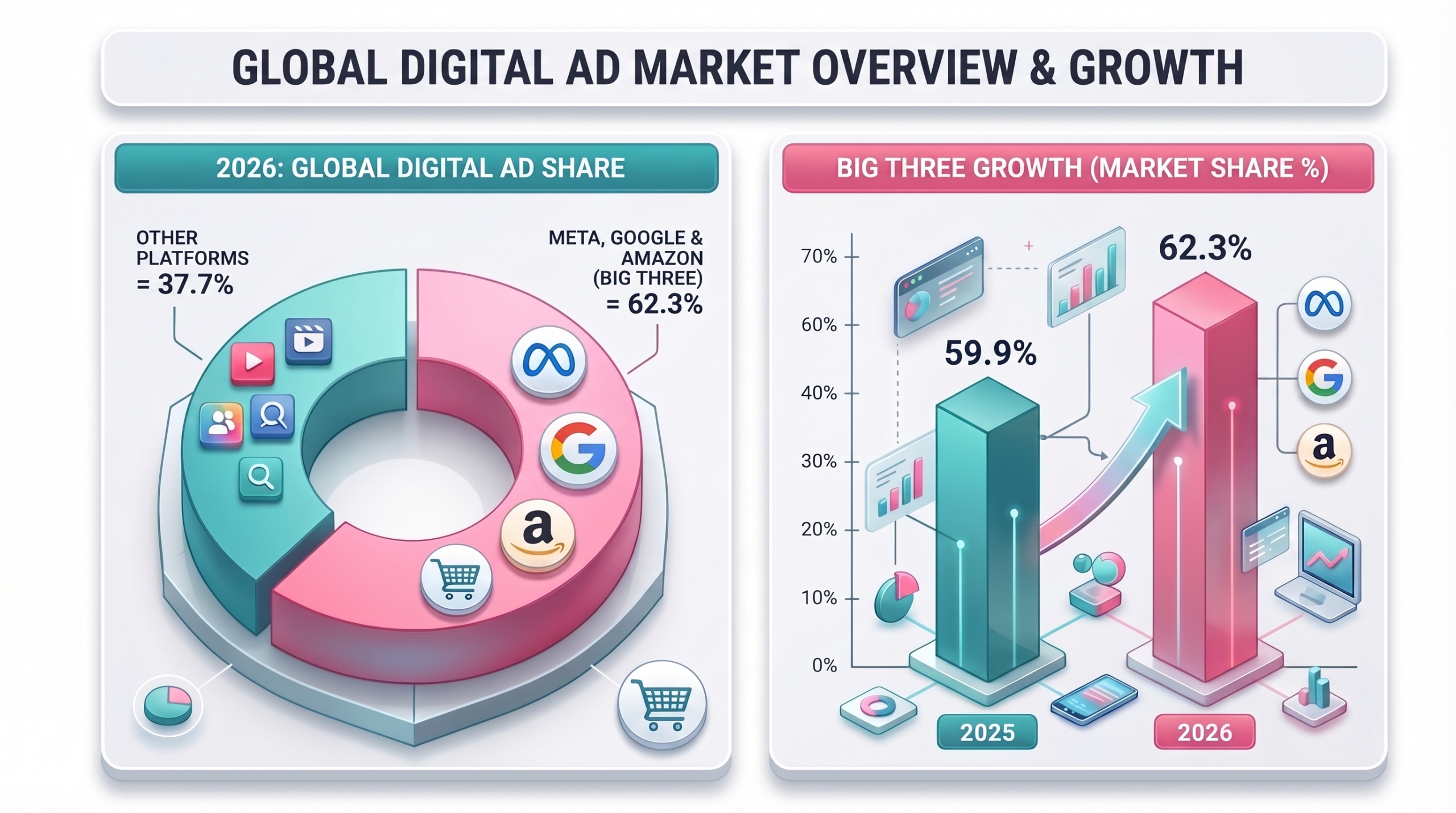
This three-platform dominance creates strategic implications for anyone building an audience. While diversification across multiple platforms remains wise, the reality is that Meta, Google (particularly YouTube), and Amazon collectively represent the vast majority of accessible audience attention. Attempting to build presence on dozens of niche platforms may spread resources too thin, while focusing exclusively on one platform creates dangerous dependency.
The most effective approach balances concentration and diversification. Strong presence on Meta's platforms—particularly Instagram and Facebook, with their combined billions of users—provides access to the largest addressable audience. YouTube offers powerful search visibility and long-form content opportunities. Amazon becomes essential for anyone with physical or digital products to sell. Together, these three platforms provide access to most of the digital audience, while secondary platforms can serve specific strategic purposes.
But the more important shift isn’t just where attention is concentrated. It’s how people discover in the first place.
What’s changing is how users enter your ecosystem. The old model of driving traffic exclusively to owned websites and capturing email early is breaking down.
Email is still one of the most valuable ways to build direct relationships, but it’s no longer where the journey starts. Today, discovery happens on platforms.
To earn attention, you need to create content where your audience already is, in the formats they engage with. Social content isn’t just distribution anymore, it’s the front door to your brand.
What This Means For Content Teams
For Content Teams, this isn’t a shift in tactics. It’s a shift in operating model.
- Create for feeds. Search is no longer the primary channel.
- Timing matters more than depth.
- If it doesn’t stop the scroll, it doesn’t exist.
The challenge lies in the execution. Staying relevant now means tracking what's happening, understanding what resonates, and turning that into content fast enough for it to matter.
That’s impossible to do without support.
ContentEngine is built exactly for this, it’s what reactive marketing is all about. It monitors live events, turns them into content aligned with your audience’s perspective, and moves you from idea to distribution without delay.