AI in Content Marketing Is the Foundation of Todays Modern Content Strategy

Artificial intelligence has rapidly shifted from a novelty to a foundational part of modern content marketing.

✒️ Paul Rigden

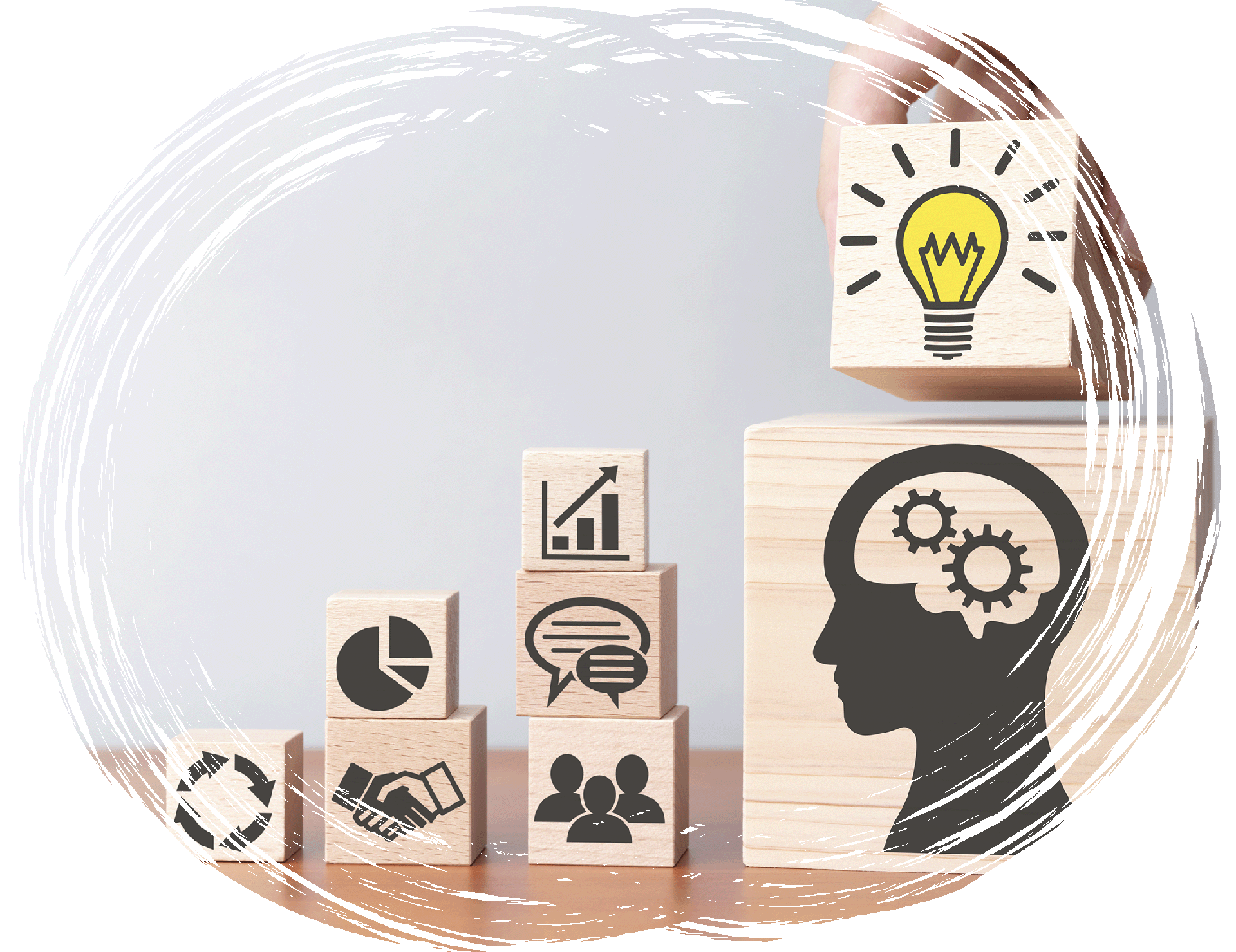
Conceptual image representing AI as the foundation of modern content marketing strategy, combining data, ideas, and human insight

Marketers now rely on AI not only for writing support, but for research, trend discovery, workflow efficiency and audience insights. The rapid pace of online conversation has made it harder for teams to keep up, and AI now plays a central role in helping brands stay relevant without sacrificing quality.

This article explores how AI fits into the content workflow, how it enables reactive marketing, and what guardrails teams need in place to use it effectively. The focus is practical and tool agnostic. The goal is to give you a clear picture of how AI can support strategy, not replace it.

The State of AI in Content Marketing

AI adoption in marketing continues to grow because it aligns with the realities of content production. Teams are under pressure to publish more frequently, respond to real-time events and maintain a consistent brand voice. At the same time, resources are often limited.

▪️Industry research shows several consistent trends:

▪️AI adoption in marketing continues to grow because it aligns with the realities of content production.

▪️Teams are under pressure to publish more frequently, respond to real-time events and maintain a consistent brand voice. At the same time, resources are often limited.

▪️Industry research shows several consistent trends:

Marketers are not looking for magic solutions. They are looking for a way to reduce the manual work that slows down planning, writing and analyzing content. The more channels a team manages, the more important AI becomes as a support system.

Where AI Fits in the Content Workflow

AI is not a replacement for strategic thinking. It is a multiplier that speeds up the steps teams were already taking. The following areas are where AI consistently provides real value.

Where reactive marketing offers immediacy, proactive marketing offers stability. It helps shape the perception of the brand over time, and it provides the consistent message that audiences rely on.

Both forms of marketing support one another. A strong proactive strategy provides the context that allows reactive moments to feel intentional and on brand.

Ideation and Research

One of the most time-consuming parts of content marketing is staying aware of what audiences care about. AI helps by:

▪️Identifying topics that are gaining traction across search, news and social

▪️Summarizing long articles or conversations into digestible insights

▪️Turning audience questions and patterns into potential content ideas

AI is not a replacement for strategic thinking. It is a multiplier that speeds up the steps teams were already taking. The following areas are where AI consistently provides real value.

"

AI is most valuable when embedded into structured workflows rather than used occasionally or without direction

Marketers still decide which ideas are worth pursuing, but AI reduces the research workload significantly. Many teams struggle with scattered sources. AI helps unify these signals.

Outlining and Planning

AI can support the planning stage by generating outlines, content calendars and creative briefs based on the topics selected. This gives teams a structural starting point that can be refined with human insight. It increases consistency without removing control.

Drafting and Optimization

Drafting is where AI is most visible, but it is only one part of the workflow. AI can:

▪️Create initial drafts for articles, posts and email content

▪️Adapt a single idea into multiple channel formats

▪️Suggest SEO improvements like internal links, headers and keyword placement

Marketers refine the copy to match tone, context and brand voice. AI handles the mechanical tasks. Humans provide the creativity and perspective that audiences value.

Distribution and Personalization

AI can help adapt content to different audience segments and channels. This includes:

▪️Generating post variations for different social platforms

▪️Adjusting tone or length based on audience behavior

▪️Recommending timing or distribution methods

These small adjustments often produce meaningful engagement improvements at scale.

Measurement and Iteration

Content performance can be difficult to analyze consistently. AI assists by:

▪️Detecting patterns in engagement or conversions

▪️Flagging which topics resonate and which do not

▪️Helping teams refine future content based on data

This closes the loop between creation and learning, which is essential for continuous improvement.

The Shift Toward Reactive Marketing

Content marketing used to revolve around editorial calendars and preplanned campaigns. While these are still important, they no longer capture the full picture. Online conversation moves too quickly. Opportunities appear unpredictably. Audiences expect brands to show awareness of what is happening now.

Reactive marketing addresses this shift.

Why Reactive Marketing Matters

Audiences reward relevance. A timely perspective on a current event or trending topic often performs better than evergreen content because:

▪️It signals awareness of the industry

▪️It generates conversation in real time

▪️It aligns with what audiences are already paying attention to

The challenge is operational. Without automation, staying reactive requires constant monitoring and rapid production, which is unrealistic for most teams.

How AI Enables Reactive Content

AI supports reactive marketing by:

▪️Monitoring news, search patterns and social activity

▪️Identifying potential content triggers

▪️Summarizing complex information into clear insights

▪️Producing early drafts across multiple channels

AI turns reactive content from a chaotic scramble into a structured process. It handles speed. Humans handle judgment, tone and context.

The Human Role in Reactive Marketing

Even with strong automation, marketers guide the strategy. They decide:

▪️Which topics are appropriate for the brand

▪️When to react and when to stay silent

▪️How to frame an event from their audience’s viewpoint

AI provides materials. Marketers shape the message.

Risks of AI Content and How to Mitigate Them

AI expands content capabilities, but it also introduces new challenges. Strong guardrails ensure content stays accurate, safe and aligned with brand values.

Accuracy and Hallucinations

AI can misinterpret facts or produce information that is not grounded in reliable sources. This risk increases when content touches on technical, legal or sensitive topics. Teams need a clear review process that includes fact-checking.

Brand Voice and Consistency

AI can drift in tone if prompts are inconsistent or if the model lacks clear direction. A documented style guide and template library helps maintain consistency across channels.

Compliance and IP Concerns

Marketers in regulated industries should be cautious with AI-generated claims or interpretations. Clear approval checkpoints reduce the risk of publishing something inaccurate or non-compliant.

Practical Guardrails

Implement these procedures, and avoid any mishaps with your AI assisted content.

▪️Human review for all published content

▪️Guidelines for tone, vocabulary and claims

▪️Source verification for factual content

▪️Templates that define structure and intent

▪️Audit tracking for AI-assisted content

These safeguards allow teams to scale output without increasing risk.

Building an AI Assisted Content Marketing System

Teams that succeed with AI take a structured approach instead of adopting random tools.

Step by step visual of an AI assisted content marketing system from workflow audit to short iteration cycles

Step 1: Audit Your Workflow

Map the stages of your content process. Identify bottlenecks such as research time, drafting delays, or multi-channel adaptation.

Step 2: Choose High Value Use Cases

Start small and focused. Good early examples include:

▪️Turning real-time events into content

▪️Summarizing long-form material for newsletters

▪️Producing variations of social posts

▪️Generating SEO optimized outlines

▪️Automating performance summaries

These use cases deliver visible improvements quickly.

Step 3: Establish Human Review Points

AI accelerates production, but humans ensure accuracy and brand alignment. Document where approvals happen and who is responsible.

Step 4: Build Short Iteration Cycles

Monitor results and refine the workflow. Track both time saved and content outcomes. Small adjustments improve output quality over time.

A Sample AI Assisted Reactive Workflow

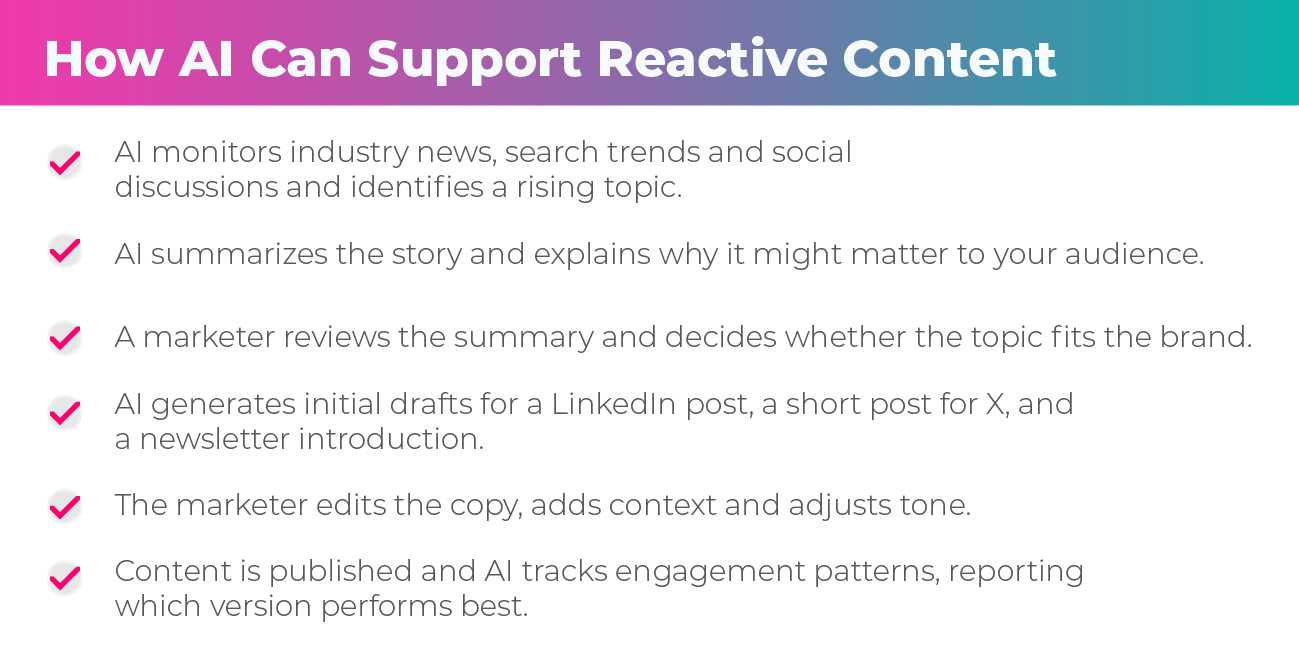
Below is a fictional but realistic example of how AI can support reactive content in a structured way.

Diagram explaining how AI supports reactive content by monitoring trends, generating drafts, and tracking performance

This workflow shows how AI supports speed while humans maintain strategy, voice and relevance.

Modern content marketing now requires both planning and responsiveness. AI supports this balance by reducing manual workload, helping teams stay aware of what matters and producing early drafts that keep the publishing cycle moving. When used with strong guardrails and clear strategy, AI becomes an amplifier for creativity and a foundation for more agile, reactive content.

If your team wants to work faster, stay current and create content that reflects what your audience cares about, AI assisted workflows offer a practical path forward.